

Islamabad Security Risk Clouds Pakistan Advisory Shift
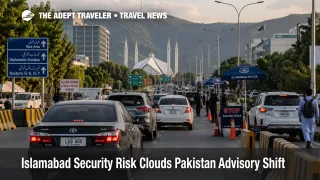
Pakistan's latest advisory changes do not add up to a broad easing for travelers. The U.S. State Department says the immediate vicinity of the Pakistan, India border was lowered from Level 4 to Level 3, but it also added an unrest indicator, added a crime indicator at Level 2, and added kidnapping language for certain Level 4 areas. At the same time, the U.K. Foreign, Commonwealth & Development Office, or FCDO, updated its Pakistan advice on April 17, 2026, to add new security language for Islamabad, warning of increased security presence and new checkpoints that may affect movement around the city and travel times. For travelers, the practical takeaway is simple, one slice of the map improved on paper, but capital movement, long overland legs, and high risk provinces still require a defensive planning posture.
Islamabad Security Travel Risk: What Changed
The most visible U.S. change was geographic, not national. Travel.State.gov says there was no overall change to Pakistan's advisory level, but the immediate vicinity of the Pakistan, India border was lowered from Level 4, Do Not Travel, to Level 3, Reconsider Travel. The same update also removed one armed conflict indicator, added an unrest indicator tied to potential armed conflict, added a crime indicator at Level 2, and added kidnapping language for certain Level 4 areas. That is a mixed signal, not a clean downgrade in risk.
The U.K. update points in the same direction. FCDO says its Pakistan advice was updated on April 17, 2026, with new information about the security situation in Islamabad. Its current page says there is increased security presence and new checkpoints in and around Islamabad, that these may affect movement and travel times, and that there remains an ongoing risk of terrorism. FCDO also tells travelers to be careful around religious sites and gatherings, security checkpoints, and tourist sites.
That Islamabad language matters because the capital is where many business, diplomatic, media, and official travelers are most likely to assume a more managed operating environment. The fresh wording says the safer assumption is the opposite, screening is tighter, route variability is higher, and ordinary city timing may no longer hold. Reuters separately reported that a February 6, 2026 suicide bombing at a Shi'ite mosque in Islamabad killed at least 31 people, while FCDO's safety page lists that attack among recent examples and says at least 36 were killed and more than 150 injured. The difference in casualty figures reflects source timing and update windows, but both sources support the same operational conclusion, Islamabad is not a normal low friction capital stop right now.
Which Pakistan Trips Carry The Most Exposure
The travelers most likely to feel this shift are not only tourists near the India border. The higher exposure group includes business travelers with same day airport to hotel to meeting chains in Islamabad, travelers moving by road through or near higher risk provinces, overland itineraries that depend on precise timing, and anyone whose trip stacks multiple transport modes without much slack. FCDO continues to advise against all travel to Balochistan, within 10 miles of the Pakistan, Afghanistan border, and within 10 miles of the Line of Control, while advising against all but essential travel to parts of Khyber Pakhtunkhwa, parts of Sindh, Dera Ghazi Khan, and within 5 miles of much of the Pakistan, India border.
Islamabad is a different kind of risk than those frontier or insurgency zones. It is still more usable than Pakistan's hardest red zones, but the issue is movement confidence, not just map color. New checkpoints, heavier security presence, and an ongoing terrorism warning can turn a routine city transfer into a longer and less predictable journey, especially around religious sites, public events, tourist sites, and security installations. FCDO also warns that protests can start with little warning, can turn violent quickly, and may bring road closures, blocked urban routes, and even internet disruption.
Travelers should also avoid reading the border downgrade as a green light for broader overland flexibility. FCDO says regional tensions remain tense and can change without warning, have already caused travel disruption, and may also affect fuel availability and pricing, leading to transport disruption and delays in some areas. In an earlier Adept Traveler article, Pakistan Advisory Raises Fuel and Transport Risk, the planning problem was already shifting from a pure security story to an operations story. That remains the right frame now.
What Travelers Should Do Now
Treat Islamabad as a managed movement city, not a casual one. Build extra time into every important road leg, especially airport transfers, hotel changes, intercity departures, and any trip segment tied to a meeting, event, or fixed onward connection. Do not assume the fastest route will remain open or that checkpoint delays will be minor. If your trip includes a Friday afternoon movement, religious gathering areas, or visible tourist sites, use more buffer than you normally would. FCDO explicitly advises varying routes and timings for regular journeys and limiting movements on Friday afternoons.
For booking and rebooking decisions, the threshold is practical. A one city trip with strong hotel security, prearranged transport, and wide timing margins is still more manageable than a multi city plan with separate tickets, late night arrivals, long road transfers, or fixed commitments on arrival day. Rework the itinerary now if success depends on a tightly timed domestic transfer, an unregulated taxi pickup, or a same day move into a higher risk province. Keep hotels and drivers informed of your arrival window, and favor properties and operators with proven security procedures over convenience alone. The tradeoff is obvious, some flexibility and spontaneity disappear, but the odds of a broken trip fall with them.
The next signals to watch are not diplomatic headlines by themselves. Watch for fresh embassy or government movement notices, airline disruption tied to regional tensions, local reporting of road restrictions or protest concentrations in Islamabad, and any expansion of checkpoint or shelter guidance. In an earlier Adept Traveler article, Pakistan Fuel Shortage Warning Hits Travel Planning, the weak point was already the transport chain around flights rather than the aircraft alone. That is still where Islamabad security travel risk is most likely to show up first.
Why The Mixed Signal Still Favors Caution
The reason this story matters operationally is that Pakistan's current advisory picture is layered, not linear. One border area improved from the U.S. perspective, but the national advisory did not change overall, several high risk regions remain under the strongest warnings, and the U.K. added fresh capital specific security language days ago. That means travelers cannot use a single headline to price the whole country. They need to separate frontier exposure, capital movement risk, and long overland fragility into different planning categories.
What happens next will likely depend less on formal advisory level changes than on whether Islamabad's tighter security posture eases, holds, or expands, and whether regional tensions create more transport disruption. For now, the practical stance is cautious selectivity. Pakistan is not equally risky everywhere, but neither is it operating on a normal capital versus frontier split. Islamabad security travel risk remains high enough that route choice, hotel choice, transfer design, and timing discipline still matter more than the border downgrade headline suggests.
Sources
- Pakistan Travel Advisory | Travel.State.gov
- Pakistan travel advice, GOV.UK
- Safety and security - Pakistan travel advice - GOV.UK
- At least 31 killed in Islamabad Shi'ite mosque bombing, Islamic State claims responsibility, Reuters
- Pakistan Advisory Raises Fuel and Transport Risk
- Pakistan Fuel Shortage Warning Hits Travel Planning