

Pakistan Fuel Shortage Warning Hits Travel Planning
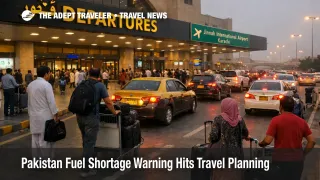
Pakistan fuel shortage travel risk moved onto the watchlist on March 14, 2026, when the U.K. Foreign, Commonwealth & Development Office updated its Pakistan advice to warn that regional escalation could affect fuel availability and cause transport disruption and delays in some areas. That matters because this is not a narrow border or security note, it is a logistics warning that can spread into airport runs, domestic transfers, and multi city itineraries even before airports themselves show major breakdowns. Travelers with flights, long road legs, or same day connections in the next 24 to 72 hours should build more slack into the plan and stop assuming normal transfer times.
The immediate point is that Pakistan is not yet under a confirmed nationwide transport breakdown. What changed is the official threshold: fuel risk is now part of the travel advice, alongside protest risk, curfews, airspace disruption, and movement restrictions tied to wider regional tensions.
Pakistan Fuel Shortage Travel: What Changed
The new signal is specific. FCDO says regional escalation has created security and economic risks, that flights are already being disrupted by Middle East airspace closures, and that global supply routes could affect Pakistan's fuel availability and pricing, leading to transport disruption and delays in some areas. It also says protests may persist in major cities, with road access restrictions and curfews possible at short notice, and notes that U.K. staff in Pakistan have been told to restrict their movements.
That makes this a travel operations story, not just an energy markets story. Pakistan's government has already announced fuel saving measures, including school closures, reduced office attendance, and cuts to official vehicle use, while Reuters reported that officials said petroleum reserves remained at comfortable levels. In plain English, authorities are acting to conserve fuel before a sharper shortage is confirmed, which is exactly the kind of stage where travelers start feeling uneven local friction before they see a formal systemwide shutdown.
Pakistan also joins a pattern Adept has already tracked in Bangladesh Fuel Rationing Slows Ground Travel, Peru Gas Shortage Hits Lima Airport Transfers, and Australia Fuel Reserve Move Flags Regional Travel Risk, but the Pakistan case is different because the trigger is regional escalation and supply chain risk, not a domestic pipeline rupture or local rationing program.
Which Travelers Face the Most Disruption
The highest exposure sits with travelers whose plan depends on long road moves, stacked same day tickets, or thin buffers between hotel, station, and airport. That includes international departures from Karachi, Lahore, and Islamabad, domestic flyers connecting onward by road, overland travelers moving between cities, and tours built around fixed departure times. The main risk is not that every airport suddenly stops working, but that the surface layer feeding those airports becomes less predictable by region and by hour.
Major city travelers are exposed for another reason. FCDO explicitly says protests may continue in some parts of Pakistan, including major cities, and that road restrictions and curfews can appear at short notice. When fuel stress and protest controls overlap, the problem multiplies. A transfer that normally has taxi backup can become harder if vehicles are conserving fuel, avoiding protest corridors, or refueling more cautiously.
The current official picture is still mixed rather than fully degraded. Pakistan Airports Authority said on March 13 that flight operations at Islamabad International Airport were normal, which is important because it suggests the warning remains broader than a confirmed nationwide airport breakdown. Travelers should read that as a reason not to panic, not as a reason to keep normal timing assumptions.
What Travelers Should Do Now
For departures in the next few days, add real buffer to every transport leg that matters. For airport runs, that means leaving earlier than usual, confirming your transfer before the day of travel, and avoiding tight same day domestic to international connections where a missed road leg could break the whole trip. If you are traveling between cities, treat the road move as the weak point, not the flight itself.
For rebooking decisions, the threshold is simple. Wait if your trip is centered on one city, your carrier is still operating, and you have a large time cushion around key movements. Rework the plan now if you have a late night airport transfer, a long road segment before departure, separate tickets, or an itinerary that depends on precise timing across multiple cities. In this phase of a fuel warning, flexibility matters more than fare optimization.
Over the next 24 to 72 hours, the signals that would mark a shift from warning to active disruption are straightforward: airlines telling passengers to arrive differently or rebook, airport authorities issuing operational notices, embassies hardening their language from possible delays to active transport disruption, or more visible government conservation measures widening beyond official use. Those are the practical triggers travelers should monitor, along with local media and direct messages from airlines, hotels, and tour operators.
Why This Is Happening
The mechanism is broader than local pump queues. FCDO ties the risk to regional escalation, Middle East airspace disruption, protests, and vulnerable supply routes. Reuters adds that Pakistan depends heavily on imported energy and that the government moved quickly to conserve fuel as oil prices surged. That combination matters because fuel stress in travel often shows up first as weaker operating cushion, not as a dramatic stop. Vehicles are dispatched more carefully, drivers hesitate on marginal jobs, transfer reliability drops, and airports feel the pressure through ground access and support chains before runways do.
That is also why uneven disruption is the likely shape if this worsens. Pakistan is large, regional, and already operating under a patchwork of security, protest, and travel restrictions. If supply tightens further, travelers should expect friction to appear unevenly by city and corridor, with multi city itineraries hit before point to point trips. The first order effect is slower, less reliable transport. The second order effect is missed check in windows, harder hotel resupply, weaker tour timing, and more fragile recovery options if one leg slips.
Sources
- Pakistan travel advice
- Pakistan to close schools, take other measures to cut energy as oil spikes
- Pakistan navy launches shipping security operation amid Middle East tensions
- News & Updates | Media | Pakistan Airport Authority
- Bangladesh Fuel Rationing Slows Ground Travel
- Peru Gas Shortage Hits Lima Airport Transfers
- Australia Fuel Reserve Move Flags Regional Travel Risk