

Hormuz Window Rescues TUI, MSC, and Celestyal Sailings
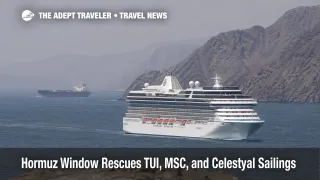
Hormuz cruise departures improved sharply over the weekend after five stranded cruise ships, including TUI Cruises' Mein Schiff 4 and Mein Schiff 5, cleared the Strait of Hormuz during a brief opening and began repositioning for their European and South African schedules. That cuts immediate cancellation risk for some mid May sailings that had looked shaky only days ago. But travelers should not mistake this for a full reopening. Reuters reported commercial traffic through the strait is still near a standstill, and military planners are still discussing how to restore safer navigation more broadly.
Hormuz Cruise Departures: What Changed
The clearest shift is that this moved from a trapped ships story to a selective schedule recovery story. TUI Cruises said on April 19 that Mein Schiff 4 and Mein Schiff 5 had successfully left the Orient region, were heading toward Cape Town, South Africa, and could return to regular schedules. That allowed TUI to reinstate the previously canceled May 17, 2026 departure of Mein Schiff 4 from Trieste, Italy, and the May 15, 2026 departure of Mein Schiff 5 from Heraklion, Greece.
Celestyal confirmed on April 20 that both Celestyal Discovery and Celestyal Journey had also safely transited the strait and were repositioning to the Mediterranean for their summer season as planned. MSC Cruises separately confirmed that MSC Euribia had departed Dubai and safely transited the strait, putting its Northern Europe deployment back on track sooner than previously expected. In an earlier Adept Traveler article, Gulf Cruise Ships Stranded Across Four Lines, the problem was that Gulf disruptions were bleeding into later European sailings. This weekend's transits eased that specific handoff risk for several ships.
That is the traveler value here. First order, some cruises that had looked like likely casualties now appear able to operate. Second order, the recovery preserves connected air, hotel, and transfer plans around Mediterranean embarkation ports that could have unraveled if those ships had remained trapped. The shift matters most for travelers booked on affected May departures, not for everyone shopping the Gulf region more broadly.
Which Cruise Travelers Benefit Most
The biggest beneficiaries are travelers already booked on the revived TUI departures from Trieste and Heraklion, plus passengers on Celestyal and MSC sailings that depended on those ships reaching their next seasonal theater on time. For them, the story changed from ship positioning uncertainty to a more normal pre departure watch, where the main task is confirming the line's latest sailing notices rather than assuming another cancellation is coming.
Travelers with pre and post cruise components also benefit. When a ship misses a repositioning window, the disruption does not stop at the pier. It can spill into nonrefundable flights, hotel stays, transfer bookings, and onward land trips. Reinstated departures reduce that chain reaction, especially for guests starting in Southern Europe where cruise air packages and independent flight bookings often tighten quickly in May. Reuters' broader shipping coverage also helps explain why this relief is meaningful: commercial traffic through Hormuz remains sparse, so operators cannot assume another easy recovery window if conditions worsen again.
The travelers who should stay cautious are those still considering Gulf based cruises or trying to read this as a sign that the region is back to normal. That would be the wrong conclusion. Reuters reported that traffic through the strait was again near a virtual standstill after the temporary opening, and military planners are now discussing a longer term maritime security effort because the navigation problem is not resolved. In an earlier Adept Traveler article, Strait of Hormuz Reopening Leaves Fuel Risk in Place, we noted that a declared reopening was not the same as operational stability. That distinction still holds.
What Travelers Should Do Now
If you are booked on one of the revived TUI May sailings, or on near term Celestyal or MSC departures linked to these repositionings, treat this as good news, but not as a reason to stop checking. Confirm that your booking has been reactivated, recheck embarkation documents, and make sure any independently booked flights and hotels still line up with the live embarkation city and date. A ship clearing Hormuz solves the biggest problem, but late operational tweaks can still affect boarding windows and pre cruise timing.
For travelers deciding whether to book, the threshold is simple. Book with more confidence when the line has formally confirmed the ship's repositioning and the specific sailing is back on sale or restored in customer communications. Wait, or only book flexible arrangements, when the itinerary still depends on a vessel or route segment exposed to the Gulf, because the wider maritime system remains fragile and another brief opening is not guaranteed.
Over the next 24 to 72 hours, watch three signals. First, whether cruise lines keep restoring specific departures rather than issuing broad reassurance. Second, whether Reuters and other shipping monitors show traffic through Hormuz meaningfully normalizing rather than staying near standstill levels. Third, whether military planning translates into a credible protected navigation framework. If those signals stall, the region remains a contingency planning problem even if several cruise ships have already escaped it.
Why the Window Helped, and What Happens Next
This worked because cruise operators did not need a permanent reopening to solve their immediate problem. They needed a narrow safe passage window long enough to move empty ships with skeleton crews out of the Gulf and back onto long repositioning routes. TUI said the two Mein Schiff vessels left the region without passengers, which reduced the operational and duty of care burden during transit. Celestyal described its own passage as a coordinated operational milestone, and MSC said its transit was completed in close coordination with relevant authorities.
The bigger system, however, still looks unstable. Reuters has reported that commercial traffic remains at a near standstill through the strait, while broader diplomatic and military efforts continue. That means the success of these cruise transits does not necessarily translate into normal merchant shipping, normal fuel flows, or normal regional travel conditions. Cruise lines got lucky with timing and preparation. Travelers should read this as a contained operational recovery for certain ships, not as proof that Gulf travel risk has broadly faded.
For cruise travelers, the next phase is less about whether these ships made it out, and more about whether operators can hold their restored schedules without further knock on changes. Hormuz cruise departures are now in better shape than they were a week ago. The region around them is not.