

Portugal Offers a Rare Summer Fuel Reassurance
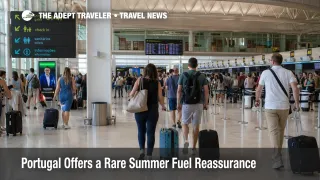
Portugal airport fuel outlook firmed on April 20, when Lisbon said it does not expect jet fuel shortages at the country's airports in the coming months, even as wider European officials and carriers keep preparing for a tougher summer supply picture. For travelers using Humberto Delgado Airport (LIS), Francisco Sá Carneiro Airport (OPO), Faro Airport (FAO), Cristiano Ronaldo Madeira International Airport (FNC), and Azores gateways including João Paulo II Airport (PDL), that does not remove all summer risk. It does, however, mark Portugal as one of the few leisure markets now offering a government backed fuel reassurance while Brussels is openly discussing stockpiles, monitoring, and even redistribution tools if the crisis worsens.
Portugal Airport Fuel Outlook: What Changed
What changed is not Europe's wider direction, it is Portugal's narrower position inside it. Reuters reported on April 20 that Infrastructure Minister Miguel Pinto Luz said the government knows stock levels at national airports and believes supply will remain guaranteed in the coming months. Two days later, the European Commission was still saying there are no current EU shortages, but it was also discussing possible jet fuel reserve requirements and redistribution tools if security of supply becomes the problem rather than only price. That puts Portugal on the reassurance side of a European story that is otherwise still moving deeper into contingency planning.
For travelers, the immediate value is practical. Portugal now looks less exposed to sudden fuel driven trimming than many other Europe headlines imply. That matters most on summer itineraries where the trip depends on schedule recovery strength, same day alternatives, or a tour, villa, or ferry handoff that gets harder to rebuild if a short haul flight disappears late. It is a meaningful stability signal, even if it is still only as strong as the underlying supply chain that supports it.
Who Benefits Most If Travelers Shift Toward Portugal
The travelers who benefit most are not only people already booked to Portugal. This also matters for travelers still comparing Portugal with Spain, Greece, Turkey, Cyprus, or Egypt for late spring and summer beach trips. TUI said on April 22 that demand has already shifted away from Turkey, Cyprus, and Egypt toward western Mediterranean destinations, while customer booking windows are shortening. That means a steadier Portugal fuel outlook can become a second order demand story, because resilience attracts substitution.
Portugal is not uniquely insulated, and that distinction matters. Spain also says it is better placed than many peers because it draws supplies largely from the Americas and North Africa, has increased refinery output, and is approaching summer with kerosene stocks at maximum levels. So the cleanest comparison is that Portugal now joins Spain as a relatively steadier western option, rather than standing alone as Europe's only protected market. The sharper contrast is with destinations where travelers are already reacting to war related stress, energy costs, or regional caution, because those trips can lose demand even before a fuel shortage becomes an airport level operational problem.
That can tighten the Portugal tradeoff quickly. A market that looks safer for flights can become less forgiving on hotel rates, car rentals, and late booking flexibility if enough travelers pivot at once. Portugal's main benefit is not that it suddenly becomes cheap or empty. It is that it may remain more reliably bookable if the wider Europe fuel story keeps worsening.
What Travelers Should Do Now
Travelers already booked to Portugal should treat this as a reason to hold steady, not as a reason to relax completely. Keep normal buffers for peak summer flying, but Portugal does not currently screen like a market where travelers need to preemptively rebuild itineraries solely because of airport fuel fear. The better move is to protect the rest of the chain, especially hotel cancellation terms, rental car timing, and any onward island, ferry, or tour connection that would still be annoying to repair if schedules change for another reason.
Travelers still choosing between Portugal and other southern Europe options should think in layers. If the goal is to reduce fuel and geopolitical spillover risk, Portugal now compares well, and Spain remains the closest like for like competitor on supply resilience. If the goal is simply to chase the lowest fare and decide later, that may backfire if western demand keeps concentrating and the best Portugal inventory disappears faster than expected. In that case, booking the trip sooner but keeping flexible lodging and car terms is the cleaner hedge.
The next decision point is not whether Portugal is perfectly safe from fuel stress. It is whether Europe's broader fuel picture starts forcing visible schedule protection. Reassess if airlines begin talking about airport specific constraints, if Brussels moves from monitoring into actual sharing measures, or if western Mediterranean pricing starts climbing faster as substitution demand builds. Until then, Portugal airport fuel outlook is one of the more constructive summer signals in Europe, but it works best for travelers who lock in flexibility before others make the same pivot.
Why Portugal Looks Better Supplied, and What Happens Next
Portugal's logic is more concrete than a generic government reassurance line. Reuters reported that Galp, the dominant supplier to Portuguese airports, sources crude mainly from Brazil and turns it into jet fuel at its Sines refinery, while also relying on its own production, stocks, and imports. That matters because Europe's broader vulnerability is a refining and product flow problem, not only a crude price problem. The European Union still depends on the Gulf for roughly 75 percent of its jet fuel imports, and officials say replacement flows, reserve rules, and refinery output remain the core levers if the crisis persists.
That also explains why Portugal should not be read as an all clear for Europe. Record inflows from the United States and Nigeria are helping, but European inventories have still tightened, and the industry is warning that recovery in supply would take weeks if shortages bite. In an earlier Adept Traveler article, EU Jet Fuel Plan Raises Summer Flight Risk, the site mapped how the story had already shifted from expensive fuel to contingency planning. In another, Europe Jet Fuel Warning Raises June Flight Risk, the warning window tightened toward possible late spring and early summer schedule effects. Portugal airport fuel outlook matters because it breaks from that darker pattern, but only for one national system that appears better matched to the product and refining chain it needs.
Sources
- Portugal confident its airports will avoid jet fuel shortages | Reuters
- EU looks to tighten grip on jet fuel as Iran war spotlights shortage risks | Reuters
- Spain says it would join potential EU jet fuel sharing as data shows more supply coming | Reuters
- Europe facing jet fuel crunch sees record inflows from US, Nigeria | Reuters
- Tour operator TUI cuts profit outlook as airlines juggle jet fuel hit | Reuters
- Greece announces aid worth 500 million euros to contain impact of Iran war | Reuters
- Our Airports | ANA Aeroportos de Portugal
- Portugal | VINCI Airports