

Saudi Arabia Advice Now Tilts Toward Leaving While Flights Hold
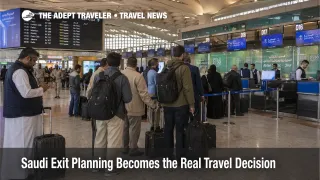
Australia's Saudi warning is no longer just a caution about regional volatility. It is now explicit about departure timing. Smartraveller says travelers in Saudi Arabia who want to leave should make plans to do so, and if they can secure a flight and safely reach the airport, they should go while commercial options remain available. Canada now uses similarly blunt language, and the United States and United Kingdom also describe a country where flights still operate, but the margin for waiting has narrowed. The harder question for travelers is no longer whether Saudi airports are open. It is how much slack is left if another escalation hits.
Saudi Arabia Exit Planning, What Changed
What changed is the wording around departure. Australia says the Middle East security situation remains volatile, urges travelers in Saudi Arabia who want to leave to make plans, and says those who can secure a flight and safely get to the airport should do so while commercial options remain available. Canada says commercial flights remain available, but may become limited on short notice, and says travelers should consider leaving while those options still exist. The U.K. has not gone quite as far in its wording, but it now tells British nationals in Saudi Arabia to be prepared to change plans quickly and to maintain a personal emergency plan for either leaving the country or staying safe during a crisis.
The U.S. position is also heavier than a routine advisory. State Department country information says commercial flights from Saudi Arabia are operational, though significantly disrupted, and notes that on March 8, 2026, the United States ordered non emergency government employees and eligible family members to leave Saudi Arabia due to safety risks. That does not amount to a public evacuation order for ordinary travelers, but it does show Washington is still treating the operating environment as fragile rather than normalized.
This is what makes the story more serious than a generic regional warning. The practical message across the advisory set is that travelers should not confuse open airports with stable onward movement. A system can be technically open and still be weak enough that missed connections, overnight hotel extensions, and airport runs become much harder after one new closure or one wave of cancellations.
Which Travelers and Airports Look Most Exposed
The travelers with the least room to wait are people on short stays, those transiting onward through already stressed Gulf or European hubs, business travelers tied to fixed meetings, pilgrims with tightly timed onward movements, and anyone booked on separate tickets. A traveler with a confirmed nonstop out of Saudi Arabia and flexible lodging has a much better position than someone trying to stitch together a same day chain through multiple carriers. In an earlier Adept Traveler article, EU Jet Fuel Stocks Raise Summer Flight Risk, the wider aviation system was already showing less slack than normal, especially for backup options through major hubs.
On airport status, the current advisory language is broad rather than airport by airport, but it points in the same direction. The U.K. says commercial travel options remain widely available despite limited disruption and temporary airspace closures across Saudi Arabia. Canada says commercial flights remain available, though they may become limited on short notice. The clearest named airport confirmation visible in U.S. mission alerts says commercial flights were operating out of Riyadh, Jeddah, and Dhahran, while Saudi airspace remained open. That means the best supported assumption today is that the main Saudi gateways are functioning, but under conditions where schedules can still change quickly.
For travelers, that distinction matters. Riyadh, Jeddah, and the Dammam area may still move passengers, but "operational" is not the same thing as resilient. The second order problem is what happens after one missed departure. Hotels near the airport fill, ground transfers get pricier, and a rebook that looks easy on paper can fail once multiple disrupted passengers chase the same limited seats. In an earlier Adept Traveler article, Iraq Flights Resume on a Limited Basis, Risk Remains, the same regional pattern was already visible, limited service can exist without restoring real itinerary security.
What Travelers Should Do Now
For Saudi Arabia exit planning, the first decision point is simple. Leave now if you already want out, can reach the airport safely, and can buy or confirm a routing that does not depend on a risky self connection. Waiting only makes sense if you have secure accommodation, strong local support, flexible timing, and a reason to believe the next few days improve your position rather than weaken it.
Repositioning inside Saudi Arabia can make sense, but only when it clearly improves your odds of a clean departure. If your current city offers poor international connectivity and a move to Riyadh, Jeddah, or the Dammam area gives you more same carrier options, that can be rational. But a domestic reposition adds its own failure point, especially if it is on a separate ticket or requires a hotel checkout before you know the onward sector is secure. The threshold for moving is not "more flights on the board." It is whether the new plan reduces the number of things that must go right.
Sheltering in place is the better choice when the airport journey itself looks less safe than staying put, when the only available fares are extreme, or when all workable routings depend on overnight airport waits and multiple border or transit assumptions. In that case, keep extra medication, power, cash, and transport backup in hand, and follow local instructions closely. Australia and Canada both explicitly tell travelers to prioritize safety and to leave only if it is safe to travel to the airport.
Why the Advisories Are Hardening, and What Happens Next
The mechanism is straightforward. Saudi Arabia is not being described as shut down. It is being described as exposed to a regional conflict where airports and airspace can be affected with little warning, and where commercial flight availability can deteriorate faster than travelers expect. Australia explicitly warns that airports in the wider region have been targeted and that even transit through some hubs can carry risk. The U.S. says there is an ongoing threat of drone and missile attacks from Iran, and notes that airports and infrastructure have been targeted across Saudi Arabia. Canada points to the risk of falling military debris, airspace closure, and renewed regional tensions.
What happens next depends less on whether Saudi airports are open this hour, and more on whether the region absorbs another escalation without fresh closures. If the next several days pass without new strikes, more travelers may still be able to leave through normal commercial channels. If the security picture worsens, the first visible crack will likely be schedule instability rather than a blanket closure, fewer workable departures, harder same day connections, and more pressure on the major hubs that are still functioning. OPSGROUP's April 22 operating picture describes Saudi Arabia as open, but under contingency measures with parts of the route network still unavailable. That fits the advisory pattern almost exactly.
The practical conclusion is blunt. Saudi Arabia exit planning is now a live traveler decision, not a theoretical precaution. Travelers who already want to leave should treat the current window as useful, but not guaranteed to stay this workable. Those who stay should do so deliberately, with supplies, a fallback plan, and an honest view of how quickly one more shock can turn an open airport into a much harder way out.
Sources
- Saudi Arabia Travel Advice & Safety, Smartraveller
- Travel advice and advisories for Saudi Arabia, Government of Canada
- Saudi Arabia travel advice, GOV.UK
- Saudi Arabia International Travel Information, U.S. Department of State
- Middle East Travel Advice & Safety, Smartraveller
- Middle East Airspace, Current Operational Picture, OPSGROUP