

TSA Pay Deadline Could Bring Back Long U.S. Airport Lines
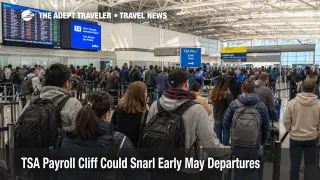
The TSA payroll cliff is back on the calendar, and that makes the first week of May a real planning problem for U.S. air travelers. Homeland Security Secretary Markwayne Mullin said on April 21 that emergency funding used to keep about 50,000 Transportation Security Administration workers paid will run out by early May, after a spring shutdown period already pushed some airport security waits past four hours and drove more than 500 officers to quit since mid February. The headline is not just another Washington funding fight. It is that travelers now have a visible payroll deadline that could hit airport screening again just as normal spring and early summer demand keeps pressure on the system.
TSA Payroll Cliff: What Changed
What changed on April 21 is the funding clock. Mullin said DHS payroll runs a little over $1.6 billion every two weeks and that, after the next paycheck, the emergency pool used to keep TSA workers paid will be gone. Reuters reported that the money would run out by early May, which means the White House no longer has the same short term cushion it used in late March to restart TSA pay after about six weeks without checks.
That matters because the last round of unpaid work already showed how quickly checkpoint stress can become a traveler problem even when flights themselves are still operating. Reuters reported that March security lines at some airports exceeded four hours, the longest in TSA's nearly 25 year history, and that daily absences at one point ran above 10 percent. When the government moved to restore pay, major airports improved, but Reuters also reported that the system had already lost more than 500 officers since mid February. In other words, the airport crisis eased, but the staffing damage did not fully disappear.
In an earlier Adept Traveler article, U.S. DHS Deal Could Lock In TSA Pay Through Sept. 30, the key question was whether Congress would turn temporary pay relief into something more durable. That is still the central issue. The latest Reuters reporting says Senate Republicans are moving ahead on a broader DHS funding blueprint, but as of April 21 the practical traveler signal is simpler, early May now looks like the next pressure point if Congress does not act.
Which Travelers Face the Most Checkpoint Risk
The most exposed travelers are not every traveler equally. The first people likely to feel this are passengers departing in the morning wave from large hubs, especially when the trip depends on a short domestic connection, a same day cruise embarkation, a fixed tour join, or a nonrefundable event later that day. That is because screening delays hit at the front of the itinerary, and once the first leg fails, the rest of the day can unravel even if the flight network itself is operating normally. This is an inference from how the March disruption behaved, not a new airport specific staffing release for May.
The airports that deserve the closest watch are the ones that already showed weak points during the spring shutdown. Reuters reported severe or longer than normal screening delays in Houston, New Orleans, Charlotte, Atlanta, Baltimore, New York John F. Kennedy, and Dallas during the March crunch, and said more than a third of workers were absent at JFK on one late March day while roughly 45 percent did not show at Houston's two airports. That does not guarantee those same airports will again be the worst by early May, but it does make them the clearest places to monitor first because they already proved they can tip from normal operations into multi hour queues when staffing slips.
Smaller airports carry a different kind of risk. They may not make headlines for four hour lines, but they generally have less staffing slack and fewer recovery options if screening capacity drops. Large hubs can create miserable waits. Smaller airports can leave travelers with fewer same day alternatives if one missed screening window breaks the trip. For travelers, the tradeoff is simple, a big hub may offer more rebooking paths after a disruption, while a smaller departure point may offer less resilience if staffing tightens. In an earlier Adept Traveler article, TSA Back Pay Leaves U.S. Airport Recovery Fragile, Adept noted that improved lines were not the same thing as a fully repaired operation.
What Travelers Should Do Before Early May
Travelers with flights in the last days of April or the first week of May should treat airport timing as the main variable, not the flight schedule alone. For domestic trips, especially from a major hub, building at least an extra 30 to 60 minutes of airport buffer over your normal habit is the sensible move right now. For international departures, or any itinerary with a fixed same day connection to a cruise, rail segment, or event, the safer approach is to widen that buffer further and avoid the mindset that a "normal" line will hold just because the airport looked fine last week.
The next decision point is congressional action, not airport rumor. If lawmakers fund DHS before the first week of May, the immediate payroll trigger eases. If they do not, travelers should assume the risk of longer screening lines rises quickly, especially at airports that already showed high absences in March. That is the threshold for changing behavior. A flexible traveler with no onward commitments can wait and monitor. A traveler with a wedding, cruise embarkation, important meeting, or short connection should lean toward earlier departures, longer layovers, or even a hotel the night before if the trip starts from an airport with a recent history of severe screening stress.
What to monitor over the next several days is also fairly clear. Watch for any House or Senate breakthrough on DHS funding, and watch airport level advisories urging passengers to arrive unusually early, because those public warnings were one of the first visible signs that March screening pressure had become operationally serious. If airports or airlines start widening check in recommendations again, that will matter more to travelers than broad political messaging.
Why The Screening Risk Could Return Fast
The mechanism is straightforward. TSA officers are essential workers, so airport security keeps operating during a shutdown, but it does not keep operating with the same margin for error when people are unpaid, absent, or leaving the job. Once absences rise, checkpoint lanes close or slow, wait times become less predictable, and the damage spreads outward. First order, travelers face longer security lines. Second order, they miss flights, lose short connection plans, hit higher same day rebooking costs, and expose ground transfers, hotel checkouts, and timed bookings to failure even when the airline itself is not the original problem.
There is also a recovery problem built into this story. Reuters reported that after pay restarted in late March, airports in Baltimore, Houston, New York, New Orleans, and Dallas quickly reported much shorter lines, but the same reporting also showed the system had already lost hundreds of officers. Pay relief can stop the immediate spiral. It does not instantly rebuild trained staffing depth. That is why the TSA payroll cliff matters more than a single missed paycheck headline. It threatens to hit a system that only recently climbed out of its last screening failure.
What happens next is now mostly political, but the traveler consequence is operational. Congress can still remove the immediate trigger before early May. If it does not, travelers should expect the TSA payroll cliff to move from a Washington budget story back into an airport timing story, first at historically stressed hubs, then across any itinerary where a weak checkpoint margin can break the day.
Sources
- US warns it will run out of money to pay airport security workers in coming weeks, Reuters
- Trump to sign order to pay tens of thousands of DHS employees, Reuters
- Major US airports return to normal as TSA workers get paid, Reuters
- Long lines reported at major US airports as more TSA officers quit, Reuters
- Security lines hit three hours at some US airports as TSA absences rise, Reuters
- US airport security lines worsen as missed paycheck looms for screeners, Reuters