

TSA Back Pay Leaves U.S. Airport Recovery Fragile
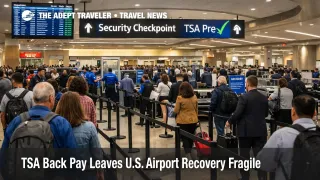
TSA airport recovery across the United States improved after March 31, 2026, when unpaid screeners began receiving back pay, but the system is not fully stable. Security lines shortened at several major airports, and the national absentee rate fell to 8.6 percent from 12.4 percent the prior Friday, according to Reuters. Even so, more than 500 officers had already quit during the Department of Homeland Security funding lapse, and ABC News reported on April 2 that some officers were still missing portions of pay or using back pay immediately to cover debts and late fees. For travelers, that means the worst checkpoint crunch has eased, but uneven waits, thinner staffing, and faster relapse risk remain part of the airport picture.
In an earlier Adept Traveler article, TSA Pay Restart Eases Airport Security Lines the focus was the first operational relief after checks started landing. The newer concern is durability. A system can look better for a day or two and still remain vulnerable if staffing has already been damaged and workers are still sorting out missed or incomplete pay.
TSA Airport Recovery: What Changed
The operational change is real. Reuters reported that major airports including hubs in Baltimore, Houston, New York, New Orleans, and Dallas saw shorter lines after TSA officers started receiving retroactive pay tied to a March 27 White House memorandum authorizing emergency payment. That brought immediate relief during a busy spring travel period, and it likely prevented a deeper airport disruption cycle from forming.
But the recovery is incomplete. ABC News reported on April 2 that some officers said they were still "in the hole" even after back pay hit because shutdown related late fees, creditor demands, and missed bills had already piled up. ABC also reported that some workers said they were still missing parts of what they were owed. That matters operationally because screening performance depends on more than whether one payroll batch clears. It depends on whether staffing levels, attendance, morale, and retention are actually stabilizing.
The broader DHS funding fight also remains unresolved. Reuters reported on April 2 that Congress still had not fully settled the funding standoff, even as the White House moved to extend emergency pay beyond TSA to other unpaid DHS workers. So the immediate airport emergency is lower than it was in late March, but the institutional stress behind it has not fully cleared.
Which Travelers Still Face Uneven Risk
The most exposed travelers are still the same groups that were vulnerable during the worst line spikes, people departing from major spring traffic hubs, travelers with early morning or late afternoon departure banks, and anyone trying to protect a short domestic connection. These are the itineraries with the least slack when staffing is uneven by checkpoint, by shift, or by day.
Smaller airports also remain worth watching. Earlier Reuters reporting warned that staffing losses could eventually force some smaller facilities into more serious operational strain because they have less depth than large hubs. A big airport can sometimes absorb a bad staffing day by redistributing officers or slowing throughput. A smaller airport often has fewer fallback options.
Business travelers and same day roundtrip flyers should also treat the situation differently from leisure travelers. When airport recovery is fragile, the tradeoff changes. A very early departure and a tight evening return may still work, but the margin for error is thinner if local screening capacity has not fully normalized.
What Travelers Should Do Now
Travelers should treat checkpoint conditions as improved, not solved. Arriving with a larger security buffer still makes sense, especially at large U.S. hubs and at airports that saw severe line spikes during the March staffing crunch. Travelers who can check in early, avoid checked bags when practical, and keep terminal changes simple are still buying themselves useful margin.
The next decision point is connection design. For trips booked over the next several days, the better play is to avoid very short domestic connections where a screening delay at origin can break the whole itinerary. If the fare difference is reasonable, paying for more schedule padding is still the safer choice than assuming all airports have returned to normal.
Over the next 24 to 72 hours, travelers should monitor two signals, not one. The first is public line performance at their departure airport. The second is whether the broader DHS funding fight moves toward a durable legislative solution. If airport waits stay lower and funding uncertainty begins to clear, recovery should firm up. If payroll problems linger or staffing slips again, localized checkpoint pain can return faster than travelers expect.
Why the Recovery Is Still Fragile
The mechanism is straightforward. Airport security lines shorten quickly when absenteeism drops, but staffing damage does not reverse at the same speed. Officers who quit are not instantly replaced, and officers who return after weeks without pay may still be managing financial strain or payroll discrepancies. That means the first order improvement, shorter lines, can coexist with a second order weakness, a system still vulnerable to another attendance shock.
That is why the April 2 ABC News reporting matters even though lines have improved. It suggests the travel system is no longer in its worst visible phase, but some of the underlying labor and payment strain is still working through the network. In practical terms, that keeps airport recovery more brittle than a headline about back pay alone would suggest.
For travelers trying to read the next move, the best interpretation is cautious progress. Screening conditions are better than they were before March 31, and that is meaningful. But as TSA Staffing Losses Keep U.S. Airport Recovery Fragile argued earlier in the week, a shorter line is not the same thing as a fully repaired operation. For a broader explanation of how these disruptions spread beyond one checkpoint or one airport, How Air Travel Disruptions Cause Ripple Effects Across Regions remains useful context. The next few days should show whether the system is moving from emergency relief into real stabilization, or simply pausing between pressure waves.
Sources
- Paying Our Great Transportation Security Administration Officers and Employees, The White House
- Absences Fall Sharply After U.S. Airport Security Workers Finally Get Paid, Reuters
- Trump to Sign Order to Pay Tens of Thousands of DHS Employees, Reuters
- Some TSA Officers Say They're Still Hurting After Receiving Backpay, ABC News
- AFGE Goes All-In for Members as DHS Shutdown Becomes Longest in U.S. History, AFGE