

Schiphol Cuts Day Charges to Ease Fare Pressure
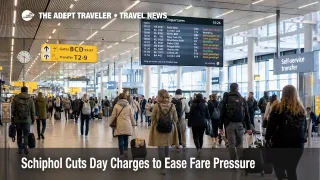
Amsterdam Airport Schiphol (AMS) is trying to keep Europe's fuel shock from turning into a bigger schedule problem. Schiphol said on April 23 it will give airlines a temporary 10% discount on airport charges for daytime flights from April 27, 2026 through March 31, 2027, a targeted move meant to offset kerosene cost pressure tied to the Middle East conflict. For travelers, the immediate question is not whether Amsterdam suddenly becomes cheap. It is whether this helps hold fares and frequencies in place at a major transfer hub that has already started to show strain.
Schiphol Airport Charges: What Changed
What changed since prior coverage is that Schiphol has moved from being a place where fuel pressure shows up through airline decisions into a hub that is directly trying to soften those decisions. In an earlier Adept Traveler article, KLM Cuts 160 Flights, Tightening Schiphol Options, the visible traveler problem was KLM cutting 160 European flights over the coming month because some services were no longer financially viable. Now Schiphol is offering limited cost relief to airlines, but only on daytime flying, which means the airport is trying to preserve daytime connectivity rather than broadly cut costs across the board.
The relief looks real, but not huge at the passenger level. Schiphol's current published passenger charges at Schiphol Centre total €49.42 for a departing local passenger and €23.72 for a departing transfer or transit passenger once the passenger service and security charges are combined. A straight 10% reduction on those passenger side charges alone would equal about €4.94 per local passenger or about €2.37 per transfer passenger. At Schiphol East, the same math comes to about €4.38 and €2.12. That is useful margin support for airlines, but it is much smaller than the recent Europe wide estimate that fuel costs have risen about €29.00 per passenger on intra Europe flights and about €88.00 per passenger on long haul departures from Europe.
Which Travelers and Flights Benefit Most
The travelers most likely to benefit are not necessarily the ones hunting for an immediate fare drop on a single Amsterdam ticket. The bigger benefit goes to travelers whose itineraries depend on a robust daytime bank at Schiphol, especially short haul feeders into long haul departures and long haul arrivals connecting onward within Europe. If airlines can keep marginal daytime frequencies instead of trimming them, same day recovery gets a little stronger, connection options stay wider, and travelers are less exposed to an overnight stay when one hop drops out.
The weaker benefit is for passengers hoping this discount will flow cleanly into lower published fares. Airports are only one slice of an airline's cost base, and Schiphol is one of Europe's more expensive hubs. Reuters reported last year that Schiphol's broader charging plan would leave airlines paying an average of about €15 more for a local departing passenger by 2027 than in 2024, and Reuters also reported in September 2025 that Schiphol later froze planned 2026 charge increases after pushback from airlines. This new daytime discount is better understood as a temporary pressure valve inside an already elevated cost environment, not as a clean ticket price cut.
What Travelers Should Do Now
Travelers booking through Amsterdam should treat this as a resilience signal, not a bargain signal. If Schiphol is competing closely with another hub on schedule quality, a protected connection through Amsterdam may now hold up a little better than it otherwise would have, especially during daytime waves. That matters more for complex itineraries than for simple point to point trips where you can just buy the lowest fare and accept some schedule risk.
Do not assume every eligible flight will suddenly get cheaper. The practical traveler test is whether Amsterdam prices stop worsening as quickly as competing options, whether cut prone frequencies remain on sale, and whether daytime connections stay easier to book than late evening or overnight patterns that are not getting the same support. If Amsterdam is only slightly more expensive than a tighter or less reliable alternate hub, paying that spread may become easier to justify. In an earlier Adept Traveler article, Europe Fuel Shock Now Has a Per Passenger Airfare Number, the main planning point was that fuel pressure had become measurable. This Schiphol move changes that calculation a bit, but it does not erase it.
The next decision point is whether airlines visibly protect daytime banks at Schiphol over the next several weeks. If more carriers still cut service despite the discount, then the relief was too small to change network behavior much. If Amsterdam holds frequencies better than nearby competitors, travelers may not see a dramatic fare drop, but they could still get the outcome that matters more, fewer cuts, better connection coverage, and less timetable brittleness.
Why This May Hold Fares, Not Cut Them
The mechanism here is straightforward. Fuel costs have jumped fast enough that airlines are already testing which flights remain worth operating. Schiphol's answer is not to subsidize all flying equally, but to support the part of the schedule that matters most to hub utility, daytime departures and connections. That can preserve passenger flows through Amsterdam, help airlines defend frequencies that are only marginally profitable, and keep the airport more competitive against other European transfer points.
There is still uncertainty around the exact scope. The announcement, as reported by Reuters, described the discount as applying to daytime flights, but did not spell out the precise local time cutoff or publish a flight by flight eligibility framework in that report. That leaves travelers with a watch item rather than a settled rule. Over the next 24 to 72 hours, the useful signals are whether airlines mention Amsterdam specific pricing or schedule protection, whether Schiphol publishes more detail on qualification, and whether fuel costs keep outpacing the airport relief. The most likely near term result is softer fare pressure and fewer marginal cuts out of Amsterdam, not a sudden wave of cheaper tickets.
Sources
- Reuters, Amsterdam Schiphol offers airlines discount on airport charges due to Iran war
- Schiphol Airport Charges and Conditions, 1 April 2026
- Reuters, Iran war fuel hike adds $100 to long-haul flight cost, study says
- Reuters, KLM cancels 160 flights in coming month due to rising fuel costs
- Reuters, Netherlands' Schiphol to increase airline fees by 37% over three years
- Reuters, Schiphol scraps plan to hike fees next year after airlines push back