

Europe Fuel Shock Now Has a Per Passenger Airfare Number
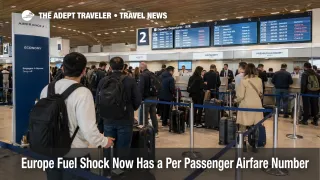
Fuel shock in Europe now has a traveler usable price tag. A Reuters report, citing new Transport and Environment modeling, says the Iran war has added about €88.00 (EUR), about $104.00 (USD), in fuel cost per passenger on average long haul flights leaving Europe, and about €29.00 (EUR), about $34.00 (USD), on average intra Europe flights. That does not mean every ticket jumps by exactly those amounts, or that airlines will label it as a fuel surcharge. It does mean travelers can now price the pressure more realistically, especially on long haul departures, thin connecting itineraries, and trips where waiting for a deal leaves little room to recover if schedules or fares worsen.
Europe Airfare Fuel Costs: What Changed
What changed is that the fuel story is no longer just about tight supply, refinery strain, or airline warnings. It now has a per passenger benchmark that travelers can compare against route choices and booking timing. Reuters reported that T&E measured prices as of April 16 against conditions before the war began on February 28, and found the average added fuel cost at €88 on long haul departures from Europe and €29 on flights within Europe. T&E's own route examples make the shift even more concrete, with about €129 in added fuel cost on Paris to New York and about €26 on Barcelona to Berlin if those higher costs are passed through to passengers.
That is a sharper traveler signal than the earlier phase of this story. In an earlier Adept Traveler article, EU Jet Fuel Plan Raises Summer Flight Risk, the main question was whether Europe's fuel strain would push from planning into selective disruption. Now there is a second layer, airlines have a more defensible cost basis for higher fares even before an airport actually runs short. Reuters also reported in March that major European airline executives were already warning that higher fares were likely as hedges unwind and fuel stays expensive.
Which Trips and Fare Types Are Most Exposed
The most exposed travelers are not necessarily the ones on the absolute cheapest base fare. They are the ones whose trip breaks if one leg becomes too expensive, too scarce, or too hard to replace. Long haul passengers leaving Europe face the biggest per person fuel hit, so Europe to North America, the Gulf, Asia, and Africa itineraries are where fare increases can show up most clearly. The T&E examples point to Paris Charles de Gaulle Airport (CDG) to John F. Kennedy International Airport (JFK) as a route where the added fuel burden is large enough to matter even on a single ticket.
Short haul travelers are not immune. A €29 average intra Europe hit is smaller, but it matters more on price sensitive trips where fares started low, where families are buying several seats, or where travelers are piecing together open jaw and self connect itineraries. Barcelona El Prat Airport (BCN) to Berlin Brandenburg Airport (BER) is one example from the T&E analysis. On those routes, a modest fare rise can erase the savings that made a separate ticket or a low cost connection look smart in the first place.
The pass through is also likely to be uneven. Airlines on stronger routes can spread the cost through base fares, while carriers in more price sensitive markets may use narrower booking classes, fewer promo seats, or explicit price mechanisms closer to departure. Reuters has already reported one real world sign of that in Spain, where Volotea introduced a temporary fuel linked pricing mechanism for some bookings, covered in Spain Summer Airfares Face New Fuel Price Clauses. The tradeoff for travelers is simple, the cheapest apparent fare is becoming a less reliable guide to the final trip cost.
What Travelers Should Do Now
Travelers leaving Europe on long haul trips should stop assuming that waiting will be rewarded. When a route already fits your dates, airport preference, and connection risk tolerance, paying up a bit earlier can be cheaper than waiting for a softer fare that never appears. That is especially true for trips built around one long haul nonstop, one protected alliance connection, or a same day handoff to a cruise, tour, or remote hotel transfer.
Rebooking logic also changes. Open jaw itineraries and mixed rail air plans still make sense when they remove a weak connection or give you more resilient departure options. They make less sense when the added hotel, rail, and separate ticket costs exceed the fare benefit you were chasing. The smarter comparison now is full trip recovery cost, not just fare difference. On some city pairs, a more expensive nonstop may now be the cheaper itinerary once fuel pressure, tighter backup options, and day of travel friction are priced honestly.
The next decision point is the next few days, not the last week before departure. Watch for three signals, broader airline language about fare pass through, more fuel linked pricing clauses or surcharge logic, and more published schedule trims from European carriers. If those spread, the market will be telling you that fuel is no longer just an airline margin problem. It is becoming a traveler shopping problem and, in some places, an itinerary resilience problem.
Why This Is Happening, and What Comes Next
The mechanism is more specific than crude oil going up. Airlines buy refined jet fuel through a physical logistics chain, and Europe remains exposed to supply disruption from the Middle East even as the EU works on diversification, stock planning, and refinery mapping. Reuters reported that Europe imports roughly 30 percent to 40 percent of its jet fuel, with at least half of that import volume coming from the Middle East, and that the European Commission is preparing guidance on shortages, distribution, and resilience. That makes airfare pressure easier to feel before full scale cancellations appear.
The other reason the fare effect matters now is that climate policy is not the main near term cost story on these routes. T&E's analysis says the geopolitical fuel premium is far larger than the cost impact of ReFuelEU and current carbon pricing on the example routes it modeled. Whether or not one agrees with T&E's policy conclusions, the traveler takeaway is still clear, fuel volatility tied to war and supply insecurity is now a bigger near term airfare driver than the green policy costs airlines have been criticizing.
That leaves travelers with a more practical outlook than a dramatic one. Europe is not yet at the point where every itinerary should be treated as unstable, but it is at the point where long haul airfare math has shifted enough to justify earlier booking on mission critical trips. In an earlier Adept Traveler article, Jet Fuel Price Shock Hits Global Travel Planning, the warning was that fuel had become a planning problem. This week's per passenger figures show just how large that planning problem has become.
Sources
- Iran war fuel hike adds $100 to long-haul flight cost, study says, Reuters
- European airlines warn of higher fares as fuel hedges unwind, Reuters
- Exclusive: EU to push for jet fuel diversification as Iran war threatens supply, Reuters
- Europe's response to the Iran war energy crunch, Reuters
- Iran crisis: a moment of reckoning for European aviation, Transport and Environment