

UAE Transit Warning Puts Dubai Layovers at Risk
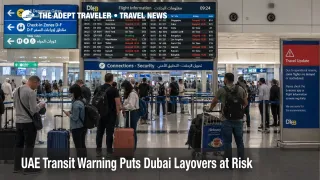
The UAE transit warning has become a direct connection problem, not just a destination advisory. Australia's Smartraveller now advises against travel to the United Arab Emirates, including transit and layovers, after warning that UAE airspace can open or close at short notice and that Dubai and Abu Dhabi airports may be affected by regional escalation. For travelers already ticketed through Dubai or Abu Dhabi, the decision is no longer only whether the airport is open today. It is whether a long haul itinerary can survive a sudden airspace closure, missed connection, or insurance exclusion.
UAE Transit Warning: What Changed
Smartraveller's United Arab Emirates page says the situation in the Middle East remains volatile and that UAE airspace may open or close at short notice, affecting flights at Abu Dhabi and Dubai international airports. It also says Australia raised its advice for the UAE to "do not travel" on February 28, 2026, and that the advice applies to transit and layovers, even for travelers who do not plan to leave the airport.
That is the operational shift. Transit through Dubai International Airport (DXB) or Zayed International Airport (AUH) is now being treated by Australia as exposure to the same country risk, not as a protected airport-only exception. Smartraveller warns that travelers who enter or transit the UAE may be unable to leave, that safety may be at risk, and that travel insurance may become invalid.
The broader Smartraveller Middle East guidance makes the same point across affected locations, advising travelers not to transit through "do not travel" countries, even without leaving the airport. It also tells travelers whose trips include such a transit point to contact the airline or travel agent about alternative routings, rebooking, or refunds, and to check insurance coverage for delays, cancellations, and changes to travel advice.
Which Dubai and Abu Dhabi Itineraries Are Most Exposed
The highest exposure sits with travelers using the UAE as a long haul bridge between Australia, Europe, Africa, South Asia, Southeast Asia, and North America. A nonstop flight into Dubai or Abu Dhabi may still operate at a given moment, but a connection depends on a chain of airspace access, aircraft positioning, crew legality, onward routing, airport processing, and seat availability after disruption.
Separate tickets carry the sharpest risk. If a traveler arrives late into Dubai or Abu Dhabi on one booking and misses a separately ticketed onward flight, the second airline may treat the passenger as a no show rather than a protected misconnect. A single through ticket gives more protection, but it does not remove the stranded passenger problem if airspace closes after arrival.
This also differs from a normal congestion warning. In an earlier Adept Traveler article, DXB Evening Arrival Delays Raise Connection Risk focused on how heavy Dubai arrival banks can compress connections when the airport is open. The new advisory layer is more serious because the risk now includes a formal government warning against using the UAE as a transit point at all.
What Travelers Should Do Before Departure
Travelers already booked through Dubai or Abu Dhabi should check the travel advice tied to their passport country, then compare it with their travel insurance policy before making a voluntary change. The insurance question is not abstract. The U.K. Foreign, Commonwealth & Development Office says travel insurance could be invalidated if travelers go against FCDO advice, and its UAE page currently advises against all but essential travel.
The cleanest reroute decision point is before the first flight begins. Once a traveler has departed toward the UAE, they may have fewer practical options, especially if the onward flight cancels after arrival or if airport hotels fill during a disruption wave. Travelers with essential trips should ask the airline or travel agent for routings that avoid "do not travel" transit points where possible, even if the replacement itinerary is longer, more expensive, or requires a different hub.
Travelers who cannot reroute should reduce exposure. That means avoiding long voluntary stopovers, avoiding separate tickets, carrying medication and documents in hand luggage, confirming visa rules for any emergency onward country, and keeping enough payment flexibility for a forced hotel night. The next signals to monitor are advisory changes, airline waiver language, UAE airspace status, and whether carriers begin canceling or consolidating flights through Dubai or Abu Dhabi.
Why Official Advice Is Not Aligned
The advisory picture is not uniform, which can create false confidence for travelers comparing only one source. Australia's language is the strongest for transit, with "do not travel" advice applying directly to UAE layovers. The U.S. State Department currently places the UAE at Level 3, "Reconsider Travel," citing armed conflict, terrorism, ordered departure of non-emergency government personnel and family members, significant commercial flight disruptions, and FAA aviation safety caution for the region.
The U.K. advises against all but essential travel to the UAE and says regional escalation has created significant security risks and travel disruption. Canada's advice highlights terrorism, missile and drone risks, airports and transportation hubs as possible targets, and available land crossings into Oman for travelers who assess that they can safely leave by land.
That does not mean one government is "right" and the others are irrelevant. It means traveler decisions should be tied to the strictest rule that affects the passport holder, ticket, employer policy, and insurance policy. For travelers needing a regional exit option, In an earlier Adept Traveler article, Muscat Evacuation Flights Become Gulf Exit Hub explained why Oman has become a practical fallback in some Gulf disruption scenarios. For new bookings, the safer planning default is simple: treat the UAE transit warning as a reason to price and hold non-UAE alternatives before accepting a Dubai or Abu Dhabi layover.
Sources
- United Arab Emirates Travel Advice & Safety, Smartraveller
- Global Travel Impacts of Conflict in the Middle East, Smartraveller
- United Arab Emirates Travel Advisory, U.S. Department of State
- United Arab Emirates Travel Advice, GOV.UK
- Travel Advice and Advisories for United Arab Emirates, Government of Canada
- DXB Evening Arrival Delays Raise Connection Risk
- Muscat Evacuation Flights Become Gulf Exit Hub