

Muscat Evacuation Flights Become Gulf Exit Hub
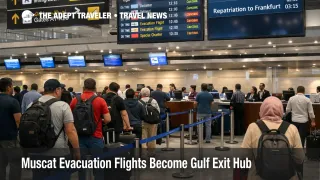
Muscat evacuation flights are quickly becoming the most practical way out of the region as nearby flight information regions stay closed, partially closed, or prone to short notice interruptions. The shift matters because it changes the traveler playbook from waiting for a normal hub restart in Dubai, Abu Dhabi, or Doha, to building an exit plan that may require getting yourself to Muscat, Oman, first. Operational reporting now describes airlines using Muscat as a base for evacuation flights, including special movements tied to national repatriation efforts, rather than open sale schedules.
That does not mean Muscat International Airport (MCT) is an easy solution. It means Muscat is one of the few places where airspace is still usable enough to stage flights safely, then connect onward outside the immediate closure zone. For travelers, the core decision is whether you can tolerate waiting for your original hub to stabilize, or whether you should treat Oman as the exit hinge and rebuild the rest of the itinerary from there.
Muscat Evacuation Flights: What Changed on March 4, 2026
The new operational reality is that Muscat is being used as a launch point for special flights, not just as a normal destination. Flightradar24's live airspace coverage says Oman's airspace remains open, and that airlines have begun using Muscat as a base for evacuation flights, specifically noting Smartwings activity over the prior two days and special flights via Muscat for the United Kingdom and Germany. Separately, Aviation Week reporting shows how carriers are moving crews and staff by ground into Oman, then operating special flights out of Muscat when other airports are harder to access reliably, or cannot legally support passenger operations under current constraints.
This helps explain why "reopening" elsewhere is not the same thing as "usable for your departure." Even when limited flights operate from the United Arab Emirates, the system can still be constrained enough that carriers prioritize tightly controlled departures, repositioning, and repatriation missions over anything resembling normal connectivity. If you are catching up on the earlier phase of the disruption, Middle East Airspace Closures Ground Gulf Hubs lays out why partial movement does not equal schedule reliability, and why transit itineraries remain fragile.
Who Can Actually Use Special Flights via Muscat
The uncomfortable truth is that "evacuation flight" often means eligibility rules, documentation checks, and capacity triage. Some flights are government chartered and prioritize vulnerable nationals, and some are airline arranged special services aimed at their own disrupted customers. UK reporting indicates the government is working on charter capacity out of Muscat, while British Airways separately planned a Muscat departure in the early hours of March 5, 2026, to bring home some of its stranded customers, with travelers typically expected to be contacted, or to use dedicated support channels, rather than self deploying to the airport.
On the airline side, the practical barrier is usually one of these: you must already be in Oman, you must be a citizen or resident covered by that government's plan, you must hold a qualifying ticket with that carrier, or you must be on a manifest assembled through an embassy, a tour operator, or a crisis assistance team. That is why Muscat being "the hinge" changes planning, but does not automatically create seats for anyone who can reach the terminal.
It also creates a new kind of crowding risk. If Muscat becomes the staging point for multiple countries' charter flows plus airline special flights, hotel inventory and ground transport capacity become binding constraints, especially for travelers arriving overland on short notice. If you are currently protected by coordinated lodging support in the United Arab Emirates or Qatar, that safety net can be worth more than chasing a speculative seat. UAE, Qatar Cover Hotels for Stranded Airspace Closures is the right reference point for that tradeoff.
What Travelers Should Do Now if You Need to Self Evacuate
Start by treating Muscat as an option with prerequisites, not as a generic reroute. The first decision threshold is documentation and border feasibility. If your plan involves crossing into Oman by road, confirm your entry requirements, your passport validity, and whether your nationality requires a visa, or can obtain one on arrival, because in disruption periods the failure mode is getting stuck at the border, not at the airport gate.
Next, separate "I can reach Muscat" from "I can depart Muscat." Before you commit to repositioning, look for one of these confirmations: an embassy instruction that you are eligible and registered for a specific flight, an airline message assigning you to a special service, or a bookable ticket on an operating carrier that is actually flying out of MCT within your risk window. If you do not have one of those, you are gambling on capacity that may never be offered to you.
Then build time buffers like you are planning around a corridor that can close with little warning, because that is what current airspace behavior implies. Aviation reporting describes how access to some airports, and even the ability to run passenger flights legally, can hinge on crew availability, safety approvals, and reliable ground processes, not simply on an aircraft being present. Practically, that means you should plan for an overnight in Muscat even if you "connect" same day on paper, and you should avoid tight onward connections until you are out of the region and back inside stable hub operations.
Why Muscat Works, and Why Transfers Stay Risky
Muscat works as a hinge because Oman's airspace is still open enough to operate, while multiple neighboring airspaces are closed, or restricted, compressing the region into narrower corridors that can change quickly. When traffic is funneled into fewer routable paths, airlines have to prioritize what they can operate predictably, which is why special flights concentrate around the places that remain operationally viable.
The second order effect is that even successful evacuation flights can pull aircraft and crews off normal networks, delaying the broader recovery. A hub can show "limited operations" and still fail travelers because the system behind it is out of position, crew legalities are broken, and airline priority is clearing backlogs, not restoring open sale schedules. That is also why Muscat hotel and transport congestion can spike quickly, because the exit path concentrates demand into one workable node.
The practical takeaway is simple. If you need out soon, Muscat is increasingly the best place to anchor an exit plan, but only if you can secure a confirmed path to a seat. If you cannot, waiting in place with official lodging support, and monitoring your carrier's special flight instructions, can be the safer move than self relocating into a new bottleneck.