

A320 Recall And Storms Hit Australia New Zealand Flights
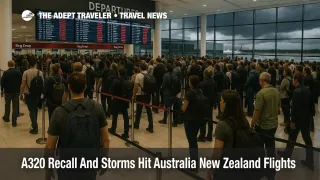
Anyone planning to route flights through Sydney Kingsford Smith International Airport (SYD), Melbourne Airport (MEL), Brisbane Airport (BNE), Auckland Airport (AKL), or Wellington International Airport (WLG) in early December now has to treat Australia New Zealand A320 recall flight delays, weather disruption, and staffing gaps as a combined, higher baseline risk rather than a one off fluke. Data from aviation analytics firms and regional media show that a late November disruption wave brought about 90 cancellations and more than 670 delays across Australia and New Zealand on November 25, followed by another day with more than 70 cancellations and over 300 delays on November 30, with Sydney and Melbourne worst hit. On top of that, Jetstar temporarily grounded dozens of Airbus A320 aircraft for an emergency software rollback while Air New Zealand trimmed a smaller set of services, creating rolling knock on effects across trans Tasman and domestic networks.
In broad terms, what has changed is that a short, sharp Airbus A320 software recall has collided with early summer storms and tight staffing in Australia and New Zealand, turning routine bad weather days into multi day disruption waves focused on a handful of major hubs. For travelers, that means December flights through Sydney, Melbourne, Brisbane, Auckland, and Wellington will remain less predictable than usual even as most A320 jets return to service.
Recent Disruption Waves On Both Sides Of The Tasman
The late November pattern is useful for understanding what early December might look like. On November 25, disruption trackers using Cirium data and airport reports logged roughly 90 cancellations and 672 delays across Australia and New Zealand, driven by storms, staff shortages, and aircraft rotations that left little slack in the system. Brisbane and Sydney each saw well over one hundred delayed movements, and airlines like Virgin Australia, Qantas, Jetstar, and Air New Zealand all reported significant knock ons as late inbound aircraft cascaded through their schedules.
A second wave hit on November 30. Data compiled by Cirium and regional outlets point to at least 72 cancellations and 336 delays that Sunday, with Sydney and Melbourne again carrying much of the load as low cloud ceilings, thunderstorms, and staff shortages forced repeated schedule changes. Other tallies for the same weekend quote up to 85 cancellations and more than 790 delays spread across Sydney, Melbourne, Brisbane, Auckland, Christchurch, and Wellington, underlining how quickly a single rough day can spread across the Tasman network. Adept Traveler has already detailed how these waves turned late November into a fragile period for Australia and New Zealand flying, with earlier coverage of disruption spikes around November 23 and 25.
The key point is that the region is not dealing with a single storm or one isolated outage. Instead, airlines are entering December with a pattern of repeated stress events that reveal how little buffer remains in aircraft and crew rotations.
How The A320 Recall Hit Jetstar And Air New Zealand
Underneath the weather stories sits the Airbus A320 software recall that has dominated aviation news. Regulators ordered an immediate rollback of flight control software on about 6,000 A320 family jets worldwide after an October 30 JetBlue flight experienced a sudden, uncommanded altitude drop, a problem later linked to solar radiation corrupting critical computer data. Airbus and regulators in Europe and the United States have now confirmed that most affected aircraft are already patched, with fewer than 100 A320 family jets still needing modifications as of December 1.
In Australia, Jetstar took the biggest immediate hit. The low cost carrier confirmed that 34 of its 85 A320 family aircraft needed urgent work, and grounded them to roll back the software. That move, combined with existing weather and staffing constraints, led to about 90 cancellations and additional delays across its domestic and international network on the main recall weekend, with impacts spreading beyond trunk routes into leisure services to destinations such as Port Vila, Singapore, and Bali. By November 30, Jetstar's travel alerts stated that the required update had been applied to all affected aircraft, with only some residual "flow on" delays expected as the network reset, and that customers on cancelled flights were being contacted directly for rebooking or refunds.
New Zealand saw a more modest, but still noticeable, impact. Air New Zealand cancelled around a dozen A320 flights initially and then extended that total to roughly twenty services over the recall weekend as engineers completed the software work, focusing most cuts on domestic and trans Tasman sectors with alternative options. By November 30 and December 1, the airline and local media were reporting that A320 operations were returning to normal, with most jets back in the air and only scattered residual cancellations while backlogs cleared. Air New Zealand also offered affected passengers one free date change, credit, or refunds in line with its disruption policies for the recall window.
This asymmetry matters for planning. The structural recall risk is shrinking quickly, but because Jetstar and Air New Zealand both rely heavily on A320 family aircraft for short haul flying, any remaining unmodified jets or knock on crew imbalances will be most visible on their domestic and trans Tasman routes through the first days of December.
Weather, Staffing, And Fragile Schedules
Even as the recall becomes less disruptive on paper, the late November data shows how easily ordinary operational stress can tip the system back into delay waves. On November 30, low cloud and storms along Australia's east coast combined with roster shortages to trigger a day of rolling changes, with Sydney and Melbourne logging the highest cancellation and delay totals and spillover effects at Brisbane and across the Tasman at Wellington and Auckland.
Australia and New Zealand already run dense, multi leg daily schedules with relatively little spare capacity at peak times. Jetstar, Qantas, Virgin Australia, and Air New Zealand all build banks of flights in and out of Sydney, Melbourne, Brisbane, Auckland, and Wellington, with narrow body aircraft often completing four to six sectors per day. When one A320 or 737 departs late due to weather or a software slot, that delay can propagate through subsequent legs, especially once crew duty time limits start to bite.
The recall added an extra constraint by pulling aircraft out of rotation for roughly two hour software sessions, sometimes at short notice. Airlines that managed to schedule those slots overnight or during off peak periods saw fewer disruptions, while carriers like Jetstar that had to ground large subfleets temporarily felt a sharper shock. Now that most jets are patched, the main remaining risk is the combination of tight rosters and stormy early summer weather that can still overload hubs even without recall driven groundings.
How Recall Waivers And Consumer Law Fit Together
For individual travelers, the practical question is what rights apply when a recall, storm, or staff shortage cancels or severely delays a flight. In Australia, the Australian Consumer Law sets out a guarantee that services will be supplied with due care and within a reasonable time, and regulators make clear that if an airline cannot offer carriage within a reasonable timeframe, passengers may be entitled to a refund or replacement transport even where terms and conditions point first to credits. Major carriers such as Qantas, Virgin Australia, and Jetstar all publish ACL guidance pages that reiterate these rights alongside their own goodwill policies.
In New Zealand, a mix of the Civil Aviation Act and the Consumer Guarantees Act provides similar baseline protections on domestic sectors, with government and consumer bodies explaining that passengers are entitled to refunds and "reasonable compensation" when cancellations or long delays arise from airline controlled causes. Air New Zealand's own customer service policies, and recent court decisions and enforcement actions, underline that carriers must not mislead customers about those rights.
The A320 recall sits in a grey zone between extraordinary safety action and airline operations. Regulators and Airbus frame the software rollback as a precautionary safety step, not a routine maintenance issue, which weakens the case for cash compensation in the European EC 261 sense. However, Australian and New Zealand consumer law still expects airlines to provide refunds or rerouting when they cannot transport passengers within a reasonable period, regardless of whether the trigger is weather, an air traffic control outage, or a manufacturer recall.
Looking ahead, Australia is debating a more explicit aviation consumer protection scheme that could add statutory compensation for long delays and cancellations, but those rules are not yet in force. For now, travelers should assume that refunds, rerouting, and care are on the table, while automatic cash compensation remains limited.
Tactics For December Trips Through Australia And New Zealand
If you are flying through Sydney, Melbourne, Brisbane, Auckland, or Wellington in the first half of December, treat your itinerary as something to engineer carefully rather than a throw of the dice. First, avoid last departures of the night on critical legs wherever possible, because late running inbound aircraft and crew duty limits make those flights more vulnerable to cancellations when schedules slip. Early morning departures on days without active storm warnings are still the best bet for leaving close to schedule once overnight software work is complete.
Second, lengthen your connection times at A320 heavy hubs. If you are connecting from long haul arrivals into domestic or trans Tasman A320 flights at Sydney, Melbourne, Brisbane, or Auckland, aim for legal connection windows that leave at least ninety minutes, and more if you are on separate tickets. That is especially important if you are heading onward to cruises, tours, or regional mining and resort airports where missed legs can mean a full day lost.
Third, keep at least one backup routing in mind for each major trip. For example, if your Sydney to Wellington flight is cancelled, check whether Brisbane or Melbourne offer workable same day alternatives, or whether shifting to a different trans Tasman city and adding a domestic sector is realistic. Flexible tickets or corporate travel policies can make these pivots much easier to execute.
Finally, use airline apps and rights information proactively. Download carrier apps for Jetstar, Qantas, Virgin Australia, and Air New Zealand, opt into notifications, and screenshot any travel alerts or waivers that mention the A320 recall, storms, or staffing issues on your route. If your flight is cancelled or heavily delayed, insist on your choice between refund and rerouting under Australian or New Zealand consumer law rather than accepting credits as the only option, and keep receipts for hotels, meals, and surface transport in case you need to claim reasonable expenses.
Early summer in Australia and New Zealand can still deliver smooth trips, but the combination of recent disruption waves, residual A320 recall work, and busy holiday traffic means that careful itinerary design and a clear understanding of your rights are more important than usual.
Sources
- 'Perfect storm' causes 90 flight cancellations and 672 delays across Australia and New Zealand, VisaHQ
- Weather and staffing woes cancel 70 plus flights and delay 300 more across Australia, VisaHQ
- Thousands of passengers abandoned in Oceania including Australia and New Zealand, Travel And Tour World
- Jetstar flights grounded and delayed due to Airbus A320 recall, ABC News Australia
- Jetstar travel alerts, Airbus A320 software update
- Jetstar cancels 90 domestic flights across Australia after global Airbus A320 recall, The Guardian
- Further flight cancellations possible as Airbus A320 jets stay grounded, RNZ
- Air NZ's Airbus A320 aircraft return to normal service after software recall, NZ Herald
- Airbus says most of its recalled 6,000 A320 jets now modified, Reuters
- Airbus says most A320 jets now have software fix, AP News
- Travel delays and cancellations, Australian Competition and Consumer Commission
- Australian Consumer Law information, Jetstar
- Flights, cancellations and delays, New Zealand Consumer Protection
- New Zealand Civil Aviation Act information, Qantas
- Domestic flight rights, Consumer NZ
- Australia And New Zealand Flight Waves Strain Summer Hubs, Adept Traveler
- Australia And New Zealand Flight Delays Hit Brisbane And Sydney, Adept Traveler
- Australia New Zealand Flight Delays From Weather, Adept Traveler
- Global A320 Software Recall Localizes Flight Delays, Adept Traveler