

Australia December 7 2025 Flight Delays At Major Airports
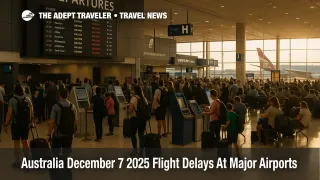
Australia summer flight delays are already biting hard, with December holiday traffic pushing Sydney Kingsford Smith Airport (SYD), Melbourne Airport (MEL), Brisbane Airport (BNE), and Gold Coast Airport (OOL) into their first serious stress test of the season on December 7, 2025. Real time data compiled by VisaHQ and Travel & Tour World show 588 delayed departures and 21 cancellations across the four airports, enough to strand same day connections and push late arrivals toward or past midnight for thousands of travelers. Families starting long haul trips, business travelers on tight itineraries, and passengers heading to cruise departures are all seeing that what might once have been a rough afternoon now behaves more like a multi airport gridlock.
Australia summer flight delays at major airports on December 7 reflect a convergence of structural problems, from Jetstar's grounded Airbus A320 aircraft after an unprecedented software recall, to tight pilot and crew rosters, to storm prone summer weather that leaves little slack when thunderheads sit over the east coast. Together, those constraints turn otherwise manageable cells of rain and wind into disruption waves that propagate across domestic feeders and international banks.
VisaHQ's breakdown of December 7 performance shows that Sydney logged roughly 223 delayed flights and six cancellations, Melbourne about 222 delays and nine cancellations, Brisbane 107 delays and four cancellations, and the Gold Coast another 36 delayed departures and two cancellations. For travelers on the ground, the distinction between a delay and a cancellation often blurs, because high load factors and already busy schedules leave limited room to rebook onto the next service, especially on evening flights or once daily routes. When a late inbound aircraft misses its slot in a departure bank, the resulting rolling holdups can easily erase nominal connection windows of 60 to 90 minutes.
This weekend's numbers also sit on top of an earlier spike in early December, when VisaHQ and other trackers recorded about 31 cancellations and 730 delays across five Australian gateways on December 5 and 6, with Melbourne and Sydney again absorbing the worst of the disruption. The pattern is clear for anyone looking at the past fortnight: Australia is not dealing with a single bad weather day, but with a sustained period in which storms, staffing limits, and aircraft availability combine into a higher baseline level of risk.
Background: A320 recall and capacity strain
The most distinctive new ingredient in this season's mix is the Airbus A320 software recall, which briefly grounded thousands of jets worldwide and continues to ripple through maintenance lines and schedules. Airbus and aviation regulators required an immediate software change after a flight control vulnerability was identified, triggering what the manufacturer itself described as an unprecedented global operation. In Australia, Jetstar confirmed that 34 of its A320 aircraft needed urgent attention, a number large enough to drive about 90 cancellations and widespread delays during the late November repair peak and to leave fleets and crew rotations misaligned well into December.
Adept Traveler's earlier piece on Australia And New Zealand Flight Delays After A320 Recall documented how those groundings overlapped with a passport system outage and weather systems to produce repeated delay waves across Sydney, Melbourne, Brisbane, Auckland, and Wellington. That history matters now, because airlines cannot simply switch in spare aircraft or idle crews to clean up December 7 delays; many of those buffers were already spent coping with earlier recall and IT problems.
Even carriers not directly affected by the A320 software change are feeling the knock on effects. Repair shops and engineering teams were already working through backlogs of engine inspections and heavy maintenance, so adding a sudden software related grounding has tightened the entire ecosystem. As Virgin Australia's own festive season outlook emphasizes, demand is high and fleets are close to fully utilized, even after airlines recruited additional staff ahead of the holidays. That leaves little headroom when a line of storms forces holding or when a single aircraft in a rotation is late.
How December 7 played out across the day
Although detailed, gate by gate timelines vary, the broad shape of December 7 disruption matches what travelers have already seen during recent storm and recall days in Australia and New Zealand. Morning departures fared comparatively better, especially the first bank of flights leaving before convection built over the coast and before ATC flows tightened. As the day progressed, thunderstorms near Sydney and Melbourne forced reroutes and speed restrictions, while aircraft that had already started the day behind schedule struggled to claw back time.
By mid afternoon, delay minutes were stacking up on trunk routes between the four major airports and on links into other east coast and Tasman destinations, straining same day connections at both ends. The most exposed itineraries were regional legs into Sydney, Melbourne, or Brisbane that were meant to feed intercontinental flights to Asia, North America, or Europe, especially where travelers had allowed less than three hours to connect or were relying on separate tickets. At the Gold Coast, delays were smaller in absolute numbers but still enough to disrupt leisure routes and short hops into larger hubs.
For business and government travelers, the timing was particularly awkward. December 7 sits early in the Southern Hemisphere summer, when offices and schools are still in session but many travelers have already begun staggered departures for the Christmas and New Year period. That combination means flights often run full, yet contingency plans such as shifting meetings or taking a later service are harder to arrange on short notice.
How this fits into a wider early summer pattern
Australia and New Zealand have been edging toward a structurally higher risk environment for several weeks, as Adept Traveler's Australia New Zealand Flight Delays From Weather and Australia New Zealand Flight Delays Hit Brisbane And Sydney coverage has already outlined. Storm systems have repeatedly targeted major hubs, air traffic control staffing gaps have nudged up the frequency and length of flow restrictions, and ongoing fleet issues have reduced the supply of spare aircraft that would normally help recover from a bad day.
VisaHQ's December 5 and 6 tallies, with 31 cancellations and about 730 delays at Melbourne, Sydney, Brisbane, Cairns, and Adelaide, reinforce the sense that December 7 is the continuation of a trend rather than a fresh shock. For travelers, the takeaway is that early summer in Australia should now be treated more like a North American or European winter in terms of disruption risk: even ordinary thunderstorms or minor IT problems can trigger cascading delays when networks are already tight.
Planning buffers from regional Australia into long haul flights
For anyone booking or holding domestic connections into long haul departures from Sydney, Melbourne, or Brisbane over the next few weeks, the safest assumption is that delay risk will remain elevated. Adept Traveler's earlier analysis of Australia New Zealand patterns recommends at least three hours for domestic connections and four hours or more for itineraries that link a domestic or Tasman leg into an intercontinental flight, and that remains a sensible baseline while recall related knock on effects are still in play.
Travelers who must self connect on separate tickets, for example pairing a low fare regional leg into a full service long haul ticket, should be even more conservative. Four to five hours between scheduled arrival and departure at Sydney, Melbourne, or Brisbane is not excessive in the current environment, particularly for itineraries that connect onto once daily or near once daily flights. Where budgets allow, keeping an entire journey on a single ticket with the same airline or alliance is still the most powerful way to shift misconnect risk back onto carriers instead of passengers.
For cruise departures from Sydney or Brisbane, or for tour and rail packages that start on fixed dates in those cities, the most resilient strategy is to arrive at least one full day before embarkation. That overnight buffer turns a multi hour delay into an annoyance rather than a trip ending failure, and it gives additional room to reroute if an A320 related cancellation forces a wholesale retiming of domestic feeders.
Working around peak banks and fragile routes
Not all flights are equally exposed. The data from December 7 and recent weeks show that mid morning and late afternoon banks, when many domestic and regional flights either feed or disperse from long haul arrivals and departures, are where delays most easily compound. Travelers who can shift to first wave morning departures, or to true off peak midday services that sit outside the tightest banks, are more likely to depart close to schedule even on days when storms flare over the coast.
On specific routes, travelers relying on Jetstar metal need to watch schedules especially closely until Airbus and airlines fully clear the recall backlog. While Qantas, Virgin Australia, and other carriers have their own constraints, the sheer number of affected Jetstar A320s means that travelers on its busier east coast trunk and leisure routes face heightened odds of last minute swaps or cancellations in coming weeks. Booking earlier flights in the day, taking advantage of any fee waivers or flexible fare options, and considering alternative carriers where inventory still exists can all reduce exposure.
What to do if you are already booked over the next week
If your trip involves one of the four major airports hit hardest on December 7, start by checking your reservation in your airline's app and making sure that contact details and notification preferences are up to date. Many carriers serving Australia have become more proactive about same day alerts after the A320 recall, but those systems only help if they can reach you.
Next, scan your itinerary for tight connections, separate tickets, or critical onward events such as cruise departures or nonrefundable tours. If a domestic leg into Sydney, Melbourne, or Brisbane gives you less than three hours before a long haul flight, or if your entire itinerary relies on the last flight of the day on any segment, it is worth calling your airline or travel advisor to explore earlier options while seats remain. Airlines are often more flexible about rebooking when disruption is clearly ongoing rather than hypothetical, and moving now is almost always easier than queuing at the airport after delays stack up.
Finally, build ground buffer into your plans. Summer storms that slow arrivals and departures can also lengthen drive times to and from airports, and queues at security and check in counters tend to grow when multiple flights re time into the same window. Leaving an extra 30 to 60 minutes for airport formalities can be the margin that keeps you on the right side of a check in cut off, especially on busy school holiday days.
Sources
- Summer Peak Disruption: 588 Delays and 21 Cancellations Snarl Australia's Four Busiest Airports
- Australia Faces New Travel Chaos as Jetstar, Qantas, Virgin Australia and More Airlines Face 588 Delays and 21 Cancellations
- Jetstar flights grounded, delayed due to Airbus A320 recall
- Nationwide flight disruptions hit five major Australian airports as peak summer travel begins
- Australia New Zealand Flight Delays From Weather
- Australia And New Zealand Flight Delays After A320 Recall