

Canada Flight Delays At Major Hubs As Weather, Strike Loom
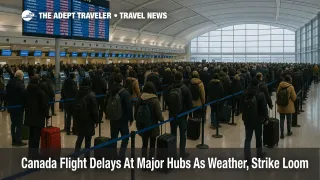
Travelers relying on Canada's biggest airports are running into a rough early December, as Canada airport flight delays mount at Toronto Pearson, Vancouver, Montreal Trudeau, Calgary, and other hubs, with about 793 delayed departures and 61 cancellations reported on a single weekday. Trade data shows Toronto, Vancouver, Montreal, Calgary, Ottawa, and Edmonton carrying most of the burden, with regional carriers Jazz, Porter, and WestJet, plus Air Canada, all seeing elevated delay counts. Anyone using these gateways for domestic hops, sun flights, or transatlantic trips over the next week will need to pad schedules, protect tight connections, and think strategically about whether to route through Canadian hubs or via the United States instead.
In simple terms, Canada airport flight delays are climbing just as winter weather and an Air Transat pilot strike window squeeze the capacity of a relatively small group of carriers, which makes it harder to recover when storms or labor disputes knock the schedule off balance.
How Bad Are The Delays At Canada's Major Hubs
A recent snapshot of airport and tracker data pulled together by trade outlet Travel And Tour World counted roughly 793 delays and 61 cancellations across Canada's main airports in one day, with Toronto Pearson International Airport (YYZ) alone reporting around 341 delays and 32 cancellations. Vancouver International Airport (YVR) logged about 93 delays and 5 cancellations, Montréal Pierre Elliott Trudeau International Airport (YUL) saw roughly 125 delays and 5 cancellations, and Calgary International Airport (YYC) added another 67 delays and 7 cancellations, while Ottawa and Edmonton contributed several dozen more.
Although smaller cities like Halifax and St Johns have been less affected so far, the pattern is clear. When the big four, Toronto Pearson, Vancouver, Montreal Trudeau, and Calgary, start to choke, the knock on effect is felt on feeder flights from across the country, on US transborder services, and on long haul links into Europe, the Caribbean, Mexico, and beyond.
For travelers, those numbers matter less as a headline than as a map of fragility. The busiest banks at Toronto, typically late morning and late afternoon into early evening, and the main departure waves at Vancouver and Montreal, are exactly when a single ground stop or deicing backlog can start to roll through the rest of the day. Once that happens, even routes that are not directly under a storm cloud can face crews timing out, aircraft waiting for new slots, and connections that simply no longer fit.
Winter Weather Adds Drag From Coast To Coast
Weather is acting as the trigger for many of these delays, even on days that do not look especially dramatic from the terminal windows. Environment and Climate Change Canada has been issuing a rotating set of snowfall, winter storm, snow squall, and wind warnings across multiple provinces, including heavy snow in parts of Alberta's mountain parks, winter storm warnings for sections of Newfoundland and Labrador, and powerful onshore winds around coastal British Columbia.
On the Pacific side, a fresh atmospheric river event is bringing rounds of heavy rain into British Columbia, with rainfall totals in some coastal zones forecast to exceed typical daily averages and wind gusts near the Strait of Juan de Fuca strong enough to trigger yellow wind warnings. That combination forces airports like Vancouver to juggle low ceilings, slick runways, and gusty crosswinds that limit the number of arrivals and departures they can safely push through per hour.
Farther inland, clippers sliding across the Prairies and bands of lake effect snow and squalls in Atlantic Canada add classic winter constraints. Even moderate snow around Alberta mountain communities means more deicing and slower turns for aircraft, while snow squall warnings near places like Corner Brook and the Bonavista Peninsula can prompt temporary route closures and reroutes, which ripple into schedules at Montreal Trudeau and Toronto Pearson where many of those flights connect.
The practical takeaway is that the forecast in your destination city is only half the story. What really matters for delay risk is the weather at each airport in your chain, including where your aircraft is coming from and where it is going next, and Canada's winter pattern right now is messy enough that several of those steps are often under some kind of advisory.
Why The Air Transat Strike Window Raises The Stakes
Layered on top of the weather is a more structural problem, the Air Transat pilot strike. The airline confirms that its pilots, represented by the Air Line Pilots Association, have issued a 72 hour strike notice dated December 7, which means a legal walkout could begin as early as December 10 if no agreement is reached. In response, Air Transat has started what it describes as a gradual and orderly shutdown of operations, saying it will progressively cancel flights from Monday with the aim of a complete suspension by December 9 if talks fail.
Guidance from the airline and from Canadian media makes clear that customers booked on or before December 12 are being asked to check flight status up to 48 hours before departure, watch for emails about cancellations and automatic refunds, and, if they prefer, use an online form to cancel proactively in exchange for a twelve month credit. Under Canada's Air Passenger Protection Regulations, any refund or credit must be provided within 30 days, but the key stress point for travelers is that entire chunks of Transat's leisure network to the Caribbean, Mexico, Florida, South America, and Europe may simply not operate for several days in the middle of peak holiday demand.
For travelers who are not on Air Transat, this still matters. A carrier that usually provides meaningful capacity on Montreal and Toronto routes into Europe and the sun suddenly disappearing, even for a few days, forces those passengers to compete for seats on Air Canada, WestJet, Porter, and US and European airlines. The system loses slack, and that loss of slack shows up as longer recovery times from storms and higher prices for any last minute rerouting.
Our existing coverage of the strike risk and current shutdown plans goes into more detail on affected routes and rebooking options, and is worth a close read if you or your clients have December flights on the airline. [Canada Pilot Strike Risk For December Air Transat Flights][2] set out the original warning, while [Air Transat Pilot Strike To Disrupt Canada Flights][1] tracks the latest shutdown decisions and waiver rules.
A Thin Carrier Mix Meets Heavy Holiday Demand
Canada's aviation landscape is concentrated. Air Canada, WestJet, Porter, Jazz, and Air Transat carry a large share of domestic and international traffic, with ultra low cost carriers and foreign airlines playing a smaller supporting role than in markets like the United States or Europe. That means when even one of these brands has a bad day, there are fewer alternative flights to soak up displaced passengers.
Globally, carriers are still dealing with capacity constraints from delayed aircraft deliveries and regulatory holdups, including FAA related delays on Boeing 737 Max 10 certification that limit growth plans and encourage airlines to run existing fleets harder instead of keeping spares on the ground. Canadian airlines are not immune, and several have had to rely on leased aircraft or aggressive utilization to cover schedules in peak season. Combined with winter weather and a live strike notice at Air Transat, this environment leaves less margin for error.
Practically, this is why delay statistics that might look manageable on paper feel worse in real life. If there are only one or two daily departures on a route and your flight is cancelled or delayed into a misconnect, you do not have a long menu of backup options. You might face an overnight stay, a reroute through another country, or the uncomfortable choice between paying for a last minute ticket on a different airline or abandoning the trip.
When To Route Through Canadian Hubs, And When To Look South
For some travelers, especially those starting in Canada, routing through Toronto, Vancouver, Montreal, or Calgary remains unavoidable. In that case, the safest move over the next two weeks is to anchor your itinerary around earlier departures into and out of those hubs, even if it means a longer layover, and to avoid last bank flights that rely on everything running perfectly. Whenever you can, give yourself at least three hours between flights at Pearson and Trudeau, and do not plan tight same day connections to cruises, rail tours, or long distance buses.
If you have more flexibility, for example a US based traveler choosing between a connection through Toronto or a connection through Chicago, New York, or Atlanta, it is worth comparing not just price but backup options. US hubs have their own winter storms to contend with, and we have detailed that risk in pieces such as [Flight Delays And Airport Impacts: December 7, 2025][3], but they often offer more alternative flights on overlapping routes if something goes wrong. A misconnect in Chicago with five later departures is easier to fix than a misconnect in Calgary where the next nonstop may be tomorrow.
Within Canada, some travelers near the border can also consider routing through Buffalo, Seattle, or other nearby US airports, accepting a bit more overland travel in exchange for more robust schedules and alliances on the other side. That trade off is not for everyone, and it depends heavily on passport, visa, and trusted traveler status, but it is part of the toolkit when Canadian hubs are under unusual strain.
Concrete Steps For Travelers In The Next Two Weeks
If you are booked on Air Transat between now and mid December, treat the strike as a live risk, not a hypothetical. Check the official strike notice page regularly, confirm that your contact details in the booking are current, and verify flight status starting 48 hours before departure. If your flight is cancelled and the airline offers an automatic refund or a rebooking within 48 hours, decide quickly whether that timing works or whether you should pursue your own alternative itinerary on another carrier, using the refund or credit later.
For passengers on other airlines, the basics still matter. Download the airline app, enable push alerts, and keep boarding passes updated in case of gate changes or automatic rebookings. Aim to fly into the main Canadian hubs earlier in the day, even if that means a longer connection, and do not rely on minimum connection times that assume zero delay. Make sure any self connections on separate tickets, for example a low cost domestic leg feeding a long haul, have a very conservative buffer or, better yet, an overnight in the hub.
Anyone with a cruise departure, safari, or major tour that starts the same day as their flight arrival into Canada or onward via Canada should consider moving the flight forward by a day, or routing through a less stressed hub with more backup options. That small extra hotel cost can save a once in a year or once in a lifetime trip.
Finally, understand your rights. Under the Air Passenger Protection Regulations, airlines operating to, from, or within Canada must refund or rebook passengers within defined time frames when flights are cancelled or significantly delayed, although the exact obligations vary by carrier size and reason for disruption. Knowing those rules before you reach the airport makes it easier to negotiate rebooking or refunds when lines are long and tempers are short.
Sources
- Thousands of Travelers Stranded in Canada as Toronto, Vancouver, Montreal, Calgary, and Other Major Airports Face 793 Delays and 61 Cancellations, Impacting Passengers on Jazz, WestJet, Porter, and More
- Strike Notice at Air Transat
- Air Transat to begin cancelling flights Monday. What you need to know
- Environment and Climate Change Canada Public Weather Alerts, including Banff region snowfall warnings, Bonavista Peninsula winter storm warnings, and Greater Victoria wind warnings
- FAA Delays on Boeing 737 MAX 10 Hit Airline Capacity
- Canada Pilot Strike Risk For December Air Transat Flights
- Air Transat Pilot Strike To Disrupt Canada Flights
- Flight Delays And Airport Impacts: December 7, 2025