

India IndiGo Winter Flight Cuts Hit Domestic Routes
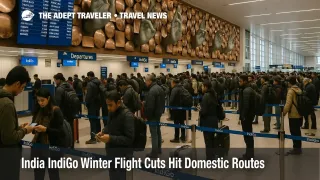
India IndiGo winter flight cuts have shifted from a short term patch to a season long constraint, after orders issued on December 9, 2025 locked a 10 percent reduction into the carrier's winter schedule across domestic routes. The move comes after at least 2,000 IndiGo services were cancelled in a week, with cancellations peaking at roughly 1,600 on December 5 and on time performance briefly collapsing into single digits. For travelers, that means fewer departure time options and tighter seat availability from major hubs such as Indira Gandhi International Airport (DEL), Chhatrapati Shivaji Maharaj International Airport (BOM), Kempegowda International Airport (BLR), and Rajiv Gandhi International Airport (HYD). The practical response is to book earlier than usual, allow bigger buffers around India domestic segments, and seriously consider rival airlines or rail on key corridors instead of assuming IndiGo will always be the easiest choice.
In plain language, India IndiGo winter flight cuts are a regulatory attempt to swap frequency for predictability, aligning IndiGo's schedule with what it can realistically operate under new crew rest rules while dozens of aircraft remain grounded for engine inspections. The government and the Directorate General of Civil Aviation, or DGCA, want fewer last minute scrubs and stranded bags, even if that means more sold out flights and a longer search for workable itineraries.
From rolling chaos to a codified 10 percent cut
The December disruption began when IndiGo failed to adjust its roster to new Flight Duty Time Limitation rules that took full effect on November 1, limiting night landings and lengthening weekly rest. As crew buffers vanished, the carrier cancelled hundreds of flights per day, leaving tens of thousands of passengers stuck at airports across India and forcing regulators to grant temporary exemptions from some rest rules while also imposing domestic fare caps.
At first, authorities framed the response as a short term reboot. IndiGo itself said that cancellations would concentrate over several days while it "scaled down" operations and then rebuilt the timetable. The DGCA also approved a winter schedule of 15,014 weekly IndiGo departures, assuming that more than 400 aircraft would be available and that the airline could still grow capacity by several percent over the previous winter. In reality, IndiGo cancelled 951 flights in November alone and then scrapped at least 2,000 more in the first week of December, revealing how far its actual operating ability lagged behind its approved plan.
That gap prompted a pivot from temporary waivers to structural cuts. On December 9, the aviation minister said IndiGo's winter schedule would be curtailed by 10 percent, up from an initial 5 percent instruction, and that the freed slots would be handed to other carriers able to operate them reliably. IndiGo subsequently confirmed that it had received a DGCA notice directing a 10 percent reduction across its domestic winter schedule, with a focus on high frequency routes where rivals also fly and an explicit goal of avoiding cuts on monopoly sectors. No firm end date was given, which in practice means the reduction could shadow the entire winter season through late March.
A constrained fleet and reallocated slots
The enforced winter cut lands on top of IndiGo's existing aircraft on ground problem. The airline has had roughly 70 aircraft out of service due to Pratt and Whitney geared turbofan engine inspections and supply chain issues, plus broader delays in new deliveries, which has limited its ability to add spare capacity or quickly swap equipment. When a carrier that already controls more than 60 percent of India's domestic market loses both aircraft and crew headroom, even a 10 percent schedule reduction can feel larger on certain days and routes.
Regulators are trying to make sure the pain does not fall solely on passengers. The DGCA has directed IndiGo to cut flights on sectors where competitors operate and to keep single flight sectors intact, which should protect thin routes to smaller cities from being stripped of service. Authorities have also signaled that released slots will be offered to other airlines such as Air India, Vistara, and Akasa, at least on the busiest metro to metro corridors, so that overall domestic capacity does not collapse for the season.
For travelers, this means that a cancelled or retimed IndiGo service between two big cities may have a replacement option on another carrier, sometimes at capped fares, but that those seats will not stay cheap or available for long. On secondary routes, where IndiGo is the only operator or dominates capacity, the 10 percent reduction is more likely to appear as a thinning of frequencies and fewer departure time choices rather than as outright loss of service.
Oversight, fare caps, and how this differs from earlier chaos
The new phase of the IndiGo disruption is also defined by closer day to day oversight. Reuters and Indian outlets report that DGCA personnel have been deployed to IndiGo's headquarters to monitor crew utilisation, schedule changes, baggage backlogs, and refunds, and to demand daily operational reports. That is a far more intrusive stance than typical slot management, and it signals that regulators are trying to rebuild public confidence while keeping political pressure on the airline.
Fare caps and refund rules remain another layer in the system. Existing temporary caps on one way economy fares, set by distance band, are meant to prevent rivals from exploiting the crisis by pushing last minute prices into the stratosphere when passengers are forced off IndiGo and onto alternate carriers. Indian passenger charter rules still require airlines to provide meals, accommodations, refunds, and in some cases cash compensation when cancellations stem from operational failures, although enforcing those rights can take persistence.
The key difference from early December is that IndiGo's winter flight cuts are now baked into a revised schedule rather than emerging day by day. That should reduce the risk of waking up to a same day cancellation on a flight that looked normal the night before. It also means that the overall domestic system will operate with less slack through peak travel periods such as Christmas, New Year, and the January school holiday season.
How this interacts with earlier Adept Traveler coverage
This article updates and extends our earlier piece, India IndiGo Flight Cancellations Hit Domestic Hubs, which focused on the immediate wave of cancellations, fare caps, and temporary rest rule exemptions. Taken together with India Domestic Flight Cancellations Disrupt Travel and India Fare Caps After Domestic Flight Chaos, the picture that emerges is of a system that will be under structural strain for weeks rather than days.
For readers planning trips into or within India, it may also be worth cross checking plans against our evergreen India Entry Requirements And New E Visa guide, since any schedule change that pushes journeys across borders or into new transit points can complicate visa and document requirements.
Practical strategies for winter itineraries
If you already hold IndiGo tickets for winter 2025 to 2026, the first step is to review every booking in your account and in your confirmation emails, paying attention to any retimed or reprotected segments. Many passengers will find that original departures have been shifted to different times or paired with new connections, in some cases with tighter margins than are comfortable for self managed long haul links.
On metro to metro routes such as Delhi to Mumbai, Delhi to Bengaluru, or Mumbai to Hyderabad, compare revised IndiGo timings with options on other airlines using the freed slots. Given the 10 percent schedule cut, likely reductions of at least 220 daily IndiGo flights from pre crisis levels, and ongoing engine related aircraft groundings, you may decide that moving to a competitor is worth a modest fare difference if it yields a simpler or earlier itinerary.
For travelers stitching together domestic legs with long haul flights, the safest posture for the rest of winter is to avoid self connecting on IndiGo with a same day long haul departure, especially to Europe, the Gulf, or Southeast Asia. Where possible, book true through tickets on a single airline group or alliance, or plan overnight stopovers in hub cities so that an IndiGo retime does not cascade into a missed international flight.
Rail remains an underused pressure valve. On some busy domestic corridors, especially under 800 kilometers, premium trains can substitute for a canceled or heavily retimed flight without adding as much stress as squeezing into the last seats on another airline. This was already visible earlier in the disruption when Indian Railways added special trains to clear backlogs on key routes, and similar rail based workarounds will remain relevant as the winter schedule cut plays out.
Finally, treat mid January through February as a period where conditions might improve but not fully normalise. IndiGo has talked about stabilising operations by early February, but full compliance with rest rules, recovery of grounded aircraft, and rebalancing of crew rosters will not happen overnight. Build flexibility into any complex India itinerary, keep an eye on official IndiGo and DGCA updates, and be prepared to rework plans if further adjustments are announced.
Sources
- India orders IndiGo to cut 10% of flights after mass cancellations, Reuters
- India deploys personnel at IndiGo headquarters after mass flight cancellations, Reuters
- 5% cut, government finally aligns IndiGo flights with airline's operating ability, Times of India
- Government will curtail IndiGo's winter flight schedule, slots will be reallocated to other carriers, Deccan Herald
- IndiGo winter schedule to be cut back, slots to go to other airlines, Business Today
- Why are IndiGo flights grounded, Greater Kashmir
- India's airlines plan 3% more flights for winter 2025, AirInsight
- IndiGo flights delayed nationwide by new pilot rostering rules, Mint
- 2025 IndiGo disruption, Wikipedia
- IndiGo fleet, Wikipedia
- India IndiGo Flight Cancellations Hit Domestic Hubs, Adept Traveler
- India Fare Caps After Domestic Flight Chaos, Adept Traveler
- India Domestic Flight Cancellations Disrupt Travel, Adept Traveler
- India Entry Requirements And New E Visa, Adept Traveler