

Flight Delays and Airport Impacts: December 20, 2025
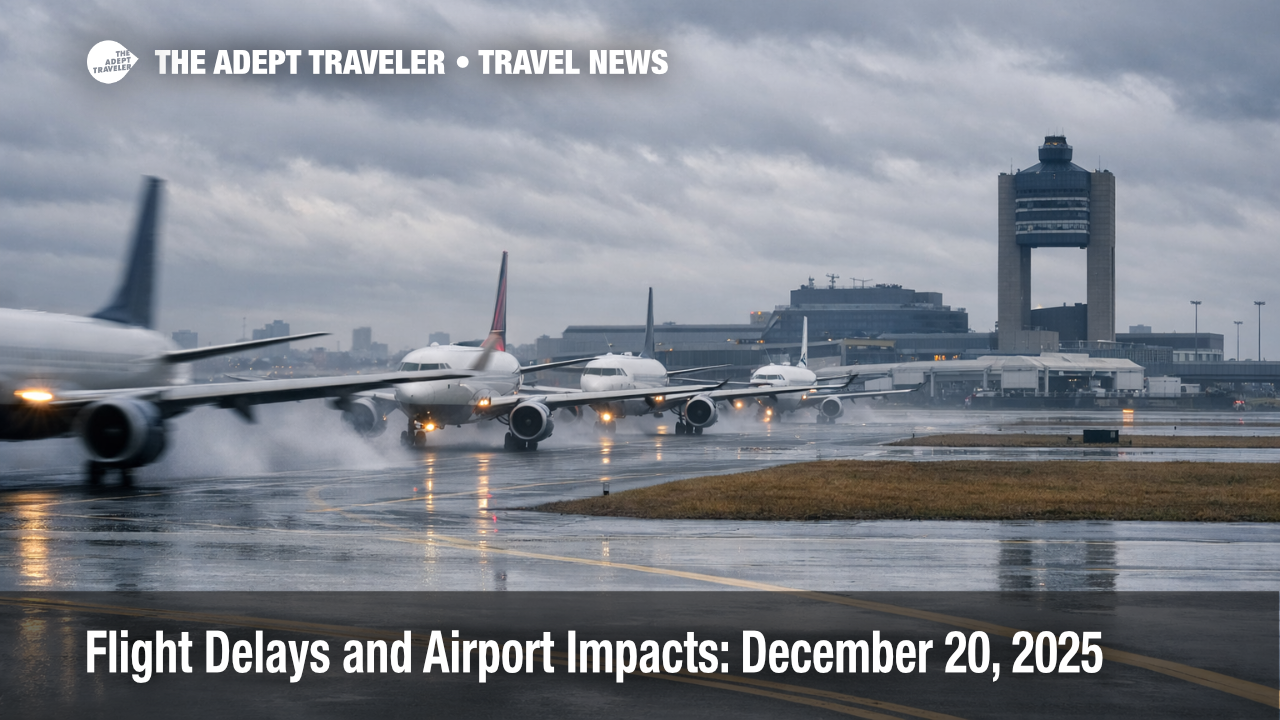
FAA air traffic managers entered December 20 with a weather and volume setup that can turn ordinary schedules into rolling delays across multiple regions. The FAA Command Center's operations plan flagged wind as a terminal constraint for Boston and the New York metro airspace complex, plus Newark and Denver, while low ceilings were listed for San Francisco and Los Angeles. Travelers most exposed are those connecting through these hubs during peak holiday banks, or anyone stacking tight onward flights, shuttles, or same day drives that cannot absorb late arrivals.
The practical change is that the FAA delay outlook US airports picture is less about one closed airport and more about several high leverage constraints happening at once, which is when missed connections, late aircraft turns, and crew timeouts become the dominant failure mode.
The FAA plan also showed active and planned traffic management initiatives that can widen disruption even if your specific origin is reporting only minor delays at a given moment. A ground delay program was active for College Station, Texas, through 1059 a.m. CST on December 20, 2025 (1659 UTC), and a ground delay program for Aspen was active early, through 159 a.m. CST (0759 UTC). The plan also listed possible ground stop or delay program activity for Denver through 100 p.m. CST (1900 UTC), for Teterboro and Palm Beach through 600 p.m. CST (0000 UTC on December 21), and for San Francisco through 900 p.m. CST (0300 UTC on December 21).
Even where real time status pages are showing "15 minutes or less" at check time, the listed constraints explain why the risk can rise quickly once arrival rates are cut and inbound aircraft start arriving late into gate constrained hubs. As of the FAA status updates posted at 915 a.m. CST to 945 a.m. CST on December 20, 2025, Boston Logan, Newark, Kennedy, LaGuardia, Denver, San Francisco, and Los Angeles were each reporting general delays of 15 minutes or less, which is consistent with a day that can still deteriorate later as wind, ceilings, and demand peak.
For continuity on how these winter constraints propagated into connection risk on Friday, see Flight Delays and Airport Impacts: December 19, 2025. If you are routing through Colorado and pairing flights with same day mountain transfers, High Winds Denver Airport Delays, I 70 Transfer Risk is the better playbook for the ground side of the problem.
Who Is Affected
Travelers connecting through General Edward Lawrence Logan International Airport (BOS), John F. Kennedy International Airport (JFK), LaGuardia Airport (LGA), and Newark Liberty International Airport (EWR) are the most exposed to wind driven spacing cuts because these airports share tightly coupled airspace and arrival streams, and a reduction at one airport can quickly spill into the others. Business travelers and leisure travelers moving through Teterboro Airport (TEB) face a similar exposure because programs there often reflect pressure across the New York metro system, not just the field itself.
Colorado travelers are in the second highest risk bucket because the FAA plan called out wind constraints for Denver International Airport (DEN) and also highlighted ski country volume and winter weather constraints in the Denver Center ski corridor. This matters most for itineraries that depend on a same day connection into mountain airports, or for trips where a late arrival in Denver immediately breaks a fixed drive, shuttle, or hotel check in window.
West Coast flyers connecting through San Francisco International Airport (SFO) and Los Angeles International Airport (LAX) should treat low ceilings as an arrival rate problem that becomes a gate and departure problem later. When spacing increases on arrivals, gates stay occupied longer, which pushes departure holds, compresses later banks, and creates the familiar pattern where the disruption feels "sudden" even though it is really a queue that has been building for hours.
Finally, travelers heading toward Florida and the Caribbean should expect flow management initiatives to show up as delayed departures at their origin airport, not necessarily at the destination. The FAA plan listed multiple en route flow programs and holiday routing initiatives, plus a long runway closure note at Palm Beach that reduces operational flexibility once the system is under stress.
What Travelers Should Do
Start by protecting the critical path of your itinerary, not the "published" connection time. If you are transiting Boston Logan, Kennedy, LaGuardia, Newark, Denver, San Francisco, or Los Angeles, build extra buffer before the first domino falls, keep an alternate routing ready that avoids the most constrained hub in your journey, and assume that same day ground transfers after a late afternoon arrival are optional once delays begin stacking.
Use a clear threshold for rebooking versus waiting. If your first leg delay pushes your connection below 60 minutes at a major hub, or below 90 minutes when winter operations are plausible anywhere in the chain, it is usually time to act rather than hope the schedule "catches up," because wind and low ceiling days fail through gate occupancy, aircraft rotation slippage, and crew legality, not just a single late departure.
Over the next 24 to 72 hours, monitor three things that typically move before airline customer facing updates. Watch the FAA Command Center operations plan and any posted ground delay programs or ground stops, track your hub's real time status page for changes in general arrival or departure delays, and keep an eye on construction and runway constraint notes at airports in your itinerary, because reduced flexibility turns small weather driven arrival rate cuts into larger, longer recovery cycles.
Background
The FAA's daily planning posture is best understood as a network stress test. Wind and low ceilings do not have to close an airport to disrupt travel, they simply have to reduce the safe number of arrivals per hour at a hub that feeds hundreds of downstream departures. The first order effect shows up as metered arrivals and longer gate occupancy, which then produces departure holds and late turns as aircraft wait for gates or crews wait for inbound airplanes.
Those first order constraints quickly become second order ripples across the travel system. When Boston and the New York metro complex run below normal arrival rates, misconnect risk rises at far away origin airports because departures are held for flow, aircraft rotations slip, and available rebooking inventory disappears faster during holiday demand. When Denver is constrained, ski country volume makes the problem worse because there are fewer alternates and fewer "spare" seats to absorb missed connections, and disrupted arrivals can also break planned road transfers into the mountains.
Construction and runway limits add a third layer that travelers often miss. A runway closure note at LaGuardia or Chicago Midway may be routine on a clear day, but it becomes a major resilience issue when weather reduces margins and the system needs extra flexibility to recover. In practice, this is how a day with modest, early delays can still produce a late afternoon wave of cancellations and misconnects, even when the initial weather looks manageable.
Sources
- Current Operations Plan Advisory, ATCSCC ADVZY 079 DCC 12/20/2025
- General Edward Lawrence Logan International Airport (BOS) Real-time Status
- Newark International Airport (EWR) Real-time Status
- John F Kennedy International Airport (JFK) Real-time Status
- La Guardia Airport (LGA) Real-time Status
- Denver International Airport (DEN) Real-time Status
- San Francisco International Airport (SFO) Real-time Status
- Los Angeles International Airport (LAX) Real-time Status
- Teterboro Airport (TEB) Real-time Status