

Northeast Winter Storm Flight Delays Raise Misconnect Risk
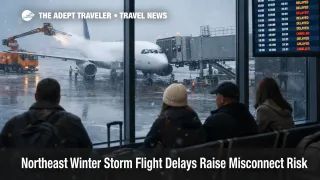
Winter storm warnings and renewed late week snow and mixed precipitation risk across parts of the Northeast are being messaged in explicitly travel relevant terms, and that changes how travelers should treat tight connections during peak holiday loads. Travelers connecting through John F. Kennedy International Airport (JFK), LaGuardia Airport (LGA), Newark Liberty International Airport (EWR), Philadelphia International Airport (PHL), and Boston Logan International Airport (BOS) are most exposed because deicing and reduced runway throughput can quickly break connection banks. The practical move is to shift to earlier departures, increase connection buffers, and use airline waivers quickly when they appear so rebooking happens before inventory is gone.
The change that matters for planning is that this is not just a busy travel period, it is a weather constrained travel period. Northeast winter storm flight delays raise misconnect risk because even modest snow can force deicing queues, slow taxi times, and arrival rate reductions that ripple outward into downstream crews, aircraft rotations, and already full later flights.
Operationally, travelers should treat Friday evening, December 26, 2025, into Saturday morning, December 27, 2025, as the highest exposure window for connection failures, especially for itineraries that rely on the last protected option of the day. Even where total snowfall is not extreme, the combination of timing, deicing friction, and holiday load factors is what turns a normal delay day into a reaccommodation problem.
For continuity on how quickly FAA traffic management and snow and ice turn times can cascade through the network, see Flight Delays and Airport Impacts: December 23, 2025 and the broader demand backdrop in U.S. Holiday Travel Forecast: Dec 20 To Jan 1.
Who Is Affected
Travelers are most affected when their itinerary touches Northeast hubs during a compressed schedule. That includes same day domestic connections through Newark Liberty and the New York City airports, transatlantic arrivals that must clear immigration and recheck bags before a short domestic hop, and any plan built on a short final leg into regional airports that have fewer alternates.
Road and rail travelers are also in the blast radius because mixed precipitation changes transfer math. A normal two hour airport drive can become a missed bag drop or missed boarding event when plows, crashes, and reduced speeds hit interstate approaches, and that risk spikes when the last flight of the day is the only realistic option.
Travelers on separate tickets face a different failure mode. When the first leg arrives late, the second ticket is not protected, and in a holiday week there may be no same day seat to buy at any price, which can force an unplanned overnight near the hub even if the weather is improving by morning.
What Travelers Should Do
Act fast on the pieces that are easiest to control. If a waiver applies to your origin, destination, or connection city, use it to move off tight connections and off the last flight of the night, and keep the new itinerary earlier in the day where there is more operational slack.
Use clear decision thresholds instead of hoping the schedule holds. If your connection through Newark Liberty, Kennedy, LaGuardia, or Philadelphia is under two hours during the late day peak, or if a delay pushes you past your last protected connection bank, rebook rather than wait, because reaccommodation seats disappear quickly once cancellations begin.
Over the next 24 to 72 hours, monitor three things that predict whether the system is stabilizing or sliding. First, watch whether winter weather advisories or warnings expand south and west toward the I 95 corridor, and whether the forecast shifts from mostly snow to mixed precipitation. Second, watch for airport acceptance rate reductions and gate holds, which usually show up before widespread cancellations. Third, watch whether your inbound aircraft is running behind early in the day, because late aircraft plus deicing is the common path to a missed evening connection.
Background
Winter weather disrupts air travel through a few repeatable mechanisms that compound each other. Snow and ice force deicing, which adds queue time at gates or on dedicated pads, and that can turn a 20 minute turn into a 60 to 120 minute turn when equipment, fluid, or ramp staffing is constrained. At the same time, visibility, braking action, and plowing cycles can reduce runway arrival rates, which forces air traffic control, ATC, to meter traffic into hubs, creating waves of late arrivals that collide with already tight connection banks.
Those first order effects propagate outward fast in the Northeast because major hubs are close together and share aircraft and crew rotations. When one hub slows, airlines often protect the next morning schedule by trimming late evening flying, which shifts the disruption from delays into cancellations, and that is when misconnect risk spikes and hotel inventory tightens around the airports. That is also why waivers matter, they move traveler demand earlier, when there are still seats to grab and before airport customer service lines become the bottleneck.