

Venezuela Airspace Warning Disrupts Caribbean Routes
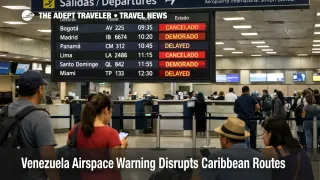
A security advisory tied to Venezuelan airspace is now reshaping flight planning across the southern Caribbean and northern South America, with knock on effects that reach well beyond travelers actually headed to Venezuela. The U.S. Federal Aviation Administration, FAA, issued a security advisory Notice to Air Missions, NOTAM, for the Maiquetía Flight Information Region, FIR, advising operators to exercise caution at all altitudes, including during overflight, and requiring U.S. operators to provide advance notice before operating in the region. In practice, airlines and their insurers tend to treat this kind of notice as a reason to reduce exposure, which is why flight plans that used to cross Venezuelan airspace are increasingly detouring around it, and why some Caracas service has been suspended or reshuffled.
What is confirmed is the advisory itself, the time window published with it, and the measurable shift in overflight behavior reported in flight tracking analysis and major media coverage. What remains uncertain, and therefore disruptive for travelers, is how long the underlying drivers persist, whether the advisory is extended or replaced, and how quickly airlines rebuild schedules after weeks of reactive adjustments. That uncertainty is the problem for travelers, because it turns normal, tight regional timings into a fragile chain where a single reroute can push a connection past the point of recovery on a full holiday week.
The immediate connectivity pinch point is Simón Bolívar International Airport (CCS) near Caracas, Venezuela, because schedule reliability and foreign carrier access can change quickly when regulatory risk, safety assessments, and politics collide. For the bigger Caribbean planning picture, the more common traveler experience is not a Caracas flight itself, it is a longer sector, a late inbound, and a suddenly tight connection at a regional hub that was built around predictable block times. For background on how this escalated and how it has already altered routings, travelers can reference Venezuela Airspace Warning Reroutes Caribbean Flights and Venezuela Airline Ban Cuts Flights To Caracas.
Who Is Affected
Travelers flying to Venezuela are the most directly exposed, especially those relying on a specific arrival day for family visits, business meetings, or onward domestic connections. When international service is reduced, there are fewer seats to reaccommodate passengers, fewer daily frequencies to absorb missed connections, and fewer airline staffed options when something breaks. That shows up as higher cancellation risk, longer waits for rebooking, and more overnight stays in transit cities.
The second group is travelers who are not going to Venezuela at all, but whose itineraries historically used Venezuelan airspace as the shortest path between the Caribbean and northern South America. When airlines detour, they add minutes that matter, not because a slightly longer flight is inherently a problem, but because it erodes the scheduled connection buffer in hubs that are already operating at holiday load factors. Tocumen International Airport (PTY) in Panama City, Panama, and El Dorado International Airport (BOG) in Bogotá, Colombia, are common bridge points in this network, so passengers connecting there feel the impact quickly when inbound flights arrive late, gates change, or crews run out of legal duty time.
A third group is travelers with time locked trip elements, especially cruises, tours, and resort stays where missing embarkation or a first day transfer effectively ruins the value of the booking. If your Caribbean trip depends on a same day arrival into an island gateway, a single missed connection can cascade into a forced overnight, a missed sailing, or a lost tour departure, while hotel availability tightens around hubs that are absorbing disrupted passengers. Even when airlines ultimately transport you, the cost and friction of getting back on track rises sharply when the region is operating with reduced redundancy.
What Travelers Should Do
Start by confirming what you are actually ticketed on, not what you originally booked. Check your airline app for aircraft routing notes, block time changes, and connection timing, and then compare your current connection time against a more conservative buffer. If your itinerary involves Panama City or Bogotá, treat tight connections as the primary failure point and proactively move to an earlier departure or a longer layover while alternate seats still exist.
Use a simple threshold for rerouting versus waiting. If you must arrive on a specific day, for a cruise, a wedding, a border crossing appointment, or the last viable holiday travel window, reroute now through the most stable, highest frequency hubs you can find, even if it costs more, because same day recovery options shrink fast once irregular operations begin. If your trip is flexible by one to two days, postponing can be the smarter play than gambling on a fragile chain, because the system strain comes from uncertainty, not from a single, predictable closure window.
Over the next 24 to 72 hours, monitor three things: whether the advisory environment changes, whether airlines extend or deepen suspensions to Caracas, and whether overflight detours become the new steady state schedule rather than an ad hoc exception. Watch for airline travel waivers, recurring flight number cancellations, and pattern changes in arrival times into your connecting hub, because those signals tell you whether to keep waiting or to lock in a safer routing. If you want broader context on why rebooking options are so constrained in peak periods, FAA Delays on Boeing 737 MAX 10 Hit Airline Capacity is a useful explainer on how fleet bottlenecks amplify disruption recovery.
Background
A security advisory NOTAM is not the same thing as an outright closure, but it is a high signal warning to operators and insurers that risk has increased. In this case, the notice covers the Maiquetía FIR, which is the airspace control region that includes Venezuela and its approaches, and it explicitly frames risk at all altitudes, including overflight. The operational detail matters because airlines can avoid landing in Venezuela yet still be affected if a shorter path between city pairs normally crosses Venezuelan airspace.
One key technical driver cited in public reporting around this episode is global navigation satellite system, GNSS, interference, which includes degradation of GPS based navigation and can raise workload and risk during normal operations, especially if combined with military activity in or near civilian air routes. Even when flights remain safe, the airline response to that risk often looks like longer routings, schedule padding, and, in some cases, suspensions while risk teams reassess. Those first order changes then ripple into the travel system through later arrivals, gate conflicts, missed connection banks, crew legality constraints, and reduced reaccommodation capacity, which is why a Venezuela airspace warning can disrupt a Caribbean itinerary that never goes near Caracas on a map.
The situation also has a policy and connectivity layer. Industry groups have urged Venezuelan authorities to preserve connectivity and provide clarity after permit actions tied to carriers that suspended service following safety advisories. For travelers, the practical takeaway is that politics can harden operational decisions, so even if the technical driver improves, route restoration can lag, and the safest assumption for planning is that reduced redundancy persists until airlines publish stable schedules again. That is why the Venezuela airspace warning should be treated as a routing and reliability constraint, not just a headline about one country.
Sources
- KICZ A0012 25 Advisory NOTAM for SVZM FIR (PDF), FAA
- FAA warns all pilots of risks of flying over Venezuela, AP News
- Venezuela revokes flight rights for six airlines amid escalating US tensions, Reuters
- Flights avoid Venezuelan airspace as tensions build, Reuters
- IATA Calls on Venezuelan Government to Reconsider Decision to Revoke Airline Operating Permits, IATA
- US issues security NOTAM for Venezuelan airspace, Flightradar24