

Devin, Ezra Great Lakes Flights Disruptions Dec 28-30
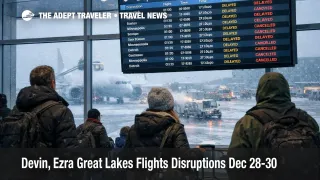
Winter storm disruption is not clearing cleanly across the Great Lakes and the Northeast, because Winter Storm Devin's Friday, December 26, 2025, cancellation wave is still echoing through aircraft rotations, crew legality, and gate plans. Travelers moving Sunday, December 28, through Tuesday, December 30, should plan for continued cancellations, missed connections, and ground transport failures, because a second system, Winter Storm Ezra, is forecast to rapidly strengthen Sunday night, then track Great Lakes to the Northeast through Tuesday. The practical move is to assume your first plan will not hold, build time buffers, and make rebooking decisions using FAA traffic management signals and airline waiver coverage, not hope.
Devin Ezra Great Lakes flights are at elevated risk because recovery days remove slack, and Ezra's snow, wind, and icing can hit the same hubs before crews and aircraft are fully reset.
Who Is Affected
Travelers whose itineraries touch major Great Lakes hubs and spokes are the first tier, including Chicago O'Hare International Airport (ORD), Chicago Midway International Airport (MDW), Minneapolis St. Paul International Airport (MSP), and Detroit Metropolitan Wayne County Airport (DTW). When Ezra loads snow and wind into these corridors, the failure mode is not only local cancellations, it is also delayed inbound aircraft that arrive late, occupy gates, and push the next departures into crew duty limits.
The second tier is the Northeast network, especially connection flows that rely on the New York and Boston airspace complex, including Newark Liberty International Airport (EWR), John F. Kennedy International Airport (JFK), LaGuardia Airport (LGA), Boston Logan International Airport (BOS), and Philadelphia International Airport (PHL). Even if your ticket does not route through the storm core, you can inherit disruption when your inbound aircraft starts its day in a constrained hub, or when air traffic control metering programs throttle arrivals and force departure holds at origin.
Road and rail dependent travelers are also exposed, particularly where icing overlaps the Monday morning commute in interior New England and where lake effect bands reduce visibility around the Great Lakes. When roads degrade, airport staff call outs rise, curb congestion worsens, and hotel, rental car, and rideshare availability tightens, which can turn a delay into an unplanned overnight even if flights keep operating. For context on how quickly New York area constraints can compound into misconnects and rebooking scarcity, see Northeast Winter Storm Delays New York Flights Dec 26 27.
What Travelers Should Do
If you are traveling Sunday or Monday, treat earlier departures as structurally safer, because they preserve options before afternoon and evening metering programs expand and before inbound aircraft lateness stacks up. Pack as if you will be separated from checked bags, and plan ground access as a separate risk item, because icing can break last mile reliability even when the runway is open. If you can shift to nonstop routings, do it, because each additional connection multiplies the ways recovery day operations can fail.
Use a clear decision threshold for rebooking versus waiting. If you have a connection under about 90 minutes at a Great Lakes or Northeast hub on Monday, December 29, or if your trip depends on a same day airport transfer, the odds favor proactive changes while seats still exist. If your trip is nonstop and you have flexible lodging, you can wait longer, but the moment your inbound aircraft is delayed or your airline publishes an expanded waiver, you should move, because recovery day reaccommodation can evaporate in minutes when loads are high.
Over the next 24 to 72 hours, monitor three things and let them drive your choices. First, the FAA's traffic management planning for your hubs, because ground delay programs and arrival metering usually precede visible cancellation banks. Second, airline waiver coverage and its affected travel dates, because waivers are the cleanest signal that the carrier expects disruption and will let you move without penalties. Third, icing forecasts and local road conditions for your airport access window, because missed flights from an impassable drive are a self inflicted loss that airlines rarely fix quickly. For a quick refresher on how FAA flow programs show up as passenger delays and missed connections, see Flight Delays and Airport Impacts: December 26, 2025.
Background
Devin's peak impact hit on Friday, December 26, 2025, when widespread winter storm warnings drove a large national cancellation count and heavy delays at New York area airports, which matters now because that disruption displaces aircraft and crews into the wrong cities for the next day's schedule. The recovery phase is where travelers often get trapped, because airlines can run out of legal crews, or they can prioritize repositioning aircraft for later banks, which turns what looks like an ordinary delay into a cancellation that is hard to rebook during holiday demand.
Ezra is forecast to become the next stress test. National forecast guidance highlights an intense cyclone with impacts that span heavy snow and blizzard conditions across the Upper Midwest and Great Lakes, plus freezing rain risk across parts of New England, and strong winds that can reduce effective runway and deicing throughput even after snowfall tapers. That combination is operationally nasty, because snow slows taxi and deicing, wind can force runway changes and spacing increases, and ice can shut down road access and reduce staffing, all at the same time.
The FAA's system planning for Sunday, December 28, 2025, reflects how quickly these weather inputs translate into travel outcomes. FAA traffic management messaging flags the possibility of delay programs at Chicago O'Hare and Chicago Midway late Sunday morning into afternoon local time, and a probable program at Minneapolis St. Paul around late morning local time, with additional Northeast terminal constraints discussed for Philadelphia, New York, and Boston as the day progresses. When those programs execute, the first order effect is controlled departure times and reduced arrival rates at the destination hub, which pushes delays back to origin airports nationwide. The second order ripple is what travelers feel most, compressed connection banks that increase misconnects, overnight hotel demand when last flights cancel due to crew duty limits, and seat scarcity on alternate routings that can persist 48 to 72 hours after weather improves. If you want deeper context on why the FAA constraint layer can continue to bite even after the snow stops, see U.S. Air Traffic Control Privatization: Reality Check.
Sources
- FAA Air Traffic Control System Command Center, Current Operations Plan Advisory (12 28 2025)
- NOAA NWS Weather Prediction Center, Short Range Forecast Discussion (12Z Dec 28 2025 to 12Z Dec 30 2025)
- NOAA NWS Weather Prediction Center, Probabilistic Heavy Snow and Icing Discussion (Dec 28 2025)
- The Weather Channel, Winter Storm Ezra To Impact Midwest, Northeast
- Reuters, U.S. airlines cancel over 1,000 flights due to winter storm Devin (Dec 26 2025)