

Flight Delays and Airport Impacts: December 28, 2025
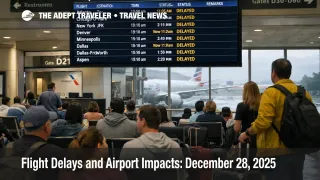
FAA traffic management planning is signaling a higher risk day for scattered U.S. hubs and the Rockies ski corridor, even though many airports are still reporting minimal baseline delays. Travelers connecting through Chicago O'Hare International Airport (ORD), Minneapolis Saint Paul International Airport (MSP), and ski gateways, including Aspen Pitkin County Airport, Sardy Field (ASE), are the most exposed to controlled departure times that can appear suddenly as the day's weather and volume constraints mature. The practical move is to avoid tight connections, favor earlier flights when possible, and build buffer for gate holds that may be assigned before you ever push back.
U.S. airport delays December 28 matter because the FAA can shift delay time from the destination to the origin using traffic management initiatives, which means a flight can look fine on an airline app until an arrival meter assigns a controlled departure time.
Miami International Airport (MIA) is already showing a traveler visible signal. The FAA is reporting departure gate hold and taxi delays in the 16 to 30 minute range tied to traffic management initiatives and volume, which is a classic setup for missed connections when a short delay becomes a longer sequence at a downstream hub.
Who Is Affected
Travelers flying to, from, or through Miami International Airport (MIA) are the most immediately exposed, especially on itineraries that depend on short domestic connections or same day international links. Gate holds at Miami tend to push departures into later banks, which then increases competition for reroutes when downstream flights fill.
Midwest travelers and anyone connecting through Chicago O'Hare International Airport (ORD) and Chicago Midway International Airport (MDW) face a different failure mode. The FAA planning posture highlights low ceilings, reduced visibility, wind, and thunderstorms in the Chicago area, and it flags a possible shift toward ground stop or delay program tactics after 9:00 a.m. CST (1500Z). When Chicago arrival rates fall, the network impact is rarely local, because aircraft and crews rotate through Chicago across multiple legs.
Ski trips are the most fragile category today. Aspen Pitkin County Airport, Sardy Field (ASE) is in an active ground delay posture in the FAA planning window, and Eagle County Regional Airport (EGE) is flagged for possible ground stop or delay program tactics as well. These markets have fewer alternates, fewer later flights, and more expensive last mile logistics, so even a moderate arrival meter can turn into missed shuttles, missed check in windows, and difficult same day recovery.
For broader context on how holiday volume days can turn into assigned gate holds and misconnect cascades, see Flight Delays and Airport Impacts: December 26, 2025. Travelers still moving through the Northeast after the December 26 to 27 storm should also review Northeast Winter Storm Delays New York Flights Dec 26 27, because recovery days can remain connection fragile even when local weather improves.
What Travelers Should Do
Start with immediate actions and buffers. Before leaving for the airport, check your airport's FAA status page and your airline app for waivers, then plan for a gate hold even if the departure board looks normal. If your trip touches Miami, Chicago, Minneapolis Saint Paul, Aspen, or Eagle County, add extra time for bag drop, security, and a possible hold at the gate that can begin after boarding.
Use clear decision thresholds for rebooking versus waiting. If your connection is under 90 minutes through a hub that is flagged for a probable ground stop or delay program window, or if a developing delay would push you onto the last flight of the night, rebook early while seats still exist. If you have multiple protected later options the same day and your itinerary does not rely on a last mile transfer that closes early, waiting can be reasonable, but only if you can absorb a second delay after landing.
Over the next 24 to 72 hours, monitor whether today's constraint set repeats into the next morning bank. Watch for any conversion of "possible" planning language into active programs at Chicago, Minneapolis Saint Paul, and ski airports, and watch whether Florida flow programs expand as seasonal volume peaks. If you are flying into a ski market, also monitor road conditions and late arrival transfer options, because an airport meter often becomes a ground transport problem after you land.
Background
The FAA Air Traffic Control System Command Center manages national demand through traffic management initiatives that keep arrival flows within safe limits when capacity drops due to weather, runway configuration, equipment, or demand. A ground delay program typically meters arrivals by assigning expected departure clearance times, so flights wait at their origin airports instead of stacking in airborne holding, and that is why your delay can show up before pushback even when the destination still looks marginally workable.
This kind of disruption propagates through the travel system in layers. First order impacts occur at the constrained airport, where arrival rates drop, gates stay occupied longer, and departures inherit late turns. Second order ripples spread through connections and crew flow because the same aircraft and crews operate multiple legs across different cities, so a late arrival into Chicago or a metered arrival into a ski airport can degrade schedules at unrelated airports later in the day. A third layer shows up off the aircraft, where late arrivals collide with limited late night ground transport, rental car counter hours, and hotel inventory, especially in thin ski markets and during holiday travel loads.
Sources
- Current Operations Plan Advisory (ATCSCC ADVZY 071 DCC 12/28/2025)
- FAA Airport Status, Miami International Airport (MIA)
- ATCSCC Flight Delay Information, Southeastern States
- FAA Airport Status, Aspen Pitkin County Airport, Sardy Field (ASE)
- FAA Delay Information, Chicago O'Hare International Airport (ORD)
- FAA Delay Information, Minneapolis Saint Paul International Airport (MSP)