

JAL JFK Flight Delays Roll Into January
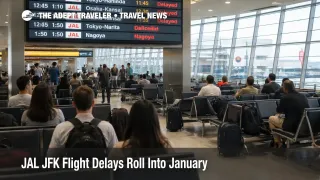
Japan Airlines is warning of ongoing long haul disruption after one of its Airbus A350-1000 jets was damaged on the ground at John F. Kennedy International Airport (JFK) in New York, New York. Passengers on select Japan Airlines flights between Tokyo, Japan, and New York, Dallas, Chicago, London, England, and Paris, France are the most exposed, with cancellations and aircraft swaps extending into January. Travelers should confirm whether their specific flight numbers are listed in JAL's latest impact update, then adjust connections and hotel plans before limited long haul inventory tightens.
The JAL JFK flight delays matter because the aircraft involved, registration JA10WJ, is out of service until repairs are completed, and widebody spare capacity is limited. In a press memo, JAL said that at about 12:40 a.m. on December 14, 2025, a towed Airbus A330 operated by another airline contacted the parked JAL aircraft at JFK, damaging cockpit windows and other areas. JAL said the aircraft cannot be used for flight operations until maintenance is completed, and that it will publish rolling operational impacts as it works through the fleet constraint.
In its operations update, current as of 1100 a.m. Japan Standard Time on December 24, 2025, JAL listed two major delays on December 24, 2025 Tokyo International Airport (HND) to Dallas Fort Worth International Airport (DFW) flight JL012 (5 hours 45 minutes), and the return JL011 (5 hours 5 minutes). For late December and January planning, JAL listed cancellations on specific dates for New York to Tokyo flight JL005 and Tokyo to New York flight JL006 on December 31, 2025, and January 12, 22, 24, and 30, 2026. JAL also listed cancellations affecting Tokyo and other long haul markets, including dates tied to Tokyo and Chicago, London, and Paris service in January.
JAL also listed a replacement operation after a London cancellation, flight JL8044 from Heathrow Airport (LHR) to Tokyo International Airport (HND) on December 24, 2025, as a replacement for JL044 on December 23. On other days, JAL's mitigation relies on aircraft substitutions that can change seat maps and cabin products, including JL011 and JL012 switching from the Airbus A350-1000 to a Boeing 777 on December 25, 27, and 29, 2025, plus January 2, 4, 6, and 8, 2026. The same update also shows knock on aircraft changes on other routes in early to mid January, a signal that the disruption is being managed across the broader network, not just on the New York rotations.
Who Is Affected
The first tier is anyone ticketed on the exact flight numbers and dates JAL listed in its incident update, particularly travelers whose long haul endpoints are JFK, Tokyo International Airport (HND), Narita International Airport (NRT), DFW, O'Hare International Airport (ORD), LHR, or Charles de Gaulle Airport (CDG). Because these are widebody routes, disruption tends to be high impact when it happens, there are fewer same day alternates, and reaccommodation can take longer when cabins are already full around holiday and early year travel peaks.
The second tier is connecting traffic, especially passengers building separate tickets. A multi hour delay can erase an onward domestic connection in the United States, a timed rail and hotel transfer plan in Tokyo, or a fixed departure such as a cruise embarkation. If your itinerary touches New York, layer in the local system constraints, winter weather and FAA flow programs can amplify missed connection risk at JFK even when the initial trigger is aircraft availability, as shown in Northeast Winter Storm Delays New York Flights Dec 26 27 and Flight Delays and Airport Impacts: December 26, 2025.
What Travelers Should Do
Confirm whether your flight number and date appear on JAL's incident impact page, then recheck your seat assignment after any aircraft change, because seat maps and cabin products can shift. If you must protect a fixed start, such as a cruise sailing or a nonrefundable tour, consider arriving a full day earlier when your trip depends on any listed cancellation date or aircraft change window.
Use a strict decision threshold for rebooking versus waiting, and be stricter on separate tickets than on protected connections. If you have to clear immigration, reclaim bags, and check in again, treat a same day connection as optional, and prefer an overnight. When JAL cancels or significantly delays a JAL operated flight, JAL's published guidance says you may change to an alternate flight or request a refund with no fees, and it notes that refunds for agency booked tickets must be handled through the original point of purchase.
Over the next 24 to 72 hours, monitor updates on JAL's incident page, watch for a late aircraft assignment change in your app, and track any operational constraints at JFK that reduce recovery speed. If you are positioning for a once a week cruise departure or a paid tour start, do not wait for a day of departure surprise, move earlier, or choose a routing that gives you a true fallback option on the same ticket.
How It Works
Long haul schedules are built around tight aircraft rotations, maintenance windows, and crew positioning, so one widebody going offline can echo for weeks. Airlines can cover some of the gap with aircraft substitutions, but that trades into seat and product variability, and it can also reduce cabin inventory, which is why you may see a flight operate but with different seating, different premium capacity, and fewer available reaccommodation options.
The ripple is visible in JAL's own mitigation plan, which spans multiple markets. In addition to cancellations on select U.S. and Europe long haul days, JAL shows substitutions on routes to Dallas, Beijing, and Shanghai Hongqiao as it tries to keep the overall network runnable. Those swaps can push displaced passengers onto later flights, tightening inventory across alliances and non alliance alternatives, and raising the odds of involuntary hotel nights at both ends of the trip.
New York adds a system constraint layer of its own. When the local air traffic control, ATC, complex is saturated, schedule recovery takes longer because arrival slots, gates, and crews are harder to line up, a backdrop discussed in U.S. Air Traffic Control Privatization: Reality Check. In this window, the most reliable traveler strategy is to build time, avoid self transfers, and choose routings where you can be protected when the aircraft plan changes.
Sources
- Impact on Flight Operations Resulting from Contact by Another Airline's Aircraft (As of 11:00 a.m. Japan Time on December 24, 2025)
- Notification of Flight Delays Due to JFK Airport Incident
- If your flight is rescheduled or cancelled
- Involuntary reservation changes and ticket refunds
- Regarding expenses incurred due to flight delays or cancellations on the day of departure
- Refunds