

easyJet France Cabin Crew Strike, January 1, 2026
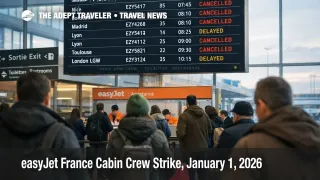
easyJet passengers should brace for a disruption heavy New Year's Day in France after the UNAC union called a one day strike by France based cabin crew for Thursday, January 1, 2026. The highest exposure is on departures and arrivals tied to French crew bases, where a cabin crew staffing gap can force cancellations or late departures even when aircraft and pilots are available. Travelers with tight same day plans should shift now toward backup routings, larger connection buffers, and rail substitutions where practical.
easyJet France strike January 1 2026 introduces meaningful cancellation risk on a peak travel date, and it can also degrade January 2 reliability if aircraft and crews finish January 1 out of position.
Who Is Affected
Travelers flying to, from, or within France on easyJet on January 1, 2026 face the most direct risk, especially on early morning flights that anchor the day's rotations. The Connexion reports expected disruption across French airports including easyJet's six main bases of Paris Orly, Paris Charles de Gaulle, Nice, Bordeaux, Lyon, and Nantes, which makes this more than a single airport problem. First mentions matter because those bases drive where crews start and end duty days: Paris Orly Airport (ORY), Paris Charles de Gaulle Airport (CDG), Nice Côte d'Azur Airport (NCE), Bordeaux Mérignac Airport (BOD), Lyon Saint Exupéry Airport (LYS), and Nantes Atlantique Airport (NTE).
You are also exposed if you are not touching France, but your aircraft rotation does. A delayed inbound from a French base can arrive late to a non French airport, then depart late again, which is how a one day labor action propagates into a wider short haul network.
Finally, anyone running a fragile itinerary is at higher risk than someone taking a single nonstop. That includes separate ticket connections, last train departures after arrival, ski and resort transfers with fixed pickup windows, and cruise or tour departures that behave like hard deadlines. If you need to be in place by a specific time on January 1, assume that rebooking inventory will thin quickly and that airport desk lines can become the limiting factor, not just the flight operation itself. For adjacent New Year disruption context in the region, see Portugal Ground Handling Strike Called Off for New Year, which shows how quickly staffing constraints can translate into missed connections and hotel pressure even when flights technically operate.
What Travelers Should Do
Start by reducing day of fragility. Confirm your flight status repeatedly on December 31, 2025, and again on the morning of January 1, 2026, because strike day schedules often change in waves, and yesterday's on time operation is not evidence of today's. If you can shift to carry on only, do it, because it keeps you mobile if you are rebooked to a different airport, a different time band, or a different day, and it lowers your exposure to baggage delivery delays when staffing is thin.
Use a clear threshold for rebooking versus waiting. If your plan breaks with a delay of about 90 minutes to two hours, for example you have a short connection, a separate ticket, or a timed transfer on arrival, proactive changes are rational while seats still exist. If you are traveling point to point and you have time slack, waiting can make sense because easyJet may still operate much of the schedule, but that only holds if you are willing to arrive materially later, or travel on January 2 or January 3. If your trip is within France, consider substituting high speed rail for short haul segments that have frequent alternatives, since rail can preserve the trip even when air capacity is constrained.
Over the next 24 to 72 hours, monitor three signals that actually predict outcomes. First, whether easyJet publishes a revised January 1 program, since multiple sources noted it had not done so as of December 29, 2025. Second, whether your specific flight is re timed into a different part of the day, because strike impacts often concentrate into early waves and then ripple forward. Third, watch for January 2 knock on issues, because an aircraft that does not complete its January 1 rotation cleanly can start January 2 in the wrong place with a crew that times out. For a broader, evergreen playbook on rights, rerouting logic, and when compensation may apply, see Europe Airport Strikes: Compensation and Re-Routing Guide. For a recent cabin crew strike pattern example in another market, see Heathrow SAS Cabin Crew Strike Dec 24 and 26.
How It Works
A cabin crew strike produces cancellations because each flight must depart with minimum safety staffing, and those crew members are not interchangeable on short notice when they are duty time constrained and physically positioned at specific bases. On a peak holiday travel day, an airline also has less spare capacity to "patch" gaps with standby staff or spare aircraft, so the system tends to fail through cancellations, merged flights, and late aircraft, not through neat, evenly distributed delays.
The first order effect is straightforward: some flights to, from, and within France may not operate, and others may run late due to last minute crew and aircraft swaps. The second order ripple is usually what breaks trips. When a rotation cancels, the aircraft may not arrive to operate its next leg, crews may time out or end the day in the wrong city, and the next morning's departure bank inherits the mess. That is why January 2 reliability can degrade even though the strike itself is only scheduled for January 1, 2026.
This is also why rail and non French hub reroutes matter. If you can shift a France domestic leg to rail, you remove exposure to a constrained short haul seat market. If you are connecting onward within Europe, rerouting through a non French hub can reduce exposure to French base staffing risk, but only if you move early enough that alternate flights still have open seats.
Sources
- EasyJet France strike on January 1: Expect travel disruptions
- Pourquoi votre voyage risque d'être perturbé si vous prenez l'avion le 1ᵉʳ janvier 2026 au départ ou à l'arrivée de Nice
- EasyJet France : l'UNAC maintient son préavis de grève et vise un " objectif zéro décollage " au nouvel an
- Grève évitée à Noël : le SNPNC-FO lève son préavis chez easyJet mais reste en alerte
- easyJet Help: Flight disruptions
- easyJet: Notice of Rights for Delayed or Cancelled Flights
- EUR Lex: Regulation (EC) No 261/2004