

Madrid Barajas Ground Handling Strike Delays Jan 2, 2026
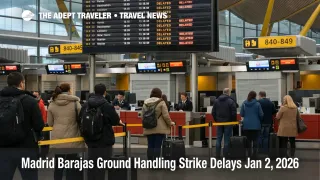
Industrial action by South Europe Ground Services staff is hitting Adolfo Suárez Madrid Barajas Airport (MAD) on Friday, January 2, 2026, with two walkout windows that target peak processing periods. Passengers flying to, from, or connecting through Madrid on airlines that rely on the affected ground handling teams should expect slower baggage flows, longer turnarounds at the gate, and late day schedule knock ons. The practical move for travelers is to shift flights outside the strike blocks when possible, pad connection and curbside time when not, and watch inbound aircraft timing and baggage performance as the earliest sign that the day is sliding.
The Madrid Barajas ground handling strike runs 800 a.m. to 1200 p.m. and 600 p.m. to 1000 p.m. local time, and it is scheduled again on Wednesday, January 7, 2026. Even outside those hours, airports often need time to unwind baggage backlogs and get aircraft rotations back onto their planned sequence, so the late afternoon period between the two blocks can still feel unstable if the morning bank slips.
Iberia is treating the strike as a disruption that can produce delays, and it has published flexibility guidance for certain customers with flights to or from Madrid on the affected dates.
Who Is Affected
The most exposed travelers are those moving through Madrid's Terminal 4 complex, because Iberia's hub operations run through Terminal 4 (T4) and Terminal 4 Satellite (T4S), with check in in T4 and many non Schengen departures operating from T4S. That matters because strike driven friction typically shows up first in check in bag drop, aircraft servicing, and baggage delivery, then spreads into departure banks as aircraft arrive late, bags miss connections, and gates turn later than planned.
Euronews flags that the Madrid ground handling action is expected to mainly affect IAG linked carriers, including Iberia, British Airways, Aer Lingus, and Vueling. Aena's airline pages place British Airways, Aer Lingus, and Vueling check in at Terminal T4, which aligns with the area where travelers will feel the heaviest queueing and bag flow consequences during the strike windows. Aena also lists South Europe Ground Services as the lost luggage handler for British Airways at Madrid, a reminder that baggage issues can persist after you land, not just before you depart.
Travelers are most at risk if they have any of these profiles: a same day international connection with limited buffer, a long haul departure that depends on on time fueling, loading, and pushback, an arrival with a tight onward rail or car pickup, or an itinerary on separate tickets where the next carrier will not protect the connection if the first segment runs late.
What Travelers Should Do
If you are traveling on January 2, 2026, aim to complete any checked bag handoff well before the strike block that overlaps your departure, and keep essentials in carry on in case baggage misses your flight. If your flight is scheduled inside the 800 a.m. to 1200 p.m. or 600 p.m. to 1000 p.m. windows, treat airport processing times as unpredictable, and build extra curbside to gate time even if you already checked in online. If you are connecting from T4 to T4S, assume the transfer and border steps will take longer when earlier flights bunch into the same departure lanes.
For decision thresholds, moving flights outside the strike windows is usually the highest leverage change, because it reduces both the chance of a delayed push and the chance your inbound aircraft arrives late from an earlier rotation. If your connection buffer through Madrid is under two hours, or if you are on separate tickets, rebooking to a longer connection or a different same day departure is typically safer than hoping the day stays contained. If you cannot move, choose seats closer to the front, and keep a backup plan for the onward segment, because the most common failure mode is arriving close to on time but losing minutes on gate availability, baggage transfer, or bus gates.
Over the next 24 to 72 hours, the key indicator for whether January 7, 2026 may be worse or better is how quickly Madrid recovers between the two strike blocks on January 2. Watch your airline app for aircraft assignment and inbound arrival times, because a late arriving aircraft is one of the earliest reliable signals that your departure is at risk even before the departure board reflects it. Also monitor baggage messaging and carousel delays after arrival, because that is a direct read on how constrained ground staffing is, and it often correlates with slower turns at the gates later in the day. If you are eligible for flexibility, act early rather than waiting for airport lines to build.
Background
Ground handling is the behind the scenes system that keeps flights moving on the ground, including baggage loading and transfer, aircraft cleaning, basic servicing, and coordination around pushback and gate timing. When a handling team is short staffed or stopped during a strike window, the first order impact is simple, bags move slower, aircraft take longer to turn, and gate operations become less predictable. The second order ripple is where travelers feel the pain most, because late turns break the planned sequence of aircraft rotations, and that can strand crews out of position, tighten duty time limits, and force later cancellations or consolidations when the schedule can no longer be rebuilt inside the day.
Madrid is a connection heavy hub, so delays here do not stay local. Missed connections create rebooking surges onto later departures, and that compresses seat availability across Spain domestic, Europe short haul, and long haul banks, while also pushing last minute hotel demand in Madrid when travelers must overnight. Ground side, a single late long haul arrival can consume a gate longer than planned and displace other flights, which then increases towing and remote stand use, and that adds bus boarding time and additional staffing needs precisely when staffing is already constrained. That is why even a four hour window can create a full day of uneven performance, and why watching inbound aircraft flow is as important as watching your own flight number.
Sources
- Strike at Madrid Airport
- Latest update of our flights
- New Year travel chaos: All the European airport strikes to expect in December and January
- Iberia at Madrid airport
- British Airways at Adolfo Suárez Madrid-Barajas Airport
- Aer Lingus at Adolfo Suárez Madrid-Barajas Airport
- Vueling at Adolfo Suárez Madrid-Barajas Airport