

Central Europe Icing Halts Vienna, Prague Flights
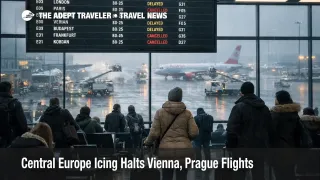
Freezing rain and rapid ice accumulation disrupted flight operations across a tight cluster of Central Europe gateways on Tuesday, January 13, 2026, after runways and taxiways glazed over and refroze during treatment. Travelers moving through Vienna International Airport (VIE), Vaclav Havel Airport Prague (PRG), M. R. Stefanik Airport Bratislava (BTS), and Budapest Ferenc Liszt International Airport (BUD) saw departures delayed, arrivals restricted, and diversions pushed into nearby hubs. If you are traveling today, assume your best outcome depends on early reroutes, longer connection times, and a willingness to overnight in a diversion city rather than trying to "chase" the original schedule.
The Central Europe airport icing event matters because even short runway stoppages in a connected hub cluster break aircraft rotations and crew schedules, which can keep delays and cancellations rolling after conditions improve.
Who Is Affected
Travelers departing Vienna, Prague, Bratislava, or Budapest are directly exposed to cancellations, long ground holds, and late gate changes while airports restore braking action and catch up on deicing throughput. Reuters reported Vienna was closed until at least 11:00 a.m. local time, and that Prague was operating in a "very limited mode," with arrivals restricted while crews worked to deice the main runway and delays expected through the day. Flights inbound to Vienna were diverted to alternates including Munich, Frankfurt, Cologne, and Venice, which is a classic signal that the disruption is not just local, it is already spreading into the wider network.
Connecting passengers are often hit harder than origin and destination passengers in this scenario. When a morning bank is disrupted, airlines protect certain long haul departures first, then cancel short haul feeders or later rotations when the aircraft is in the wrong place. That creates a second wave of misconnects at hubs that were never iced themselves, particularly for travelers routed through Munich or Frankfurt to salvage Central Europe itineraries. Add winter constraints, like limited spare crews, deicing queues, and gate scarcity at diversion airports, and reaccommodation can turn into next day travel even if the weather improves by midday.
Travelers attempting same day ground repositioning are also exposed. Ice events that shut runways often coincide with hazardous road conditions and delayed rail service, so the obvious escape hatches, like driving from Vienna to Bratislava, or taking rail to a different airport, can underperform at the exact moment everyone tries them. Recent winter disruption in Germany shows how rail slowdowns and cancellations can overlap with airport disruptions and remove what many travelers assume is a reliable backup. For regional context, see Frankfurt Airport Flight Cancellations, 102 Flights Jan 12, 2026 and Freezing Rain Germany Cuts ICE Routes January 12, 2026.
What Travelers Should Do
Start with immediate triage and protect optionality. Do not travel to the airport based on a scheduled departure time alone, because icing events create repeated stop start cycles as surfaces refreeze. Check your airline status, your inbound aircraft, and your airport's operational notices, then decide whether you are better off holding where you are, or moving early to a larger alternate hub where your carrier has more flights and staff.
Use a clear reroute threshold instead of waiting in a shrinking seat market. If your itinerary includes a connection of two hours or less, or if you are on separate tickets, treat the plan as fragile once you see arrivals restricted or diversions underway. Rebook when you still have inventory choices, especially if you can move to a single ticket routing via a larger hub, or if you can shift departure to later in the day after the runway backlog clears. If your travel purpose cannot tolerate an overnight, your decision point should be early, not after you have already lost the last practical connection bank.
Over the next 24 to 72 hours, monitor two signals that predict whether disruption lingers into Wednesday, January 14, 2026. First, watch for airport updates about runway conditions, deicing capacity, and whether arrivals remain restricted, because that tells you if the recovery is paced or accelerating. Second, watch the network side, specifically whether your airline starts canceling later rotations or retiming aircraft, which indicates crews and aircraft are still out of position. If you are rerouting through diversion cities, price and book a realistic hotel buffer early, because hotel inventory often tightens fastest in the same cities receiving diversions.
How It Works
Icing disruption is less about snowfall volume and more about surface physics and operational limits. A thin glaze that refreezes after treatment can make braking action unreliable on runways, taxiways, and aprons, and that forces airports to pause or sharply limit movements until conditions stabilize. Reuters described Vienna's problem as a thick layer of ice that kept freezing again after clearing efforts, which is the pattern that produces repeated shutdowns and a slow restart rather than a clean recovery.
The first order effect is immediate, departures stop, arrivals are held or diverted, and aircraft that should have turned quickly remain on the ground. The second order ripple is what travelers feel for the rest of the day, aircraft and crews are stranded away from their next legs, gate plans collapse, and airlines run out of legal duty time for crews, which can trigger cancellations even after a runway reopens. Diversions also push stress into other layers, like baggage handling, rebooking desks, and airport area hotel capacity in the cities absorbing the diverted flights. German wire reporting on Vienna's closure also pointed to normalization taking longer than the initial shutdown, with impacts expected to extend beyond the day of the event as schedules are rebuilt.
In practice, the traveler decision is not only "Is my flight delayed," it is whether the remaining schedule still offers a protectable chain. If your trip relies on tight connections, separate tickets, or a same day onward reservation, your best move is often to trade time for certainty, either by rerouting through a higher frequency hub, or by taking an overnight buffer and departing on the first stable bank the next day.
Sources
- Ice closes Vienna airport, disrupts flights in Prague (Reuters)
- Blitzeis: Betrieb auf Airport Wien zeitweise eingestellt (WELT, dpa)
- Major airports shut across Central Europe amid severe icing: Ongoing disruptions (Air Cargo Week)
- Freezing rain and ice disrupt travel across central and eastern Europe (Associated Press)
- Airports close and flights disrupted across Europe due to icy weather (Sky News)