

Flight Delays and Airport Impacts: January 18, 2026
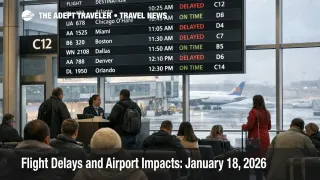
The FAA's air traffic system planners flagged multiple factors that can push delays higher across U.S. routes on January 18, 2026, led by Northeast winter weather planning and scheduled runway work at La Guardia Airport (LGA). Travelers connecting through the New York area and the Northeast corridor are the most exposed if air traffic control initiatives are activated this afternoon and evening. The practical move is to protect connections with extra time, watch for airline waiver messages, and be ready to reroute around the Northeast if your itinerary can tolerate a longer connection.
The US flight delays January 18 setup is a mix of forecast driven planning and capacity constraints, with FAA noting a Northeast snow event forecast, possible ground stop or delay programs after 1200 p.m. ET at Philadelphia International Airport (PHL) and Newark International Airport (EWR), possible programs after 200 p.m. ET at General Edward Lawrence Logan International Airport (BOS), and a delay program listed as probable at La Guardia through early evening.
FAA's airport status pages showed many major hubs were operating with general delays of 15 minutes or less as of the late morning U.S. time window, including La Guardia, Newark, Boston Logan, Philadelphia, Chicago O'Hare International Airport (ORD), Miami International Airport (MIA), and San Francisco International Airport (SFO). That snapshot can change quickly once programs start, because even modest reductions in arrival rates at a hub can propagate into missed connections and rolling aircraft turns.
Who Is Affected
Travelers flying into, out of, or connecting through the Northeast corridor are first in line for disruption risk on January 18, particularly itineraries that depend on short connections at La Guardia, Newark, Boston Logan, or Philadelphia. The FAA planning note also listed terminal constraints for Detroit Metropolitan Wayne County Airport (DTW) and Minneapolis St Paul International Airport (MSP) tied to snow, Denver International Airport (DEN) tied to wind, and Seattle Tacoma International Airport (SEA) tied to low ceilings, which matters for travelers relying on single late flights where there is limited recovery capacity.
Florida travelers can also see knock on impacts even when local airport boards look normal. FAA flagged thunderstorms in South Florida with route management notes affecting Miami and Fort Lauderdale flows, and it listed multiple flow constraint areas that can throttle arrivals into the region. Later in the day, a planned SpaceX Starlink launch window off Cape Canaveral can introduce additional route structure changes for Florida traffic, which can lengthen routings and increase holding when combined with weather.
West Coast travelers are less likely to see broad programs today, but FAA did list a tower staffing trigger window at San Francisco, while also stating that traffic management initiatives were not anticipated there due to favorable weather. Even when weather is fine, staffing triggers can reduce flexibility if demand spikes, which is why travelers should treat "15 minutes or less" as a momentary condition, not a promise.
What Travelers Should Do
If you are flying through the Northeast today, protect your itinerary before programs start. Increase connection buffers, plan to arrive at the airport earlier than usual for checked bags and rebooking lines, and check your airline app for same day change offers or waiver language tied to snow and rain. If you have a connection under 90 minutes through New York area airports, assume you may need a backup option.
Use decision thresholds instead of hope. If your first flight is delayed enough that you would land with less than 45 minutes before boarding on the second flight, rebook proactively rather than waiting at the gate, because ATC initiatives tend to compress schedules and shrink rebooking inventory as the day goes on. If you are on separate tickets, treat any Northeast connection as high risk today, and price out a single ticket reroute or a later departure that avoids New York airspace entirely.
Over the next 24 to 72 hours, monitor whether today's Northeast disruption knocks aircraft and crews out of position for Monday morning departures. If you are traveling January 19, 2026, watch the same hubs for rolling delays caused by late inbound aircraft, crew duty time limits, and packed flight loads. For Florida routes, keep an eye on late afternoon and evening updates, especially if the Cape launch window triggers route changes on top of thunderstorms.
Background
FAA's Command Center uses traffic management initiatives to keep aircraft flows safe when weather, staffing, runway closures, or en route constraints reduce capacity. A ground delay program meters departures bound for a constrained arrival airport, often assigning controlled departure times, while a ground stop is a stronger measure that can temporarily halt departures to an airport when arrival capacity drops sharply. Even when a traveler never hears those terms, the effects show up as late departures, longer taxi times, airborne holding, missed connections, and tight seat availability on later flights.
Today's Northeast risk is a classic propagation pattern. Snow and rain forecasts can reduce arrival rates at hub airports, which then backs up departures at origin airports across the country because inbound flights are held or slowed. That first order slowdown at the hub becomes second order disruption when aircraft arrive late to their next legs and crews run into duty limits, which can turn a weather delay into an equipment change, a cancellation, or a late night misconnect that pushes travelers into unplanned hotel stays.
Capacity and flexibility matter even more when airports are running on constrained infrastructure. FAA's planning note listed multiple ongoing runway and taxiway projects at major airports, including a taxiway closure tied to a ramp reconfiguration at Chicago O'Hare and additional runway closures and construction at airports such as San Diego International Airport (SAN), Tampa International Airport (TPA), and San Antonio International Airport (SAT). Construction is normal, but during weather or ATC initiatives it can reduce the system's ability to recover, because there are fewer routable options on the ground and fewer spare gates or taxi routes when arrivals bunch up.
For additional context on how structural choices and capacity constraints influence delays, see US Air Traffic Control Privatization Reality Check. Travelers tracking the ongoing pattern of FAA driven disruption can also compare today's setup with Flight Delays and Airport Impacts: January 16, 2026 and the separate long haul routing pressure in Iran Airspace Closure Reroutes Europe Gulf Flights.
Sources
- Current Operations Plan Advisory (ATCSCC ADVZY 026, 01/18/2026)
- FAA Daily Air Traffic Report (last updated January 16, 2026)
- La Guardia Airport (LGA) Real time Status
- Newark International Airport (EWR) Real time Status
- General Edward Lawrence Logan International Airport (BOS) Real time Status
- Philadelphia International Airport (PHL) Real time Status
- Chicago OHare International Airport (ORD) Real time Status
- Miami International Airport (MIA) Real time Status
- San Francisco International Airport (SFO) Real time Status
- US Air Traffic Control Privatization Reality Check
- Flight Delays and Airport Impacts: January 16, 2026
- Iran Airspace Closure Reroutes Europe Gulf Flights