

Iran Airspace Closure Reroutes Flights, Delay Risk Grows
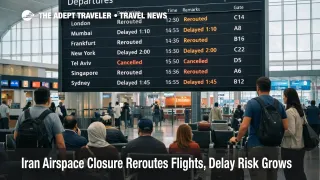
Airlines are rerouting long haul flights after short notice restrictions in Iranian airspace, a shift that is already showing up as longer flight times, occasional technical stops, and some outright cancellations on corridors that normally cross Iran on great circle routings. The travelers most affected are those connecting between Europe, the Gulf, South Asia, and North America, especially when itineraries depend on tight connection banks at major hubs. The practical next step is to assume your scheduled arrival time may move, then decide early whether to rebook to a longer connection, a different hub, or a different travel day before disrupted passengers consume remaining inventory.
The underlying driver is not just the initial closure window, it is the follow on avoidance behavior. Even after Iranian airspace reopened, regulators and airline security teams continued signaling elevated risk, and that keeps routings longer and less predictable than the published timetable suggests. EASA issued a Conflict Zone Information Bulletin on January 16, 2026, recommending operators avoid the Tehran Flight Information Region, at all altitudes, and to apply contingency planning for neighboring airspace, which tends to prolong the period of "flight time variability" that travelers feel as missed connections and last minute reaccommodation.
Two related reads on the same system effects are Iran Airspace Closure Reroutes Europe Gulf Flights and Iran And Iraq Airspace Avoidance Extends Flight Times.
Who Is Affected
Long haul travelers transiting Gulf hubs are the core risk group because hub schedules are built around timed arrival, and departure "banks." When a reroute adds even a modest amount of block time, a connection that looked safe can slip past the onward bank, and the result is often a same day misconnect that becomes a next day arrival after rebooking. This is most visible on Europe to Gulf to South Asia flows, but it can also hit North America to India routings when westbound detours compress crew duty limits and reduce recovery options later in the day.
Passengers on Indian carriers have been warned directly about knock on disruption. Reuters reporting described Air India and IndiGo among the airlines affected during the closure, and Indian media carried carrier advisories warning of possible delays, and cancellations, as aircraft route around Iran. If you are traveling on separate tickets, treat this as a higher risk period, because a late first flight can be treated as a no show by the onward carrier, even when the delay was outside your control.
Travelers with Tel Aviv, Israel plans are facing a different, but related, operational constraint. Some carriers adjusted Tel Aviv schedules by limiting night operations, or by canceling rotations, to avoid overnight crew exposure and to preserve operational flexibility during a period of heightened uncertainty. Lufthansa publicly described bypassing Iranian and Iraqi airspace, and limiting overnight stays for crews, and Reuters also noted ITA Airways actions on Tel Aviv night flying in this context.
Finally, advisory changes matter even if your flight operates. The U.S. Virtual Embassy in Iran issued a security alert urging U.S. citizens to consider departing Iran, and the UK Foreign Office continues to advise against travel to Iran while also updating Israel guidance, which can affect insurer positions, corporate travel approvals, and your own risk tolerance for onward ground plans.
What Travelers Should Do
Start with immediate actions and buffers. Recheck your itinerary by flight number in your airline app, because reroutes can change scheduled arrival times even when departure times look unchanged. If you have a connection under two hours at a hub, or you are landing close to the last onward flight of the day, assume higher misconnect risk and move now to an earlier inbound or a longer planned connection while inventory still exists.
Use a decision threshold for rebooking versus waiting. If your trip has a hard commitment, such as a cruise embarkation, a wedding, a paid tour start, or a first day business meeting, do not gamble on "day of" reaccommodation. Rebook to a routing with more schedule slack, ideally on a single ticket, and consider adding a buffer night at the hub or destination if arriving a calendar day later would break the trip. If your plans are flexible, you can wait longer, but only if you have a same day fallback, and you are comfortable with the possibility of being rolled to a later flight with limited seat choice.
Monitor the next 24 to 72 hours with a specific checklist. Watch for updated conflict zone bulletins and aviation restrictions, plus airline travel waivers that allow no fee changes, which tend to appear, and disappear, quickly as the operational picture shifts. Also watch your government travel advice for Iran and Israel if you are traveling into the region, because advisory language can change insurance coverage, and can also signal a higher chance of short notice airport, staffing, and security disruptions that ripple beyond the airspace routing itself.
How It Works
Airspace closures, and conflict zone avoidance, propagate through the travel system in layers. The first order effect is route geometry, flights take longer paths to avoid a flight information region, which increases block times, fuel burn, and schedule variance. That variance is what breaks tight hub connections, because a network built around banked arrivals cannot easily "stretch" without pushing passengers into later banks. The second order ripples show up as crew legality constraints, aircraft rotations that arrive late and depart late, and a higher chance of cancellations when an airline cannot recover a tail in time for its next assignment.
From a traveler perspective, the cascade is predictable. A rerouted long haul arrival misses a connection, reaccommodation shifts you onto later inventory, baggage may not follow on the same timeline, and hotels near hubs tighten as more passengers are forced into overnights. Tel Aviv schedule reductions compound this because fewer daily frequencies reduce same day recovery options, and they concentrate displaced passengers into fewer flights, which can raise rebooking friction and cost even when you book well in advance.
Sources
- Iran reopens airspace after temporary closure forced flights to reroute
- European regulator warns airlines not to fly in Iranian airspace
- Iran and neighbouring airspace (CZIB 2026-02)
- View PDF - EASA (CZIB 2026-02)
- Airlines continue avoid Iran, Iraq despite airspace reopening
- Iran Security Alert - Land Border Crossings (January 12, 2026)
- Iran travel advice
- Israel travel advice
- Prohibitions, Restrictions and Notices
- Air India, IndiGo Flights Impacted As Iran Shuts Airspace