

Middle East Airspace Detours Extend Europe Asia Flights
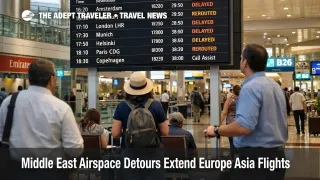
Airlines are expanding their avoidance of Iranian and nearby regional airspace, which is forcing longer routings on some Europe to Asia services and on flights connecting through Gulf hubs. Travelers are most exposed when itineraries rely on tight arrival and departure banks at Dubai International Airport (DXB), Hamad International Airport (DOH), and Zayed International Airport (AUH), or when a single late inbound can break a same day cruise embarkation or tour pickup. The practical move is to add connection buffer, watch for airline waiver rules, and be ready to reroute via different hubs if your carrier trims frequencies on short notice.
The Middle East airspace detours are turning a geopolitical risk into a schedule reliability problem, because longer tracks reduce padding, and raise the odds of cancellations that cascade into the next day.
Carrier actions are now detailed enough to change planning. KLM has published multiple updates showing how quickly flying can be paused and then partially restored, with Tel Aviv still not resuming "for the time being," and Dubai positioned to restart on Friday, January 30, 2026 after earlier cancellations and airspace avoidance across Iran, Iraq, Israel, and parts of the Gulf region. Lufthansa Group's operational notice says Iranian airspace remains unavailable for overflights and that the group will also avoid the airspaces of Iraq, Kuwait, and Bahrain "until further notice," while also shifting some Tel Aviv and Amman flying to daytime rotations to avoid overnight stays, and flagging that some flights may still be canceled. Finnair's travel update says it is not using Iraqi airspace, and that the detour can extend certain Dubai and Doha flights to Helsinki by about one hour. Major news reporting also indicates some westbound flights from the Gulf are adding technical fuel stops, because detours can push sectors beyond comfortable fuel and crew limits on specific aircraft types and routings.
Who Is Affected
Travelers transiting Gulf hubs are affected first, because hub schedules are built around tight banks where a modest slip can strand large numbers of connecting passengers at once. If your itinerary connects at Dubai International Airport (DXB), Hamad International Airport (DOH), or Zayed International Airport (AUH) with less than about two hours of buffer, the risk is not only arrival delay, it is also missed onward departures when gates close on time and the next available seat is one or two days out. This is especially painful on journeys that connect from an international long haul to a regionally high frequency flight, because those shorter sectors are where airlines often trim capacity first when aircraft and crews are out of position.
Europe to Asia flyers who do not touch the Gulf can still feel knock on effects. When a carrier detours around a conflict zone, the longer block time can disrupt aircraft rotations that later operate intra Europe sectors, repositioning flights, or overnighting patterns. That is how a disruption that begins in one air corridor shows up the next morning as a cancellation out of a different airport entirely, because the aircraft, the crew, or both, did not arrive on time, or a crew hit duty limits and could not legally continue. Lufthansa's own note about daytime only operations to Tel Aviv and Amman is a good example of how risk management decisions can reshape schedules, and introduce more cancellation variability on affected city pairs.
Travelers with time sensitive ground logistics are the third group, including cruise embarkations, weddings, fixed start tours, and rail reservations that are expensive to change. If your arrival time controls a port transfer or a hotel check in window with penalties, a one hour detour can become a cascading cost problem once you add baggage delivery time, immigration queues, and surface transport variability.
What Travelers Should Do
For trips in the next 24 to 72 hours, treat schedules as provisional. Recheck flight status the night before, and again on departure day, and confirm your contact details are in the booking so the airline can push rebooking options quickly if a sector is canceled, which both KLM and Lufthansa Group emphasize in their passenger and agency guidance. If you have a same day cruise, tour, or meeting, build a conservative buffer, or consider arriving a day early where the cost of missing the event is high.
Use decision thresholds, not hope, for rebooking. If your itinerary has a short connection at a Gulf hub, or it relies on the last flight of the day into your final destination, it is often smarter to proactively move to an earlier departure, or to a routing with more daily frequency, rather than waiting for day of disruption when alternative seats disappear. Watch for waiver or flexible rebooking policies tied to this situation, because airlines commonly permit one time changes without fees when they anticipate rolling irregular operations, and Lufthansa Group explicitly outlines free rebooking or refund options for canceled flights.
Monitor the triggers that can change conditions fast. The European Union Aviation Safety Agency has issued a Conflict Zone Information Bulletin for Iran and neighbouring airspace, and those advisories, along with airline security updates and any public notices of schedule suspensions, are the signals that typically precede broader reroutes and additional cancellations. If your carrier begins adding fuel stops or extending block times on your specific flight number, adjust onward plans immediately, because the second order ripple is often next day aircraft displacement, and a tighter hotel market near major hubs when misconnects stack up.
Background
Airspace avoidance works like a forced detour on a highway system, except the detour also changes fuel planning, crew legality, and the ability to recover after a delay. When a carrier routes around Iranian airspace and other nearby corridors, the great circle path between Europe and Asia can become significantly longer, and that added time consumes the schedule padding airlines normally use to keep aircraft rotations on track. EASA's Iran and neighbouring airspace bulletin highlights heightened risk conditions and recommends avoiding Iran's airspace at all altitudes, which is the kind of guidance that pushes airlines to adopt conservative routings even if airports remain open and demand remains strong.
The first order effect is simple, longer flights and occasional technical stops. The second order effects are what travelers notice most: crews time out, aircraft miss their next departures, and airlines start trimming or canceling lower priority frequencies to protect core bank integrity at hubs. Those adjustments then ripple into hotels, because passengers and crews need rooms when they are stranded overnight, and into surface transport, because arrival banks can bunch, creating long taxi queues and missed pre booked transfers.
For travelers trying to compare this to other disruption types, the dynamic is closer to air traffic control capacity shocks than to a single airport closure, because it spreads across multiple routes and days. Related context on how schedule stress propagates through the system is covered in U.S. Air Traffic Control Privatization: Reality Check, and recent Europe disruption watch items show similar ripple mechanics in different forms, including French ATC Strike Warnings Could Hit Summer Weekends and Verona ATC Strike Risk Jan 31, Flight Delays Likely.
Sources
- Statement situation Middle East
- Lufthansa Group airlines adjust flight offer to and from the Middle East
- Iran and neighbouring airspace 2026-02
- Conflict Zones Advisories
- The situation in the Middle East affects flight times for our Dubai and Doha flights to Helsinki
- Airlines reroute, cancel flights as tensions ramp up over Iran