

Flight Delays and Airport Impacts: February 12, 2026
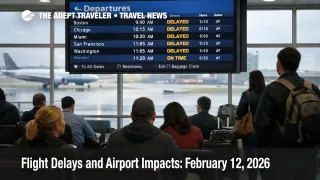
Gusty winds are the core operational risk across several major U.S. hubs on Thursday, February 12, 2026, and the FAA is explicitly flagging possible delays in Boston, Massachusetts, the New York area, Philadelphia, Pennsylvania, and San Francisco, California. Travelers are most affected if their itineraries touch General Edward Lawrence Logan International Airport (BOS), Newark Liberty International Airport (EWR), John F. Kennedy International Airport (JFK), LaGuardia Airport (LGA), Philadelphia International Airport (PHL), or San Francisco International Airport (SFO), because wind driven arrival rate reductions can ripple quickly through connection banks. The practical move is to protect tight connections early, shift time sensitive arrivals into the morning window when possible, and avoid relying on the last flight of the day if your trip cannot tolerate a misconnect.
The FAA is also calling out low clouds as a separate friction point that may slow traffic at Seattle Tacoma International Airport (SEA) and Tampa International Airport (TPA). Even when those airports are not the headline for nationwide disruption, low ceiling days can produce uneven delay pockets that break otherwise clean itineraries, especially when paired with wind constraints elsewhere that reduce rebooking flexibility.
Who Is Affected
Travelers routing through the New York airspace complex are the most exposed group today, because small changes in arrival spacing at EWR, JFK, and LGA propagate into missed connections across the network. When New York is constrained, the first order effect is fewer arrival slots, longer taxi times, and more gate holds. The second order ripple is what travelers feel at non New York origins, late inbound aircraft rotate onto later departures, crews time out, and the last departure options get canceled first because there is no slack left to absorb the day's delays.
Boston Logan and Philadelphia are also sensitive in wind regimes because runway configuration changes and spacing rules reduce throughput at the same time schedules are dense. If you are connecting through Boston Logan to international departures, or using Philadelphia for transatlantic banks, the risk is not just a late flight, it is a late flight that arrives after check in cutoffs, bag drop cutoffs, or minimum connection windows.
On the West Coast, SFO is the key node in today's FAA outlook. When SFO gets metered, it can spill into California and Mountain West departures within hours, and it can also disrupt long haul timing because late inbound widebodies and late outbound departures tighten the overnight aircraft and crew positioning that supports the next day's schedule.
Separately, ongoing airport constraints can make a weather driven day harder to recover from. The FAA's current operations plan lists runway and taxiway closures at LaGuardia that continue into late February, and it also notes continued operational adjustments at Ronald Reagan Washington National Airport (DCA). These are not the same thing as a ground stop, but they reduce flexibility when weather pushes the system toward metering, because there are fewer clean options to reroute traffic on the surface.
For travelers tracking the common hub set, Los Angeles International Airport (LAX), San Diego International Airport (SAN), and SFO remain the airports to watch most often when wind and ceilings are in play, and today's operations plan continues to list construction activity at SAN that can add friction when banks are tight.
What Travelers Should Do
Start with immediate actions and buffers. If your itinerary touches BOS, EWR, JFK, LGA, PHL, or SFO, check your connection margin and transfer plan now, then add time where you can, especially if you have a long terminal change, a checked bag, or an onward rail or cruise connection that cannot wait. If you are flying into SEA or TPA, treat low clouds as a capacity reducer that can turn a modest delay into a missed meeting when you stack ground transport on the back end.
Use decision thresholds rather than hope. If your connection through New York or SFO is under 90 minutes, or if you are on separate tickets, rebook to an earlier arrival window or a different routing as soon as you see sustained delays building, because reaccommodation inventory tends to collapse in the late afternoon when banks overlap and aircraft rotate late. If your itinerary is protected on one ticket and you have a longer buffer, you can often wait longer, but the cutoff is when the last viable backup routing disappears.
Over the next 24 to 72 hours, monitor the signals that predict whether an ordinary weather day turns into irregular operations. First, watch whether winds verify at the specific hub airports named in the FAA daily outlook. Second, watch ATCSCC operations plan updates for expanding flow constraints and airport level advisories that indicate metering or route restrictions. Third, watch airline waiver language, because it determines whether you can move flights without fees before airport lines and call queues spike.
For a recent comparable pattern in this same week, see Flight Delays and Airport Impacts: February 11, 2026 and Flight Delays and Airport Impacts: February 10, 2026. For structural context on why localized constraints can still feel systemwide, see U.S. Air Traffic Control Privatization: Reality Check.
How It Works
The FAA daily outlook is a planning signal about where capacity is most likely to be reduced, typically by weather, low ceilings, wind, runway configuration, or airspace flow constraints. When winds or low clouds reduce the number of arrivals an airport can accept per hour, traffic managers meter inbound flights, hold aircraft at gates, and sometimes apply route restrictions to keep demand aligned with the reduced arrival rate. That first order effect is visible at the hub. The second order effect shows up everywhere else, because the same aircraft and crews are scheduled to fly multiple legs, so a late arrival becomes a late departure somewhere else, shrinking connection windows and forcing rebookings into already full flights.