

Lufthansa Strike Germany Rebooking and Refund Rules
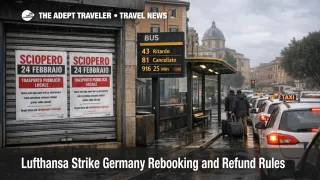
Lufthansa's February 12, 2026 strike day cancellations did not end when flights restarted, because many travelers were automatically rebooked, rerouted onto partners, or forced into refunds that still need to be reconciled. Germany bound passengers, especially those routed through Frankfurt Airport (FRA) and Munich Airport (MUC), are now in the less visible phase, closing out tickets, requesting eligible reimbursements, and gathering proof for insurance and credit card claims. The fastest way to reduce lingering cost is to follow Lufthansa's published irregular operations pathways, document each decision, and escalate only after you have a clean record of what the airline offered and what you paid out of pocket.
This matters now because Lufthansa strike rebooking Germany is no longer about finding any seat, it is about making sure the final itinerary, refund status, and receipts align so you are not left eating hotel, rail, and replacement transport costs that should be reimbursable under the right framework.
Who Is Affected
Travelers who had Lufthansa operated departures from German airports canceled on February 12, 2026 are the core group, but the spillover includes anyone who missed a connection through Frankfurt or Munich, even if the long haul segment itself operated. The strike hit the connection bank model that makes Lufthansa's hubs work, so disrupted passengers were pushed into later flights, into group carriers, or onto partner inventory, and that reshuffling is exactly what creates post event ticketing errors, baggage mismatch issues, and refund delays.
Passengers rebooked onto Lufthansa Group carriers or partners should assume that "who fixes what" can change by segment. A ticket may still be a Lufthansa document, but the operating carrier controls day of departure execution, baggage acceptance at check in, and in some cases the most practical customer service path. That is why the first administrative step after you travel is to confirm the final operating carriers and keep the reissue confirmation that shows your new ticket numbers or booking references, not just the flight numbers.
If you abandoned travel because February 12 broke the purpose of the trip, you are in a different bucket. Once you choose a refund rather than rerouting, the airline's obligation to transport you forward usually ends, and your remaining task becomes getting the refund processed correctly, then aligning any additional losses with your insurer or card benefits using documentation that proves the cancellation and your decision not to travel.
What Travelers Should Do
Start by building a simple evidence packet while details are still fresh. Save the cancellation notice, the rebooking offer you received, your final itinerary, and screenshots of flight status, then add itemized receipts for meals, hotels, ground transport, and any replacement tickets you bought. If you paid for a hotel because you were stranded overnight, keep the folio that shows dates and taxes, not just a card receipt, because that is what both airlines and insurers typically accept as proof of loss.
Use a clear threshold to decide whether to keep pushing Lufthansa for reimbursement versus shifting to insurance or card coverage. If your costs are mostly "care" items, such as reasonable meals and a necessary hotel during a long delay or cancellation disruption, pursue the airline first under passenger rights, because that is the primary channel. If your loss is more structural, such as a prepaid tour you missed, a nonrefundable hotel at the destination, or a separate ticket connection that collapsed, you will usually need to document the airline disruption and then move the claim to your insurer or the benefits tied to the card you used to purchase the trip.
Over the next 24 to 72 hours, monitor three operational loose ends that often linger after a mass cancellation day. Confirm that your ticket coupon status shows flown for the segments you actually took, confirm that any refund shows as processed rather than merely requested, and track checked baggage status until it is physically in hand. If your refund or reimbursement stalls, keep your communications in one thread with dates, names, and case numbers so you can escalate cleanly to dispute resolution channels without rebuilding the story from scratch.
How It Works
A strike day creates two separate problems, transport, and accounting, and the second one is what travelers are facing now. On February 12, the direct effect was cancellations across the network, concentrated at Lufthansa's Germany hubs, which forced reroutes and overnight stays for many itineraries. After that, the airline has to rebuild its network geometry, reposition aircraft, reassemble legal crew pairings, and clear the passenger backlog, all while call centers and airport service desks handle unusually high volumes.
The post strike admin layer is where travelers can lose money if they do not close the loop. Under EU passenger rights, a cancellation triggers a choice between reimbursement or rerouting, and during long delays the airline also owes duty of care, such as meals, communications, and hotel accommodation where an overnight becomes necessary. Separately, cash compensation under EU261 is conditioned on eligibility rules and whether the cause is treated as an extraordinary circumstance, and strike attribution is often where real world outcomes diverge, with airlines sometimes disputing compensation even when they still owe rerouting and care.
Lufthansa's own passenger rights materials highlight that compensation is not owed when a disruption is attributed to extraordinary circumstances, while still describing the core refund, rerouting, and care framework. The practical takeaway for February 12 cancellations is to pursue the items that are least ambiguous first, rerouting or refund status, duty of care reimbursements where applicable, and written disruption proof. Then, if you believe you meet the conditions for cash compensation, file the claim anyway, and be prepared to escalate with the same documentation if the airline denies it.
For domestic Germany cancellations, Lufthansa's irregular operations guidance also points to rail substitution, letting some travelers swap a canceled internal flight for Deutsche Bahn service. This can be a useful pressure valve when partner flights are full, and it can also reduce downstream losses by preserving the rest of the itinerary, but you still need to keep proof of the swap and any seat reservation costs so you can reconcile what was covered and what you paid.
When Lufthansa support channels stall, Germany also has established complaint and conciliation pathways, including the Schlichtung Reise & Verkehr process, which generally expects that you first contacted the company and either received an unsatisfactory response or no response. For travelers, this is not the first step, it is the backstop when a clear claim is not being handled, and when you need an independent process to move the dispute forward.
Sources
- Strike announcement at Lufthansa by Vereinigung Cockpit and UFO for 12 February 2026
- Passenger rights
- Hundreds of Lufthansa flights cancelled as pilots, cabin crew walk out
- Air passenger rights
- FAQs, Air passenger rights
- Regulation (EC) No 261/2004
- Your conciliation request, Schlichtung Reise & Verkehr
- Complaint Procedure