

Germany Transit Strike Starts Feb 27, Buses, Trams Halt
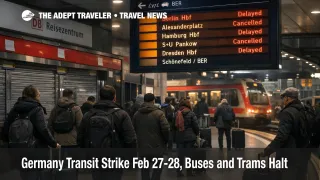
The Germany transit strike has moved from forecast risk to live disruption on February 27, 2026, and February 28, 2026. ver.di called a nationwide local transport walkout that is halting or sharply curtailing buses, trams, and many city run services in major hubs, including Berlin, Germany, and Hamburg, Germany. For travelers, the immediate failure mode is urban mobility, not necessarily the long distance flight or rail schedule itself. If your plan relies on city transit for airport access, station transfers, or timed entry tickets, assume your normal timing model is broken for these two days.
This Germany transit strike matters now because the last mile is where trips fail first, and once taxi demand spikes and roads thicken, even a "working" alternative can become too slow to protect a fixed departure or check in window.
Germany Transit Strike: What Changed for Travelers
The actionable change is that the strike is now underway, so travelers should stop planning around a risk window and start planning around a constraint. Reuters reports widespread disruption to public transport across Germany at the start of the two day action.
Operator guidance in the biggest hubs underlines the scale. In Berlin, Berliner Verkehrsbetriebe (BVG) says trams, U Bahn, and most BVG buses will be at a standstill from 300 a.m. on February 27, 2026, until 300 a.m. on March 1, 2026, and it warns of possible disruption spillover around the edges of the window. In Hamburg, Hamburger Verkehrsverbund (hvv) says a 48 hour warning strike affects HOCHBAHN and vhh.mobility from 300 a.m. on February 27, 2026, until 300 a.m. on March 1, 2026, which matters because it removes many of the default options travelers use to reach rail spines and terminals.
Which Itineraries Are Most Likely To Break
The most exposed itineraries are the ones with a fixed time commitment paired with a single urban transit dependency. That includes early airport departures, tight same day rail to air connections, cruise embarkation transfers, and timed attractions where being late means losing the slot. The first order impact is unreliable transfers to airports, stations, and hotel corridors that sit on local transit links. The second order ripple is that taxi and rideshare demand surges, pricing rises, and road congestion makes pickup and drive times less predictable, even for travelers who plan to "just take a car."
For Berlin travel, the risk concentrates around the chain between hotel neighborhoods and the rail nodes used to reach Berlin Brandenburg Airport (BER). Even if some rail layers continue operating, reaching the correct station can become the weak link when U Bahn and most buses stop. For Hamburg travel, the pattern is similar, with U Bahn and large bus networks impacted, and more travelers forced onto S Bahn, regional rail, and limited substitutes, which tends to crowd the remaining corridors at exactly the wrong times.
What Travelers Should Do Now
Rebuild your plan around what is most likely to remain stable, and add buffer where the system is least elastic. If your trip depends on reaching an airport or station by a specific time, anchor the plan on S Bahn or regional rail where available, then solve the last mile to that rail spine with a walkable route, a hotel arranged car, or a pre booked taxi. A just in time rideshare hail is a weak plan during a citywide mobility squeeze because pickup times can drift, and the road network can saturate quickly.
Use a decision threshold that forces action early. If you cannot arrive at the airport with at least two hours of slack beyond your normal plan, and you do not have a reliable path to the station or terminal, leaving materially earlier is usually cheaper than gambling. If the consequence of delay is a missed long haul departure, a last train, or a cruise check in deadline, shifting to a travel day outside the strike window can be the rational move, even if it costs a change fee, because same day recovery inventory tightens fast when thousands of travelers pivot at once.
Monitor operator advisories and real time routing shortly before you leave, and expect edge effects near the start and end of the strike window. BVG explicitly flags that additional disruptions may occur before and after its stated period, which is a practical warning that travel plans can fail even if you are traveling "near but not inside" the main window. For related disruption logic where ground mobility becomes the silent trip breaker, see Italy Rail Strikes Raise Missed Flight Risk Feb 26 to 28 and, for a broader rebooking and rights playbook on European strike days, see Europe Airport Strikes: Compensation and Re-Routing Guide.
Why This Strike Cascades Into Airport and Station Risk
A local transport strike breaks travel because it removes the highest throughput layer of movement inside large cities, and it forces too many people onto modes that are not designed to absorb a sudden citywide shift. First order effects are straightforward, buses and trams do not run, and metro lines stop. Second order effects are what break itineraries, road congestion rises as demand shifts to cars, taxis become scarce or expensive, and the remaining rail corridors crowd because they suddenly do double duty as commuter spine and luggage corridor.
The nuance that some rail layers continue is important, but it does not fully solve the traveler problem. BVG tells passengers they may use S Bahn and regional trains as alternatives during the strike, and Hamburg reporting similarly notes that the Hamburg S Bahn is not affected. That keeps a backbone alive for many trips, but travelers still have to reach that backbone, and the last mile is where time variance spikes enough to cause missed departures and failed connections.