

Berlin BVG Strike Halts Transit Feb 27 to Mar 1
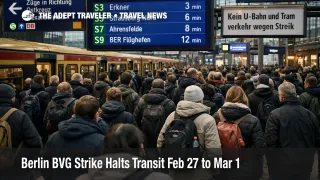
Berlin, Germany, is in an active disruption window as Berliner Verkehrsbetriebe, BVG, services are largely stopped from 300 a.m. local time on February 27, 2026, until 300 a.m. on March 1, 2026. BVG says U Bahn, trams, and most BVG buses are at a standstill, and it also warns that additional knock on disruptions can occur immediately before and after the published window.
This matters more than a typical weekday strike because the shutdown overlaps peak weekend leisure movement, late night venue travel, and the exact arrival patterns that create "last mile" failures, airport arrivals, and early departures. The practical workaround is that S Bahn and regional rail become the backbone, and everything else, taxis, rideshares, walking, and limited exceptions, becomes the pressure valve. S Bahn Berlin says it is not affected and is adding service, but the crowding risk moves from roads to platforms and interchange stations.
Berlin BVG Warning Strike: What Changed for Weekend Travel
The key update versus earlier strike framing is the fully active window that runs Friday into early Sunday, rather than a disruption that ends Saturday night. BVG's published timing is 300 a.m. Friday, February 27, 2026, through 300 a.m. Sunday, March 1, 2026, with U Bahn, trams, and most buses stopped.
That "into Sunday" tail is where travelers get surprised. It hits late Saturday returns, early Sunday airport runs, and the first wave of hotel check outs and station transfers, when people assume service has reverted. BVG also explicitly flags that service may not snap perfectly to normal immediately before and after the window, which is another way of saying you should not plan Sunday morning movements with tight margins.
For readers who want the broader Germany context and why airport access can break even when flights run, see Germany Transit Strike Feb 27, 28 Hits Airport Access. For the earlier Berlin playbook and the list of limited BVG exceptions, see Berlin BVG Shutdown Feb 27 to Mar 1.
Which Berlin Travelers Get Hit Hardest
Travelers staying "inside the S Bahn ring" often still have a workable city grid, but only if they accept a different mental model. Instead of short U Bahn hops, movement becomes longer walks to S Bahn nodes, heavier reliance on a few interchange stations, and more time lost to platform circulation. That is why weekend sightseeing itineraries with multiple timed entries are more fragile than they look on a map.
Airport transfers are where the strike becomes expensive. Berlin Brandenburg Airport (BER) is reachable by rail, and BER's own guidance points travelers to rail connections under Terminal 1, with S Bahn and regional options feeding the airport. The problem is not "can you get to BER," it is whether your hotel to rail link depends on a BVG bus, tram, or U Bahn for the first or last leg.
Nightlife, concerts, and Saturday events are the other high exposure segment. When the shutdown compresses movement onto fewer corridors, taxis and rideshares get more expensive and less available right when demand spikes. The strike window also pushes more travelers onto the same S Bahn platforms after events, which raises the risk of missed meetups, delayed returns, and long waits at the wrong station.
How to Move Through Berlin and Reach BER During the Strike
Route planning works best when it is station first, not line first. Pick the S Bahn or regional station you can reliably reach on foot from your hotel, then build the rest of the journey around the smallest number of transfers. During strike weekends, every extra interchange is a risk multiplier because crowding, platform dwell, and missed trains compound.
For BER access, start by anchoring on rail. S Bahn Berlin notes that S9 connects BER with central Berlin, including Berlin Hauptbahnhof, and that the airport station sits under Terminal 1. Deutsche Bahn's regional guidance also describes S9 as a direct cross city option, and it is often the easiest mental model for visitors because it stays on one service through multiple central stops.
Buffer guidance should be blunt. Add at least 45 to 60 minutes to any airport plan that requires a transfer inside Berlin, and add more if you are departing during early morning peaks, after big events, or in bad weather. If your plan requires two transfers before you reach the airport rail corridor, treat that as the threshold to consider a taxi or rideshare for at least the first leg, even if you prefer rail for the rest. The point is not comfort, it is avoiding a cascading failure where one missed connection forces an expensive, time starved sprint.
Inside the city, avoid fragile interchanges by choosing fewer, bigger, simpler nodes. The tradeoff is that major stations can be crowded, but they also offer more frequent alternatives if you miss one train. If you are heading to a tour start, a dinner reservation, or an intercity departure, arrive at your final station early and walk the last segment rather than gambling on a missing bus connection.
Why a BVG Strike Breaks Airport Runs and Weekend Plans
The first order effect is capacity removal. U Bahn, trams, and most buses vanish for 48 hours, and the people who would have used them do not disappear. They reallocate onto the remaining network, meaning S Bahn and regional platforms take demand that would normally be distributed across multiple modes.
The second order effect is where itineraries fail. Crowd density slows movement through stations, trains run full, and minor delays become meaningful because you have fewer fallback paths. On weekends, the pattern is worse because movement is spikier, nightlife creates large surges, and travelers are more likely to be carrying bags between hotels and stations.
Finally, the timing matters. A strike that extends to 3:00 a.m. Sunday turns the early Sunday window into a recovery phase, not a clean restart. BVG's own warning about disruption before and after the window is a signal to plan Sunday morning travel as if service will be uneven, at least until frequency normalizes.