

Germany Transit Strike Feb 27, 28 Hits Airport Access
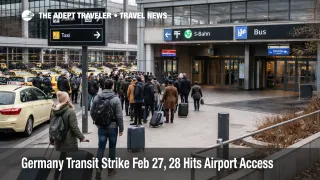
Germany's Verdi union has called a nationwide local public transport strike for Friday, February 27, 2026, and Saturday, February 28, 2026, which materially changes airport access plans across multiple cities at once. The first order effect is straightforward, many municipal buses, trams, and U Bahn style metro networks are expected to shut down or run at severely reduced levels, forcing travelers into taxis, rideshare, walking, or rental cars. The second order effect is what breaks itineraries, road congestion and longer airport transfer times raise the odds of missed flights, while remaining rail options such as S Bahn and regional trains can get overcrowded as everyone funnels into the same substitutes.
The key timing detail travelers should plan around is that in at least some major cities the walkout is framed as a 48 hour action starting early Friday and running into Sunday morning, rather than a simple "two calendar days" disruption. That matters because early morning airport runs on Friday, and late night arrivals into Saturday, can be hit at the exact moment travelers assume service is still normal.
Germany Transit Strike: What Changes for Airport Transfers
For travelers, the strike turns "getting to the airport" into the highest risk part of an otherwise normal flight day. If you were planning to reach an airport by city metro, tram, or bus, you should assume that option is unavailable in many places during the strike window, even if the airport itself is operating normally. This is especially exposed in big hub cities where public transport is the default airport connector, because when those systems drop out, the remaining road network becomes the new bottleneck.
Expect taxi and rideshare queues to lengthen quickly during the morning and afternoon peaks, with the longest waits at central hotel districts and main stations where demand concentrates. Airport curbside congestion can also rise because more people arrive by car than usual, which slows drop offs and makes curb to check in timing less predictable. The travel mistake to avoid is treating the strike like a minor inconvenience and keeping a normal buffer, the missed flight risk is not the flight itself, it is the transfer.
If you are also planning around other late February Europe disruption windows, it is worth sanity checking your connection logic across modes and cities, because clustered strike days create an inventory problem when everyone rebooks onto the same alternate routings. See Italy Late Feb Strikes Hit Flights and Trains and Brussels March 12 Strike, Airline Waivers Expand for how quickly "backup plans" degrade when multiple systems are constrained.
Which Cities and Itineraries Are Most Exposed
The most exposed trips are the ones that depend on a single local transit link to make a fixed time event, usually an international flight, a same day rail connection, or a hotel check in that triggers staffing and room readiness timing. In practice, that means travelers in the largest metro areas where municipal operators run dense bus, tram, and metro networks, and where airports are commonly accessed via U Bahn or tram lines, not just by car. Reuters' reporting on the nationwide call explicitly points to broad, multi state participation affecting local transport workers, including in major cities such as Berlin, Germany, and Hamburg, Germany.
The second category of exposure is business travel and conference itineraries built around same day positioning. When airport transfers slow down, the whole day compresses. A 40 minute transfer becomes 80 minutes, security and check in lines do not care why you are late, and last flights and last trains are less forgiving when the whole city is using the same substitutes.
Hotel operations are a quieter, but real, risk layer. When staff rely on local transport, shift changes can slip, housekeeping sequencing can drift, and luggage storage desks can get slammed when more guests arrive early or late. That usually does not shut hotels down, but it does mean travelers should be more intentional about early check in expectations, baggage hold time, and planning a buffer between arrival and any fixed dinner reservation or timed ticket.
How To Plan Around the Disruption
Start by rewriting your airport transfer plan as if public transport is not available. If you can reserve a taxi, hotel car, or private transfer, do it early, because availability tightens once the strike becomes common knowledge. If you plan to use rideshare, assume longer waits and surge pricing, and build extra time for pickup friction at large hotels where multiple guests are competing for the same curb space.
Next, decide whether you are taking a rail substitute, or avoiding rail stations entirely. In many areas, Deutsche Bahn run S Bahn and regional trains are described as not being affected by this municipal transit action, which makes them the primary "still running" alternative for airport and city movement, but that also means they can crowd quickly and become less comfortable with luggage. If you choose this path, treat it like peak commuter rail with bags, travel earlier than you normally would, avoid tight connections, and be ready for platform crowding.
Then set a decision threshold for your flight day. If your itinerary requires arriving at the airport with less than two hours to spare before boarding, and you cannot lock a reliable transfer, you should seriously consider moving your departure earlier in the day, shifting to a different airport access mode, or rebooking to a day outside the strike window. The tradeoff is cost and convenience now versus the cascading cost of a missed flight later.
Finally, monitor local operator updates for your specific city, because the strike scope and any limited "emergency" lines can vary by region and operator, even inside a national call. Do not rely on social posts as your primary confirmation. Use the official app or service status page for the transit operator you would normally ride, and build your plan around what they actually publish.
Why the Strike Ripples Beyond Local Transit
A municipal transit strike hits travel systems because it removes the highest throughput, lowest friction way to move people inside large cities. The first order effects are visible, empty tram stops, closed metro gates, and buses not running. The second order effects are what travelers feel, everyone shifts onto slower, lower capacity substitutes such as taxis and cars, roads clog, and transfer time variance spikes, which is exactly what causes missed flights, missed rail connections, and late hotel arrivals.
The "what still runs" question is nuanced, and it matters. Many S Bahn and regional rail services are operated by Deutsche Bahn rather than municipal operators, and reporting around this strike specifically notes that these rail layers are not affected in at least some major markets, which keeps a backbone for movement, but also concentrates demand onto fewer lines. Long distance rail and flights may operate normally, but they do not solve the last mile problem between your hotel and the platform or terminal, and that is where the strike does the most practical damage.
The takeaway is that this is not just a commuter story. It is an access story. Travelers who plan around the access layer, and who leave time buffers that match the new variance, will get through the same day that breaks everyone else's tight itineraries.
Sources
- German union calls nationwide local transport strike for Feb 27, 28 (Reuters)
- Two-day warning strike at BVG starting Friday (Berlin.de)
- Another widespread transport strike to bring travel chaos to Germany on Friday (The Local Germany)
- Nationwide strike to shut down German public transport on Friday and Saturday (I am Expat)