

Iran NOTAM Rocket Launch Window Disrupts Overflights
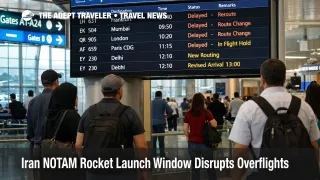
Iran issued an aviation notice warning of planned rocket launches across parts of the country's south, and that matters because a single restricted window can bend long haul routings across the Gulf region. The travelers most exposed are those flying between Europe, the Gulf, and South Asia on schedules that assume a predictable great circle crossing. The practical next step is to treat February 19, 2026, as a higher variance day, recheck your flight's scheduled arrival time by flight number, and add buffer if you are connecting the same day.
The Iran NOTAM rocket launch overflights update is the publication of a defined hazard window from 330 a.m. to 130 p.m. GMT on February 19, 2026, which increases the odds of day of reroutes, airborne congestion in alternate corridors, and late arrivals that break tight connection plans.
The NOTAM itself is not a guarantee your flight will delay, but it is a concrete constraint that dispatchers must plan around. Airlines that still cross Iranian airspace on certain tracks may need to route around the restricted zones, and airlines already avoiding Iran can still be affected because the detour corridors they rely on get busier when more flights funnel into the same lanes. That is why travelers often feel the impact as a shifting estimated arrival time, not a dramatic departure disruption at the origin airport.
Who Is Affected
Long haul travelers crossing the Gulf region are the core risk group, especially itineraries that chain two or three segments through a hub with timed arrival and departure banks. When a reroute adds even a modest amount of block time, the connection that looked safe on paper can slip past the bank, and the result is a same day misconnect that turns into a later arrival after reaccommodation.
Europe to Gulf to South Asia city pairs are the classic exposure set because many routings were historically optimized over Iran and Iraq, and detours push flights onto longer arcs that reduce schedule slack. Travelers heading to India, Pakistan, Sri Lanka, Bangladesh, and the Maldives often have fewer daily frequencies on the last leg, which reduces same day recovery options when an inbound arrives late.
A second exposure group is travelers relying on downstream banks in Europe and North America after a long haul arrival from the Gulf. If your Gulf to Europe flight arrives late, you can miss the last viable onward wave for the day, which increases the odds of an overnight near the transfer airport. This is where the cost shows up, hotels tighten, ground transfers get missed, and travelers burn time standing in rebooking queues while remaining inventory disappears.
Cargo also gets dragged into this even when you are not shipping anything personally. Widebody flights carry belly cargo, and when routings stretch, airlines may adjust payload, retime departures, or reshuffle which flight carries what. That can feed back into passenger operations as aircraft assignments and schedules get tuned for legality and performance, not for convenience.
Finally, EU operator guidance matters even if you are not flying an EU airline. When EASA advises operators to avoid a flight information region, many airlines treat that as a risk boundary, and their avoidance behavior can concentrate traffic into fewer alternative corridors. More concentration means more competition for favorable routes, and that is where airborne holding, flow restrictions, and arrival variability can rise.
What Travelers Should Do
Start with immediate actions and buffers. Open your airline app and check your itinerary by flight number, not just by your original confirmation email, because reroutes often show up as updated scheduled arrival times. If you have a connection under two hours at a major hub, or you are landing close to the last onward flight of the day, assume misconnect risk is higher on February 19, 2026, and move to an earlier inbound or a longer connection while seats still exist.
Use decision thresholds for rebooking versus waiting. If you cannot miss a cruise embarkation, a wedding, a paid tour start, a visa appointment, or a first day business meeting, do not gamble on same day recovery. Rebook to an itinerary with a larger connection margin, ideally all on one ticket, and consider an overnight buffer at the hub if arriving a calendar day late would break the trip. If your plans are flexible and you are traveling on a single protected ticket, waiting can be reasonable, but only if there are later same day fallback options.
Monitor the right signals over the next 24 to 72 hours. Watch for updated conflict zone bulletins, airline waiver language that covers your city pairs, and repeated schedule retimes that widen block times. Also watch your aircraft rotation if your airline app shows it, because an inbound aircraft arriving late from a prior sector is a strong predictor that your flight will depart or arrive late even before airspace complexity is applied. If you are flying on separate tickets, treat this as the highest risk posture, because a late first flight can still be treated as a no show by the onward carrier.
How It Works
A NOTAM is an operational warning distributed to pilots and dispatchers to communicate hazards, restrictions, or abnormal conditions that affect flight planning. In this case, the critical traveler translation is simple, a defined hazard window forces airlines to plan around restricted zones, and that pushes flights onto longer tracks or into more congested corridors.
The first order effect is route geometry. Longer routings increase planned block time, fuel burn, and arrival variance, especially when flights are threaded through narrow corridors where many operators converge. Even when the added time looks small, it matters because hub schedules are built around timed banks, and a long haul arrival that misses a bank does not arrive 20 minutes late, it arrives in a different part of the schedule, sometimes the next day.
The second order ripple is network legality and recovery. When a long haul sector stretches, crews get closer to duty limits, aircraft rotations arrive late, and dispatchers lose options. Airlines then choose between adding slack, swapping aircraft, adding operational steps, or canceling a later leg when the resources no longer fit the plan. Travelers feel this as rolling disruption, missed connections, rebookings onto later flights with worse seat availability, baggage arriving later than the passenger, and tighter hotel inventory near hubs.
For readers who want the broader system pattern behind why avoidance behavior can persist beyond a single day window, the earlier reporting on Iran Airspace Closure Reroutes Flights, Delay Risk Grows and Iran And Iraq Airspace Avoidance Extends Flight Times is the right framing. For deeper context on how air traffic control constraints become traveler visible delay and reroute outcomes, U.S. Air Traffic Control Privatization: Reality Check explains the incentive and capacity mechanics that make variance so hard to absorb.