

Northeast Blizzard Grounds NYC, Philly Flights Feb 22
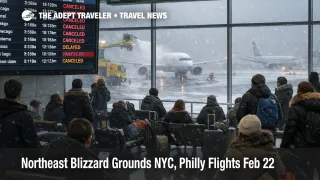
A major Northeast winter storm on February 22, 2026, triggered widespread flight cancellations and air traffic constraints across the New York and Philadelphia airspace complex. Travelers connecting through John F. Kennedy International Airport (JFK), LaGuardia Airport (LGA), Newark Liberty International Airport (EWR), and Philadelphia International Airport (PHL) are seeing the highest risk of missed connection banks and limited same day rebooking. The practical move is to treat this as a system event, not an airport event, and either rebook into the recovery window, reroute away from the New York complex, or postpone if your trip is optional.
The Northeast blizzard flight cancellations problem is that snow, low ceilings, and low visibility reduce arrival rates at several major hubs at the same time, which forces airlines to cancel aggressively to protect what is left of the schedule.
FAA traffic management planning advisories for February 22 flagged snow plus low ceilings and visibility limits in the New York TRACON (N90) region and the Philadelphia corridor, and also outlined a slate of probable ground stop style initiatives at New York area airports and Philadelphia as the day progressed. FAA advisory timelines are published in UTC, and they are best read as a sequencing signal, not a promise that every program will launch exactly as listed.
On the traveler facing side, the cancellations are already visible in live tracking. FlightAware totals for February 22 showed heavy cancellation counts at JFK, LaGuardia, Newark, and Philadelphia, which is the hallmark of a preemptive schedule reduction rather than a handful of weather delays.
Who Is Affected
The highest exposure group is anyone whose itinerary relies on the New York and Philadelphia hub banks, including transatlantic connections, Florida and Caribbean connections, and short haul spokes that only run a few times per day. When JFK, LaGuardia, Newark, and Philadelphia all degrade together, you lose the usual escape hatches because the alternates are inside the same airspace and weather regime.
Travelers departing smaller Northeast airports that feed these hubs are also in the blast radius, even if their local weather looks manageable. When the hub cancels, your spoke leg often cancels too because there is nowhere to go, and because airlines need to protect aircraft and crews for the next recovery day.
International travelers are disproportionately penalized by this pattern because rebooking inventory is thinner, and because missed connections can create passport control, baggage, and overnight hotel complications that do not exist on domestic point to point trips. If you are on separate tickets, the risk is worse because a misconnect becomes your problem, not the airline's problem.
What Travelers Should Do
Start with immediate actions and buffers that preserve options. If your trip touches JFK, LaGuardia, Newark, or Philadelphia on February 22 or February 23, open your airline app, then look at both your flight status and the inbound aircraft, because the earliest warning is often that your plane never leaves its prior station. If you have a same day connection, pad your plan for slow taxi, gate holds, and terminal crowding, and assume customer service lines will be long once the cancellation wave builds.
Use decision thresholds for rebooking versus waiting, and be ruthless about them. Rebook if you are down to one remaining departure that still gets you to your destination without an overnight, or if your connection is under about 90 minutes through the NYC complex or Philadelphia. Waiting only makes sense when you are protected on one ticket and you have multiple later options that still work for your real constraints, like hotel check in, cruise boarding cutoffs, or last onward departures.
Over the next 24 to 72 hours, monitor three things that actually move outcomes. First, FAA flow constraints and ground stop signals, because they tell you whether the system has regained arrival rate, or is still metering demand. Second, your carrier's waiver terms, because waivers are only useful while seats exist. Third, whether the cancellation pattern is spreading into Monday and Tuesday, which is how you spot crew and aircraft mispositioning rather than a one day weather hit.
Carrier waiver language is broadly consistent in this event. American published a Northeast severe weather alert that waived change fees for eligible tickets and travel dates, but typically requires you to keep the same origin and destination cities. Delta issued an exception policy covering February 22 to February 23 travel through a long list of Northeast airports, including the New York area and Philadelphia. JetBlue posted a Northeast winter weather fee waiver covering February 22 to February 23 travel dates. United's business facing waiver feed listed a Northeast winter weather waiver with a broad airport list that includes New York area and Philadelphia.
For a recent example of how weather driven capacity limits propagate through schedules and create "looks fine at my departure airport" traps, see Flight Delays and Airport Impacts: Feb 20. For a winter operations case study that shows how a single constraint, de icing throughput, can break connection reliability at a hub, see Schiphol De Icing Delays Raise Winter Connection Risk. For the structural context on why the New York region runs brittle under stress, see U.S. Air Traffic Control Privatization: Reality Check.
Background
A blizzard warning is not just "snow is coming," it is a specific operational threshold where blowing snow reduces visibility to one quarter mile or less for at least three hours, paired with sustained winds or frequent gusts at or above 35 mph. For aviation, the operational consequence is that approach spacing grows, runway acceptance rates fall, and surface movement slows at the same time that de icing and snow removal cycles are eating runway and taxiway availability.
The disruption propagates in layers. The first order effect starts at the hubs, cancellations reduce demand to match reduced arrival rates, and remaining flights absorb longer taxi times, gate holds, and missed connections as banks compress. The second order effect is where travelers get surprised, aircraft and crews drift out of position, duty time limits trigger additional cancellations, and what looked like a Sunday storm becomes a Monday and Tuesday schedule integrity problem. A third layer shows up on the ground, hotel inventory tightens around the corridor, and travelers shift to Amtrak and long distance buses to bypass the airspace pinch points, which can further concentrate demand at alternative gateways.
Sources
- Current Operations Plan Advisory (ATCSCC, FAA)
- National Airspace System Status (FAA)
- Live Airline Flight Cancellations, JFK (FlightAware)
- Live Airline Flight Cancellations, LGA (FlightAware)
- Live Airline Flight Cancellations, EWR (FlightAware)
- Live Airline Flight Cancellations, PHL (FlightAware)
- Travel alerts, Severe weather, Northeast U.S. (American Airlines)
- East Coast Winter Weather, Bulletin 1 (Delta Pro)
- Travel Alerts, Weather Update (JetBlue)
- Travel Waiver, Northeast Winter Weather (United Jetstream)
- Maps show winter storm forecast to bring snow, blizzard conditions to East Coast (CBS News)