

Northeast Storm Transatlantic Flights Cancellations
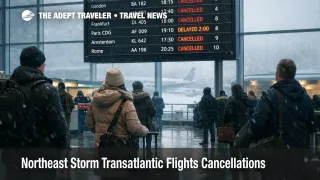
A Northeast winter storm is forcing deep schedule cuts at the U.S. hubs that anchor many Europe to U.S. itineraries, and that is now showing up as transatlantic cancellations, not just domestic disruption. Travelers booked through John F. Kennedy International Airport (JFK), Newark Liberty International Airport (EWR), and Boston Logan International Airport (BOS) are seeing cancellations and forced reaccommodation as airlines protect the parts of their networks that can still operate safely. The practical next step is to treat this as a network event, not a single airport event, and to move early toward routings that avoid the most constrained Northeast hubs when your arrival date actually matters.
FAA command center planning for February 23, 2026 described snow and low ceilings and visibility constraints in the Northeast corridor, and it explicitly noted that broad delay program references were removed because cancellations were already driving the day's capacity reduction. In plain terms, when cancellations become the primary control lever, airlines are no longer trying to "delay through" the weather, they are shrinking the schedule to match what the airspace and runways can realistically accept. That is exactly when long haul flights get cut or consolidated, because they are hard to re time, and they consume scarce gates, de icing throughput, and crew duty time.
For transatlantic travelers, the key detail is that the disruption is concentrated at gateway airports, not evenly distributed across the U.S. map. If your itinerary touches the New York area airports or Boston Logan, the storm's impact does not end when the snow stops, it extends into the recovery days as aircraft and crews are out of position, and as rebooking inventory is consumed by stranded passengers.
Who Is Affected
The highest exposure group is anyone traveling Europe to the U.S. on itineraries that rely on JFK, EWR, or BOS as the first U.S. touchpoint, especially if they also have a same day onward connection. Those airports are not just destinations, they are sorting hubs for connecting banks, and when arrival rates fall, the cancellation blast radius expands outward into feeder flights that would normally carry you to your final city. Travelers flying Ireland to the U.S. are in a similar position on days when Dublin to JFK, Newark, or Boston services are trimmed, because the nonstop set is smaller, and alternatives often require a connection through another constrained hub.
Airlines and industry outlets in the U.K. reported multiple transatlantic cancellations tied to the storm and to operational suspensions at key gateways, including impacts on Heathrow and Manchester schedules into the New York and Boston markets. Even when your long haul flight still shows "on time," your real risk may be the U.S. arrival and connection environment, which can change rapidly as ground programs, gate holds, and crew legality constraints stack up.
Second order effects show up away from the airport, and this is where travelers lose money. If you arrive a day late, or into a different U.S. city, you can miss onward rail departures, prepaid tours, and cruise embarkation windows, and you may be pushed into an unplanned hotel night because the airline can only reaccommodate you on a later week departure. That downstream squeeze is often worse for travelers on separate tickets, and for anyone with tight, same day ground connections that cannot be flexed.
What Travelers Should Do
Start with immediate actions that preserve options. If your trip is within the next 72 hours and touches JFK, Newark, or Boston Logan, open your airline app and look at both your flight status and the inbound aircraft, because the earliest warning is often that your aircraft never leaves its prior station. If you have a connection, add buffer now, and do not assume the airline will protect a separate ticket or a self built connection if the first flight cancels.
Use a decision threshold for rebooking versus waiting, and be strict about it. Rebook proactively if you are down to one remaining departure that still meets a hard constraint such as cruise boarding cutoff, a last onward train, or a same day event, because the next cancellation wave will consume the remaining seats. Waiting only makes sense when you are protected on one ticket, your airline has published flexibility, and you still see multiple later alternatives that actually get you to the same arrival city you need, not just "somewhere in the region."
Over the next 24 to 72 hours, monitor the signals that predict recovery, not the headlines. Watch FAA flow planning language for whether ground stop risk persists into the evening banks, watch your airline's waiver terms for both the covered travel dates and the rebook by deadline, and watch whether cancellations begin to spread into the following day, which is a tell for crew and aircraft mispositioning. If you can change your U.S. gateway, prioritize routings that avoid the New York area airspace complex until the system shows stable arrival rates again.
How It Works
Northeast storm transatlantic flights fail in a predictable way because the constraint is not just snow, it is throughput. When low ceilings, visibility, wind, and runway contamination reduce arrival rates at multiple major airports at the same time, airlines cancel aggressively to keep the remaining schedule flyable, and the FAA meters demand to protect safety. The FAA's operations planning language for February 23, 2026 highlights that dynamic, constraints from Philadelphia north, and ground stop probabilities for Boston and the New York area airports, paired with a reality that cancellations were already driving the day's capacity reduction.
Once the first order cancellations hit the gateways, the second order ripples propagate across at least two more layers. First, the airline network layer, aircraft and crews are now in the wrong places, and duty limits force additional cancellations even after weather improves. Second, the traveler behavior layer, stranded passengers crowd remaining flights and fill hotel inventory near hubs, and that makes reaccommodation slower and more expensive. Transatlantic travelers are disproportionately exposed because long haul aircraft types, crew qualifications, and immigration and customs processing create less flexibility than domestic point to point flying.
For a recent local case study of how this New York and Philadelphia corridor fragility shows up for travelers, see Northeast Blizzard Grounds NYC, Philly Flights Feb 22. For the day by day FAA signal that often precedes a wave of misconnects, see Flight Delays and Airport Impacts: Feb 22. For broader structural context on why flow constraints in the New York region can ripple nationwide even outside storms, see U.S. Air Traffic Control Privatization: Reality Check.
Sources
- Current Operations Plan Advisory (FAA ATCSCC) (Feb 23, 2026)
- East Coast Winter Weather, Bulletin 2 (Delta Pro)
- Latest Travel Updates, Disruption to some North American routes (Aer Lingus)
- Powerful winter storm shuts schools, disrupts travel across US Northeast (Reuters)
- Major flights disruption as massive snowstorm hits US east coast (Travel Weekly)