

Flight Delays and Airport Impacts: Feb 22
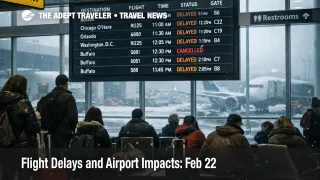
FAA traffic management planning on February 22, 2026, pointed to a split system day, snow and low ceilings constraining the Northeast airspace complex while thunderstorms and volume management tightened flows into Florida. The practical change for travelers was not one single airport closure, it was the combination of planned ground stop probability at multiple New York area airports and active reroutes aimed at Florida bound traffic, which is the exact recipe that turns ordinary delays into missed connections.
The ATCSCC operations plan update listed terminal constraints tied to snow, wind, low ceilings, and visibility in the New York, Philadelphia, and Potomac airspace, plus Detroit area winter limits, and central Florida thunderstorms. In the same update, FAA planners noted that national delay programs had been removed because observed volume did not warrant broad initiatives, but they still escalated ground stop language for Northeast terminals as cancellations continued to update.
On the operational side, the command center showed active ground delay programs for Aspen Pitkin County Airport (ASE), Palm Beach International Airport (PBI), and Yampa Valley Regional Airport (HDN), and it flagged multiple Northeast ground stops as probable or possible across the afternoon and evening windows. Those programs matter because they usually manifest as gate holds at your origin airport, not just airborne holding near the destination.
Who Is Affected
Travelers routing through the New York region airports and the Philadelphia complex carry the highest compounding risk, because arrival rates there are constrained by shared airspace, complex runway use, and weather that forces conservative spacing. The FAA planning timeline specifically called out Teterboro Airport (TEB), Philadelphia International Airport (PHL), John F. Kennedy International Airport (JFK), LaGuardia Airport (LGA), and Newark Liberty International Airport (EWR) with ground stop probability windows, and it also included Washington area risk for Washington Dulles International Airport (IAD) and Ronald Reagan Washington National Airport (DCA).
Florida itineraries are also in the blast radius, even if your departure weather looks fine. The command center flagged central Florida thunderstorms and listed reroutes and flow constraints aimed at Orlando International Airport (MCO) and the broader Florida stream, which can turn into late pushes, longer routings, and connection breakage during peak arrival banks.
Mountain leisure flows face a different failure mode, reduced arrival rates and limited same day rebooking inventory. Ground delay programs for Aspen and Hayden are a warning that the constraint is already binding, and when you combine that with system wide reroutes and longer block times, airlines often protect hubs first and thin routes second.
Midwest travelers should not assume they are insulated. Chicago O Hare International Airport (ORD) and Chicago Midway International Airport (MDW) were reported as normal in the FAA update, but that is a local status snapshot, not a network guarantee. When the Northeast and Florida are both constrained, aircraft and crews drift, and the second order effects can still cancel your late day departure elsewhere because the inbound rotation never arrives on time.
What Travelers Should Do
Start with immediate actions that preserve options. Open your airline app and look up the inbound aircraft and its prior legs, because on flow control days your delay often starts as a metered release at the origin gate. If you see multiple Northeast ground stop probability windows, treat that as a signal to add buffer, avoid tight connections, and reroute sooner rather than later.
Use a clear decision threshold for rebooking versus waiting. If your itinerary includes a connection under about 90 minutes through JFK, LaGuardia, Newark, Philadelphia, Dulles, or Reagan National, or you are on separate tickets, the rational play is usually to move earlier, move to a nonstop, or route through a less constrained hub before reaccommodation waves consume remaining seats. Waiting is only rational when you are protected on one ticket and you still have multiple later same day backups that meet your real constraints, like cruise boarding cutoffs, last onward departures, or same day hotel check ins.
Over the next 24 to 72 hours, monitor the system signals that actually predict reliability. Watch for recurring FAA reroute requirements into Florida, continued Northeast ground stop language, and any continuation of mountain airport ground delay programs, because those indicate the network is losing slack, not merely experiencing a one hour delay. For context on how these capacity squeeze days propagate, see Flight Delays and Airport Impacts: Feb 20 and the ski corridor example Reno Tahoe Airport Snow Delays Flights Feb 20, 2026.
How It Works
When weather reduces how fast aircraft can land and depart safely, the system's core lever is metering, not heroics. Low ceilings, snow, wind, and reduced visibility force wider spacing on approaches and departures, which lowers the arrival rate exactly when airlines schedule dense banks. The FAA command center then uses tools like ground delay programs, ground stops, reroutes, and flow constraints to keep demand below the reduced capacity, which is why you often sit at the gate at your origin airport even when skies there look clear.
Florida adds its own complexity because thunderstorm management is not just about rain at one airport, it is about convective corridors that block the preferred routes into the peninsula. When those routes compress, ATCSCC will publish reroutes and flow constraints for streams like Northeast to Central Florida, and that increases block times, burns schedule slack, and raises the odds that crews hit duty limits in the evening.
The second order ripple is where travelers lose money and time. Once aircraft rotations drift, airlines start making tradeoffs, protect hub banks and long haul segments, and cancel thinner legs to reset the network. Customer service lines grow, hotel inventory tightens near constrained hubs, and rebooking options degrade quickly because everyone is chasing the same remaining seats. If you want the structural backdrop for why these system days are brittle, not just annoying, read U.S. Air Traffic Control Privatization: Reality Check.