

Greece Ferries Halt Feb 28, 24 Hour Seafarers Strike
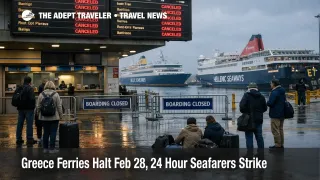
Greece's ferry network is set to go dark on Saturday, February 28, 2026, after the Panhellenic Seamen's Federation announced a 24 hour nationwide strike that is expected to keep vessels docked from 12:01 a.m. through midnight. For travelers, that effectively removes same day ferry connections between Athens area ports and the islands, plus many inter island moves that depend on ship rotations starting or ending in Attica.
This is no longer a vague risk window. Major operators have begun publishing route level cancellations and ticket change instructions, which is the signal that February 28 should be treated as a no sail day in itinerary planning.
If you are looking for a quick baseline and earlier planning logic, see Greece Ferry Strike Halts Island Sailings Feb 28.
Which Routes and Itineraries Get Hit First
The highest exposure is any plan that uses the Athens port complex as a connector, meaning Port of Piraeus and other Attica departures, for example Rafina and Lavrio, to reach the Cyclades, the Dodecanese, Crete, and nearby island groups. These are the routes travelers most commonly rely on for weekend breaks and flight plus ferry combinations, so a full day stoppage tends to strand people on the wrong side of a hotel check in, a flight, or a pre booked tour pickup.
Within that, the most failure prone pattern is a tight same day chain, ferry into Athens, transfer to Athens International Airport, Eleftherios Venizelos (ATH), then fly. When the sea leg cancels, the flight does not wait, and the replacement capacity usually compresses into the day before and the day after, not later the same day. That is why this kind of strike creates fast price jumps and sold out sailings on February 27 and March 1, even for travelers who were not originally booked on peak departures.
Vehicles, freight, and island supply chains are also part of the impact picture. Even if you are traveling as a foot passenger, a strike that halts cargo movement can add second order friction when service restarts, because ports have to unwind backlogs, crews have to reposition ships, and terminals have to process concentrated demand.
How To Rebuild an Itinerary Without a Single Point Ferry Failure
Start by protecting the immovable parts of your trip. If you have a flight, a cruise embarkation, a non flexible hotel check in, or a timed activity that cannot slide, move the ferry layer off February 28 first, even if that forces a mainland overnight. The tradeoff is straightforward, one extra hotel night often costs less than a same day scramble that turns into missed flights, reissued tickets, and lost deposits.
Next, decide whether you are shifting the day, or switching modes. For most island trips, the practical fix is moving to February 27 or March 1, because there is no partial sailing schedule to lean on during a nationwide strike. For islands with viable air service, a flight can work, but only if seats still exist at a price you are willing to pay, and only if you can also rebuild ground transport on arrival. If the air option is your backup, check it before you change anything else, because it is the fastest inventory to disappear when a ferry day drops out of the network.
Then follow the operator's rebooking workflow, not social media guidance. Operator notices are already listing cancellations by vessel and route, and many are explicitly telling passengers to process changes through the original booking channel, agency, call center, or app. Treat that as a time sensitive task, because the rebooking surge typically arrives well before the strike day itself.
If your plans also involve wider Greece transport disruption patterns, it can help to review how prior nationwide actions affected transfers and city mobility, especially around Athens. See Greece general strike on Oct. 1: what's running and how to reach the airport.
Why a Full Day Strike Removes the Ferry Layer So Cleanly
A nationwide seafarers strike stops ferry travel because crews are the enabling constraint for departures. When a labor action is scheduled across categories of ships, operators cannot run normal passenger service, and the practical outcome is vessels remaining at berth for the defined window.
That is why the traveler experience feels binary. Instead of reduced frequency, February 28 is effectively removed from the timetable, and demand is forced into the adjacent days. The first order effects are obvious, cancellations and missed connections. The second order effects are what break itineraries for people who thought they were insulated, meaning limited domestic flight seats selling out, hotel demand rising in Athens, and ports processing concentrated crowds when service restarts.
Finally, pay attention to what the operators are actually publishing, because it tells you how broad the disruption is in practice. For example, Blue Star Ferries has posted route specific cancellations and change instructions for multiple services, and Superfast Ferries has posted revised Adriatic sailing notes tied to the same strike window. Those are strong indicators that the operational scope is not limited to a single corridor or island group.