

Greece Ferry Strike Halts Island Sailings Feb 28
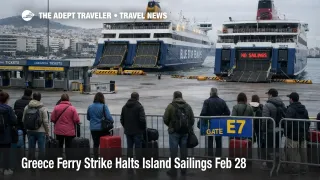
Ferry services across Greece are expected to stop for a full day after seafarers announced a nationwide 24 hour strike that would keep passenger and cargo vessels in port on Saturday, February 28, 2026. Island travelers are the main group affected because ferries are the connective tissue between Athens area ports and the Cyclades, the Dodecanese, Crete, and many smaller islands that do not have frequent air alternatives. The practical move is to treat February 28 as a no travel day for ferries, then shift sailings to February 27 or March 1, and rebuild any flights, hotel check ins, and tours that depended on same day ferry positioning.
The Greece ferry strike Feb 28 changes plans in a simple way, the ferry layer is removed nationwide for a defined window, which forces travelers to either move their sea leg to an adjacent day, or replace it with limited domestic air seats where that is even possible.
Who Is Affected
Travelers moving between the mainland and the islands are affected first, especially anyone routing through major departure points such as Port of Piraeus, or trying to island hop on a tight sequence where one missed leg collapses the rest. The strike is not just a passenger inconvenience, it also halts cargo movement on many routes, which can amplify operational pressure on the days immediately before and after as ports, crews, and ship rotations try to catch up.
The second group is travelers using ferries as a positioning leg for flights. The common failure mode is a same day plan that looks fine on paper, ferry to Athens, transfer to the airport, then fly. When the ferry segment is cancelled, the traveler is not delayed, they are stranded on the wrong side of the flight, and alternative sailings can sell out quickly because everyone is trying to rebook into the same narrower set of departures.
A third group is travelers who already booked tickets and need to know what happens next. Operators are publishing strike related itinerary cancellations and directing passengers to change tickets through the agency or channel where they booked, which is a signal to handle this proactively rather than waiting until you are standing at the port.
What Travelers Should Do
Start with the immovable items. If you have a flight, a cruise embarkation, a nonrefundable hotel check in, or a timed tour that cannot slide, protect those first by moving the ferry leg off February 28, even if you have to add a mainland overnight. For most itineraries, the cheapest fix is not a heroic same day workaround, it is buying time with an extra night so one cancellation does not wipe out multiple prepaid segments.
Set a decision threshold, and act before inventory compresses. If your itinerary depends on arriving on February 28, do not wait for day of certainty, because the strike is already being described as nationwide and time boxed, and adjacent day sailings are the only realistic replacement for most routes. If your ferry is a convenience, not a hard requirement, rebook to February 27 or March 1 and accept that ports may run crowded and slower as backlog clears.
Over the next 24 to 72 hours, monitor only signals that change decisions. Watch your ferry operator bulletins for your exact vessel and route, confirm whether your booking channel requires an active ticket change, and track whether domestic air seats to your island are disappearing if you are considering switching modes. If you are traveling through Athens, Greece, and you have been hit by recent weather related sailing bans, treat this strike like a second shock to the same system, ports can unwind backlogs slowly even after service restarts. Related coverage that may help you compare restart patterns is Greece Ferry Sailing Bans at Athens Ports and Celebrity Infinity Piraeus Malfunction Cancels Sailing.
How It Works
A nationwide seafarers strike stops ferry travel because crews are the enabling constraint. When labor action is scheduled across categories of ships, operators cannot legally or safely run regular passenger services, and ports may effectively freeze departures for the full window. Reporting around this action describes it as a 24 hour shutdown from just after midnight through the end of day, which is why the disruption is so cleanly felt by travelers, there is no partial schedule to lean on, the day is simply removed from the network.
The first order effects hit the source layer, sailings are cancelled, ships remain docked, and passengers stack into rebooking queues. The second order ripples spread fast into at least two other layers. One ripple is capacity shift to domestic flights for islands with airports, where limited seats can tighten quickly and push travelers into higher fares or awkward routings. Another ripple is lodging and ground transport around major ports, where missed connections turn into unexpected hotel nights, retimed transfers, and extra costs for travelers who planned minimal buffer. Even when service resumes on March 1, the system does not reset instantly, vessels need to be in the right place, crews need to rotate, and ports need to process a backlog, so the practical risk window often extends beyond the single strike date.