

Greece Ferry Strike Halts Sailings on March 5
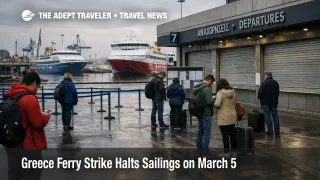
Greece's 24 hour seafarers strike is underway on March 5, 2026, and the practical result for travelers is simple, domestic ferry service is largely offline for the day. This is an update from March 4 coverage because the disruption has moved from announced risk to live operational shutdown, which removes same day island moves as an option and forces travelers into rebooking decisions immediately. If your itinerary includes an island hotel check in, a day trip that depends on a specific sailing, or a ferry to connect to a flight, assume you will not travel by ferry on March 5 unless your operator posts a rare, explicit exception.
Greece Ferry Strike March 5: What Changed Today
The strike is a nationwide, fixed window stoppage rather than a route by route slowdown, and that difference matters. When crews are out across vessel categories, operators cannot run normal schedules, so most sailings are canceled instead of merely delayed. Greek reporting said ships remained docked at ports across the country as the action began, and Reuters described the strike as halting local ferry services.
For travelers, the main consequence is that the ferry layer disappears for an entire calendar day, which breaks plans that treat Athens, Greece as a connector rather than a destination. The common failure pattern is an island departure on the morning ferry, a same day transfer across Attica, then an international flight out of Athens International Airport Eleftherios Venizelos (ATH). When the ferry cancels, the flight does not wait, and replacement air seats often price up quickly once a nationwide stoppage is clear.
This disruption is also tied to the wider Middle East travel shock. Unions have linked the action to crew safety concerns and repatriation demands for seafarers stranded in the Gulf, asking for the area to be treated as a war risk zone to enable evacuation and return. That linkage matters because it makes a last minute partial rollback less likely than a narrow local labor dispute.
Which Travelers Are Most Likely To Get Stranded
The highest exposure is any traveler who must move between the mainland and islands on March 5, 2026, and cannot absorb a 24 hour slip. That includes island hotel check ins, last minute accommodation changes, vehicle rentals that must be returned on the mainland, and tours that are timed to a ferry arrival.
Travelers on islands with limited flight options are the most constrained, because they cannot easily substitute air travel. By contrast, travelers on islands with frequent domestic flights have a potential workaround, but only if there is seat availability at a price they will accept, and only if ground transfers at both ends still work on the revised timing. Even then, the tradeoff is real, flying may save the itinerary, but it can create unplanned baggage and car rental problems if your original plan assumed a vehicle or large luggage load on the ferry.
Connections and onward international travel are the second major risk bucket. Travelers with one ticket that includes a protected connection might still be shielded once they reach the airport, but the ferry portion is often not part of that protected chain. If you are on separate tickets, the risk increases sharply, because a ferry cancellation behaves like a no show, not a misconnect, from the airline's perspective.
If you are tracking the wider regional picture, this is another example of disruptions that do not stay local. The same Middle East shock that is driving evacuation flows through hubs like Muscat, Oman is also showing up indirectly in European domestic networks through labor and safety pressure. For background on that evacuation channel, see Muscat Evacuation Flights Become Gulf Exit Hub.
What Travelers Should Do Now
The first step is to protect anything that cannot move, an international departure, a cruise embarkation, a timed tour, a medical appointment, or a non refundable hotel night. If any of those sit on March 5 or early March 6, you should shift the ferry segment first, even if it forces an extra night on the island or on the mainland. The cost of one extra night is often lower than the cost of a failed same day scramble that becomes reissued flights, lost deposits, and unplanned transport.
Next, make a clean decision between shifting days and switching modes. Shifting the ferry to March 4 or March 6 is usually the most reliable fix, but it comes with a known constraint, rebooking pressure concentrates demand into the adjacent days. That can tighten ferry space for foot passengers and vehicles, and it can also tighten hotel inventory in mainland gateways. Switching to a flight can work, but it is a capacity race, and the price curve often steepens once the strike is visibly live.
Finally, use operator instructions as your source of truth for rebooking mechanics, not social posts. In most Greek ferry disruptions, rebooking and refunds are processed through the original booking channel, the operator website or app, the issuing agency, or the call center tied to the ticket. If you booked through an agency, you may need the agency to reissue or reroute the ticket. If you booked direct, the operator's self service tools typically move fastest when call queues spike.
If you want the pre strike planning guidance and the timing window in one place, the March 4 explainer remains useful context, even though today's traveler decision is now immediate, Greece Seafarers Strike Halts Ferries March 5, 2026.
Why a One Day Ferry Strike Creates Multi Day Ripples
A nationwide seafarers strike stops ferry travel because crews are the enabling constraint for departures. When the labor action covers vessel categories for a fixed window, operators cannot legally or practically run the normal passenger schedule, so the travel outcome becomes binary, travel outside the window, or do not travel.
The first order effect is the obvious one, canceled sailings and failed island transfers. The second order effects show up after the clocks restart. Passengers who would have traveled on March 5 flood March 6, and that surge can collide with uneven vessel rotations and crew positioning after a full stop day. Even if timetables look normal on paper, the restart day can still see late changes, delayed departures, and load limits.
There is also a broader economic mechanism. When ferry capacity disappears, demand shifts to air and to scarce mainland hotel nights, which raises prices and increases the chance that travelers end up splitting itineraries, changing islands, or dropping an island leg entirely. Because this strike is tied to safety and repatriation claims connected to the Gulf conflict, travelers should treat it as a system stress signal rather than a routine, easily negotiated local dispute.