

Athens Taxi Strike Hits Airport Access Through March 20
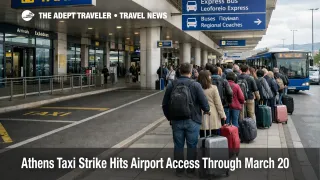
Athens taxi strike airport access is now a real airport transfer problem, not just another labor headline, because Athens International Airport (ATH) is warning that taxis are unavailable starting at 6:00 a.m. on Tuesday, March 17, 2026, and continuing until further notice. The airport says metro, suburban rail, public buses, and regional buses are still operating, but that shift matters because a flexible, luggage friendly last mile option has suddenly disappeared at one of southern Europe's main gateways. Travelers arriving into Athens, Greece, heading onward to Piraeus, Greece, or trying to catch early departures should move now to rail, express bus, or confirmed non taxi pickup plans, then add more buffer than they normally would.
The wider strike signal is also more serious than a single day airport note. Greek reporting says Attica taxi drivers are staging coordinated stoppages from March 17 through March 20, 2026, while union leaders have warned the action could continue longer while Parliament debates the disputed transport bill. That means travelers should not treat Tuesday as a one off inconvenience. They should treat the whole March 17 to March 20 window as unstable for airport and port transfers, with some risk of escalation beyond it.
Athens Taxi Strike Airport Access: What Changed
What changed is simple, but operationally important. Athens International Airport is no longer just warning about possible disruption. It is explicitly telling passengers that taxis are not available, while confirming that Metro Line 3, the Suburban Railway, public buses, and regional buses remain in service. That shifts the transfer burden onto fixed capacity systems that work well in normal demand, but become slower and less forgiving once a whole class of curbside transport disappears.
For central Athens hotels, the cleanest fallback is usually Metro Line 3 or the X95 airport express bus. OASA says Metro Line 3 links the airport with downtown Athens, and its airport bus network runs 24 hours a day, including the X95 to Syntagma Square. For Piraeus ferry and cruise connections, the X96 airport express bus is the most direct bus fallback, while the airport's own transport page also points to Metro Line 3 and the Suburban Railway as links toward Piraeus. OASA's published estimates put X95 at about 60 minutes and X96 at about 90 minutes, though real world times can run longer once overflow demand and city traffic build.
Which Travelers Face The Most Disruption
Late arrivals, families, travelers with checked bags, and anyone on a same day airport to ferry handoff are the most exposed. Taxis absorb the awkward demand that scheduled modes do not handle elegantly, especially late at night, after long haul arrivals, or when travelers are carrying enough luggage that stairs, platforms, and bus racks become friction points. Once that demand moves onto metro and bus service, the trip can still work, but the margin for error gets thinner.
Piraeus transfers are the sharpest risk inside Athens, because ferry check in windows are fixed and missed sailings are expensive to recover. Travelers heading from the airport to port should think less like a city break visitor and more like someone protecting a hard departure cutoff. If your ferry or cruise embarkation is same day, this is the kind of strike where buying buffer is smarter than hoping the queue moves fast enough. Related Adept coverage on Greek transport strike behavior may help with that planning, including Greece Taxi Strike, Athens Airport Transfers Jan 13-14 and Europe Transport Strike Dates 2026 for Flights and Trains.
There is also a narrower but important protest risk. eKathimerini reported before the strike that union chief Thymios Lymberopoulos said airport blockades were under consideration, and later reporting said a protest motorcade to Parliament was part of the pressure campaign. That does not mean access roads are blocked now. It does mean travelers should monitor for road action, not just the absence of taxis, because an access road problem would hit buses, private cars, and hotel pickups too. For broader Athens protest context, Adept's November 17 Protests To Slow Athens, Thessaloniki remains useful.
What Travelers Should Do Now
Protect the hardest to replace segment first. If you are flying out of Athens International Airport (ATH) on March 17 to March 20, move your airport approach onto Metro Line 3, the Suburban Railway, or an airport express bus plan now, and add at least one extra decision layer, such as leaving earlier than usual, booking a hotel nearer the airport, or confirming whether your hotel can arrange a non taxi transfer that is still operating. If you are going to Piraeus, favor the X96 or a rail based routing that you have checked in advance, then build a wider buffer than you normally would for a same day sailing.
The rebook versus wait threshold is not complicated here. Wait only if a delay would be annoying but survivable. Rework the plan now if missing the transfer would break a cruise embarkation, a last train, a separate ticket flight, or an overnight arrival into a hotel far from a rail stop. In those cases, paying for a buffer night or a different transfer structure is cheaper than repairing the whole itinerary after one missed handoff. This logic matches the pattern already seen in earlier Greek strike coverage, where fixed route backups still exist, but the failure point moves to queues, timing, and the lack of flexible curbside capacity.
Over the next 24 to 72 hours, monitor three things in parallel, the airport support page, OASA service information for buses and metro, and local reporting on whether the March 20 strike endpoint holds or slips. Right now, the official airport message confirms no taxis and normal operation for the replacement modes, but union aligned reporting makes clear the action could extend. That is the real traveler risk, not only Tuesday's disruption, but the possibility that a supposedly temporary airport access problem lingers into the rest of the week.
Why The Disruption Spreads Through Travel
Taxi strikes matter in Athens because taxis are not the backbone of the city, but they are the shock absorber. They carry late arrivals, luggage heavy groups, families, and travelers making time critical hops between Athens International Airport, central hotels, ferry terminals, and rail stations. When that layer disappears, demand shifts to metro, suburban rail, and airport express buses, which have published routes and schedules but cannot expand instantly when a whole airport taxi rank goes dark.
The first order effect is slower and less flexible airport and port access. The second order effect is timing stress across other parts of the trip, longer bus queues, tighter rail platforms, more pressure on hotel pickup services, and more missed check in windows for ferries, cruises, and separate ticket air itineraries. Add even limited protest driving or road action to that system, and the disruption stops being a taxi story and becomes a citywide transfer reliability problem. That is why the airport warning matters so much. It marks the point where labor action has moved out of politics and into the trip itself.
Sources
- Support | AIA
- Public Transportation - Airport | AIA
- Airport Express Bus Lines | OASA
- Metro Line 3 to Airport | OASA
- Taxi Strike Signals Longer Fight Ahead | eKathimerini
- Taxi Drivers Plan Indefinite Strike, May Block Airport Access Over Contentious Bill | eKathimerini
- Taxi Drivers in Attica Set to Begin 4-day Strike | To Vima