

Cancun Travel Safety After Jalisco Unrest Alerts
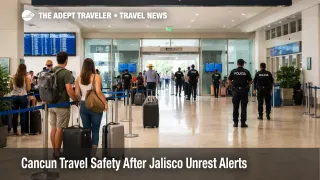
The U.S. Embassy and Consulates in Mexico said on February 23, 2026, that the situation had "returned to normal" in Quintana Roo, the state that includes Cancun, Cozumel, Tulum, and Playa del Carmen, after a weekend of wider security alerts tied to cartel retaliation in other regions. That is the key practical distinction for travelers headed to the Caribbean side of Mexico, most tourism services are operating, and there have not been broad shelter in place instructions for the Cancun region.
At the same time, local reporting described a cluster of arson incidents on February 22, 2026, including vehicles set on fire in Playa del Carmen and fires set at convenience stores in Tulum, plus vehicle fires reported on Highway 180 near Cancun. Those incidents matter because they can create short, localized road disruption that hits airport transfers and day trip timing even when airports and hotels remain open.
Which Trips Face More Risk In Quintana Roo
Most leisure travelers staying inside major resort zones around Cancun and the Riviera Maya are primarily exposed during movement, airport transfers, intercity drives, and independent errands, rather than while inside managed hotel properties. The arson reports were spread across multiple municipalities, which is a reminder to treat "the region" as a set of nodes and corridors, not a single uniform condition.
Travelers with tight arrival or departure windows are the most sensitive to small disruptions. Cancun International Airport (CUN) can remain operational, but a short highway incident, a traffic diversion, or a sudden police operation can still break a carefully timed transfer, especially for families, groups, or travelers relying on one prebooked ride. By contrast, travelers whose plans are mostly on property, or who have slack in their schedules, can usually wait for clearer signals if conditions get noisy.
What Travelers Should Do Now
If you are traveling to Quintana Roo in the next 24 to 72 hours, build buffer into ground movement. Prefer daytime airport transfers, confirm your pickup channel in writing with your hotel or a vetted operator, and avoid last minute cross town runs that force you to improvise if a road segment goes sideways. If you see an incident or heavy police activity near your route, the better move is usually to pause, reroute with your operator, and avoid pushing through congestion.
If your itinerary includes western Mexico, treat it differently. Reporting on the February 22 to February 23 disruption cycle indicates that Puerto Vallarta and Guadalajara saw meaningful flight disruption tied to the wider security situation, even as other airports continued operating. Licenciado Gustavo Díaz Ordaz International Airport (PVR) and Miguel Hidalgo y Costilla Guadalajara International Airport (GDL) are the kinds of endpoints where airport access can become the real constraint, not the runway itself, so do not assume "flight operating" equals "transfer is safe and predictable."
Finally, keep your information inputs clean. Misinformation spreads fast during security events, and reputable reporting, plus official advisories, should carry more weight than viral clips and unverified posts.
Why This Is Happening, And How Disruption Spreads
This episode is a classic two layer travel problem. The first layer is the direct security response in specific states, which can produce shelter guidance, road blockages, and sudden limits on local transportation. The second layer is operational spillover, when airlines, ground handlers, transfer providers, and even travelers self reroute, demand shifts, and systems get stressed in places that are not the center of the event.
Quintana Roo's February 22 incidents, as reported locally, illustrate the "localized shock" pattern. A small number of arson or vehicle fire events can be enough to create short lived highway closures and a heavier security posture, which is inconvenient for travelers but not automatically a signal that tourism operations have broadly shut down. The decision model that holds up best is corridor focused, reduce unnecessary movement, buy time buffers, and make your go, no go call based on what is happening on your specific route and date, not on a national headline.
Sources
- 'Shelter In Place' Remains Active for Americans in Western Mexico, Cancun and Riviera Maya Operating 'As Usual'
- Cars and businesses set on fire: Criminal gang retaliation hits Quintana Roo amid rumored death of CJNG founder
- Mexico Travel Advisory, United Mexican States
- Flights to SFO from Puerto Vallarta canceled as U.S. warns of danger after drug lord's killing
- Mexican security forces reportedly kill drug cartel boss "El Mencho"