

US Spring Break Flights Set Record as Shutdown Hits
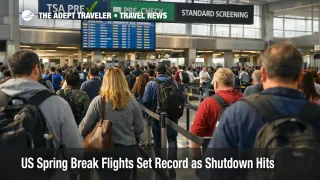
U.S. airlines are forecasting a record spring break rush, and the numbers imply less tolerance for airport friction than travelers had in 2025. Airlines for America (A4A) projects carriers will average about 2.8 million passengers per day from March 1, 2026, through April 30, 2026, totaling 171 million passengers across the two months. A4A also estimates airlines will run about 26,000 daily passenger flights with roughly 3.5 million seats, a four percent increase in passengers versus March and April 2025.
The complication is timing. Those record forecasts arrive while the partial U.S. government shutdown continues with the Department of Homeland Security unfunded, which has created whiplash around Trusted Traveler Programs. DHS reversed course and kept TSA PreCheck operating, but Global Entry remains paused under DHS emergency measures, which turns the biggest spring travel pain point into an arrivals and connections problem, not only a security line problem.
Which Travelers Will Feel This Most
The highest exposure is international round trips that depend on predictable re entry timing. When Global Entry is paused, travelers who normally clear passport control quickly are pushed into standard inspection flows, and the variability spikes during peak arrival banks. That is most likely to break itineraries with a tight domestic connection after an international arrival, especially in late afternoon and evening waves when multiple long haul flights land close together.
Domestic only travelers are not immune. Even with TSA PreCheck still operating, DHS and TSA have signaled airport by airport adjustments are possible depending on staffing and resources, which is exactly the kind of "it depends" that matters when passenger counts are at record levels. At high volume hubs such as Chicago O'Hare International Airport (ORD), a small change in lane staffing or checkpoint configuration can cascade into missed boarding windows during morning departure peaks.
Frequent travelers and families are also the ones most likely to feel the opportunity cost. The "spring break" headline often reads like leisure demand, but the forecast covers the entire March and April peak, including business heavy midweek flows and major conference weeks. In that environment, the main failure mode is not one long line, it is system variability that forces earlier arrivals, longer connection buffers, and more conservative same day scheduling.
What Travelers Should Do Now
If you have international travel during March or April 2026, plan your return like Global Entry will not be available until you see an official restart notice. The practical move is to buy time in the itinerary, meaning longer scheduled connections on international to domestic transfers, and avoiding last flight of the night onward legs when a misconnect turns into an overnight by default. If you want the deeper return trip playbook, start with Global Entry Paused, Plan Longer U.S. Passport Lines, because that is where the current bottleneck is most predictable.
For domestic departures, keep TSA PreCheck, but stop treating it as a guaranteed time savings. Arrive with extra buffer during the highest volume windows, and assume your airport could consolidate lanes or adjust hours with little notice if staffing tightens. If you need the latest operational posture in one place, TSA PreCheck Suspension Reversed at US Airports captures what changed, and what did not.
Over the next 24 to 72 hours, watch the signals that change your odds, not the political noise. First, monitor DHS and TSA updates on Trusted Traveler operations, because another policy swing can change airport throughput fast. Second, if you are traveling internationally, check whether your arrival airport has Mobile Passport Control, and have it set up before you depart, because it can be a practical fallback when Global Entry is offline.
Why The Shutdown Matters More At Peak Volume
A4A is effectively describing a system operating closer to its throughput ceiling, where delays propagate faster. At 2.8 million passengers per day, the travel day is less forgiving because queues form sooner, rebooking inventory drains faster, and customer service loads stack up across airlines and airports. The first order effect is straightforward, longer lines at security or passport control when staffing is constrained. The second order effect is what breaks trips, missed connections, missed pickup windows, later hotel check ins, and a higher chance that one disruption turns into an overnight.
Trusted Traveler programs exist to reduce that variability by segmenting low risk travelers into faster processing lanes, which helps both travelers and the system. That is why the current split decision, PreCheck preserved while Global Entry remains paused, matters so much right before a peak period. Outbound trips may feel mostly normal at some airports, while inbound returns can degrade sharply in arrivals halls, and you cannot "make up time" once you are in the passport control queue.
If DHS keeps Global Entry paused through March, the risk will concentrate at the exact moment many travelers return from spring break trips, which is when airports are already busy and when airlines have less flexibility to recover from misconnections. The traveler takeaway is not panic, it is itinerary math. Add buffer where the system is most likely to pinch, and treat your return day as the fragile link until the program is fully restored.
Sources
- U.S. Airlines Prepare for Record Number of Passengers this Spring amid Government Shutdown (A4A)
- Statement from A4A's President and CEO Chris Sununu (A4A)
- 1 Week into Democrats' Shutdown, DHS Implements Emergency Measures (DHS)
- DHS reverses course on suspending TSA PreCheck after outcry (The Washington Post)
- DHS suspends Global Entry as partial government shutdown drags on; TSA PreCheck still operational (ABC7, via AP)