

Northeast Storm Hernando Keeps Flights Canceled
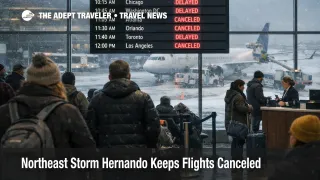
Winter Storm Hernando is no longer just a storm day, it is a recovery and imbalance day that can still break itineraries across the Northeast corridor. Even as snowfall eases in some places, lingering power outages, road restrictions, and backlogged aircraft and crew positioning keep flight cancellations and long delays elevated across the New York area and Boston airports, with knock on effects that can spread nationwide. The practical change since the initial impact phase is that "delayed" flights are more likely to flip into late cancellations as airlines try to rebuild rotations with fewer usable aircraft, fewer rested crews, and constrained gate and deicing throughput. Travelers with tight connections, same day events, or cruise embarkation windows should treat February 27, 2026 as a high misconnect risk day, not a normal return to schedule.
Winter Storm Hernando Flight Cancellations: What Changed
The key update is that Hernando's disruption footprint has shifted from the peak blizzard period into a prolonged recovery window where airport operations can look "open" while the network is still unstable. Airlines canceled thousands of flights during the storm's core days, and that volume matters because it creates a multi day aircraft and crew displacement problem that cannot be fixed in a single schedule cycle. As a result, travelers are still seeing cancellations and rolling delays in the Northeast, particularly around the New York airspace complex and Boston, where runway availability may improve faster than gate availability, deicing capacity, and inbound aircraft flow. The Federal Aviation Administration's National Airspace System status updates remain the fastest way to confirm whether an airport has active delay programs or ground stops before you commit to the airport trip.
Which Travelers Face the Most Disruption
Travelers touching John F. Kennedy International Airport (JFK), Newark Liberty International Airport (EWR), LaGuardia Airport (LGA), and Boston Logan International Airport (BOS) remain the most exposed because these airports are both destinations and connectors, and they sit inside the same constrained airspace corridor. If your itinerary includes a connection through any of these hubs, the highest risk pattern is a first leg that operates late, followed by a missed connection into a limited rebooking inventory environment. That risk is even higher if you are on separate tickets, if you have a last flight of the day connection, or if your arrival depends on a single remaining flight that still meets a hard deadline.
Power outages and ground transport limits amplify that exposure. Heavy snow and wind have knocked out electricity across parts of the region, and restoration work can be slowed by access constraints and ongoing hazards. When power is out at scale, the travel system takes longer to restart evenly, hotels fill faster near airports, rideshare supply tightens, and basic trip logistics like charging devices and getting to the terminal become harder at the worst possible moment.
What Travelers Should Do Now
The best rebooking strategy in a recovery window is to act early, and to optimize for reliability over convenience. If you have a tight connection, a same day commitment, or a cruise or tour cutoff, shift to a nonstop if one exists, or move your trip by one day rather than gambling on a fragile bank of connections. If you are already inside the travel day, check your inbound aircraft and crew driven signals in your airline app, because that is often the earliest indicator that a "delay" is heading toward a cancellation.
Use a clear decision threshold instead of waiting for the airport to "normalize." Rebook now if you only have one remaining option that meets your real constraint, or if your itinerary depends on a connection inside the JFK, EWR, LGA, or BOS corridor. Waiting can be rational only if you are protected on a single ticket, your airline has published flexibility for your travel dates, and you can see multiple later alternatives that still reach the same airport you need, not just the same region.
Add buffer where it actually reduces failure risk. For departures, plan extra time for road conditions, parking constraints, long security lines, and gate holds as aircraft wait for deicing and runway acceptance rates. For arrivals, avoid tight onward trains, car pickups, and timed entries for at least 24 to 48 hours after a major cancellation wave, because the second order delays often arrive after the weather headlines fade.
How the Disruption Spreads Through Travel
Hernando's lingering impact is a throughput and positioning problem, not just a snow total story. First order effects include runway contamination, low visibility, wind limits, and deicing queues that reduce departure and arrival rates. Second order effects follow quickly, aircraft that were supposed to fly the next morning are parked in the wrong city, crews time out or are stranded by road restrictions or hotel shortages, and airlines cancel additional flights to rebuild a flyable schedule with the resources actually in place.
Power outages make this worse by slowing the broader regional restart. Utilities have described multi day restoration expectations in some areas because damage assessment, access, and safety constraints can delay repairs. For travelers, that means a longer period where airports, hotels, and ground transport are operating under stress, and where disruption can reappear late in the day even if the morning looked manageable.
For related coverage and practical recovery guidance built from FAA planning signals, see Northeast Storm Recovery Keeps Feb 24 Cancellations. For deeper structural context on why New York area constraints can ripple nationwide even outside storms, see U.S. Air Traffic Control Privatization: Reality Check.
Sources
- Powerful winter storm shuts schools, disrupts travel across US Northeast (Reuters)
- More than 380,000 customers without power as winter storm hits US Northeast (Reuters)
- The Latest: Northeast US digs out from brutal snowfall as second storm may near (AP News)
- National Airspace System Status (Federal Aviation Administration)
- Winter Storm Hernando: Operations to resume at Northeast hubs (Delta News Hub)
- National Grid Responding to Impacts of Powerful Blizzard (National Grid)