

Northeast Storm Recovery Keeps Feb 24 Cancellations
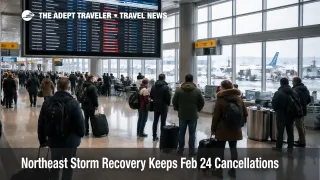
The Northeast moved from peak shutdown into an uneven restart on February 24, 2026, but thousands of cancellations are still rolling because recovery is now constrained by runway clearing, deicing throughput, aircraft positioning, and crew legality, not just snowfall totals. Reuters reported more than 2,000 U.S. flight cancellations as of February 24 as winds lingered even while the storm weakens. The FAA's latest daily briefing continues to flag Boston, the New York area airports, and Philadelphia for delays and cancellations tied to snow and wind, with gusty winds also a factor farther south into the Washington corridor.
What is new versus the last 48 hours is that the "can we fly at all" question is being replaced by "can the system restart evenly," and the answer is no, not yet. That matters because the restart phase is when misconnect risk spikes, rebooking inventory disappears, and today's late aircraft turns into tomorrow's first wave of delays.
Where Recovery Looks Fastest, and Where It Stays Fragile
The FAA Command Center's Northeast planning notes point to runway availability as the near term gating item. For the New York airport system, the New York Port Authority expectation conveyed to the FAA was that all runways would be open by 17Z on February 24, which is about 1200 p.m. in the New York area. For Boston Logan International Airport (BOS), the same planning discussion pointed to targeted runway reopening milestones later in the day, with controllers expecting Runway 33L open by 18Z, and Massport aiming to bring Runways 9 and 27 back as close to that time as practical, roughly 100 p.m. local.
Philadelphia International Airport (PHL) remains in the wind constrained set in FAA planning language for February 24, which is a reminder that "cleared snow" does not always mean "normal arrival rates." In plain terms, New York can look like it is reopening earlier, Boston can still be catching up into the afternoon, and both can still suffer rolling ground delay programs if wind limits arrival throughput during the restart banks.
What Travelers Should Do Now, and the Decision Thresholds That Matter
If your itinerary touches John F. Kennedy International Airport (JFK), LaGuardia Airport (LGA), Newark Liberty International Airport (EWR), Boston Logan, or Philadelphia International, treat same day rebooking as the scarce resource. Rebook now if you have a tight connection, if you are on the last departure that still meets a hard arrival need, or if your inbound aircraft is still sitting at a storm impacted airport with no clear departure time, because that is how "delayed" becomes "canceled" late in the day.
Waiting can be rational only if three conditions are true at once. You are protected on one ticket, your carrier has an active waiver that fits your dates, and you can see multiple later options that still meet your real constraint. Delta's published Hernando update points customers to app based rebooking and notes its flexibility window, including a fare difference waiver through February 25, with rebooking deadlines described in its notice. American Airlines' Northeast severe weather alert similarly lays out the covered travel window, purchase by date rules, and a firm "changes must be booked by" date, which is the deadline most travelers miss until it is too late. JetBlue also announced a fee waiver update tied to the storm, which matters most if you are trying to shift away from the highest cancellation airports while seats still exist.
If you are deciding whether to reroute, the practical threshold is whether your trip can tolerate a forced overnight near a hub. If it cannot, prioritize nonstop options, alternate gateways outside the NYC and Boston flow core, or a one day delay, even if it costs more, because the restart phase often produces fewer reliable same day options than travelers expect.
Why the Restart Is Uneven, Even After the Snow Eases
The mechanism is a stack of bottlenecks that do not clear at the same time. Runways can reopen while taxiways are still constrained, gates can be usable while deicing queues limit departures, and aircraft can be "available" while the crews that operate them are out of position or near duty limits. That is why the FAA can talk about runways reopening by specific Z time targets while still flagging wind constraints and the possibility of renewed delay programs at Boston, New York, Newark, and Philadelphia after 1500Z.
Second order effects are now driving traveler pain more than snowfall totals. When cancellations persist into the next schedule day, it is usually because aircraft and crews are not where they need to be to rebuild rotations, and because airlines are trying to protect the parts of the network that can operate reliably. That is the same coupling problem covered in Northeast Bomb Cyclone Flight Cancellations Feb 23 and it is amplified when ground access is also strained, which is why NYC Transit Shutdown Blocks JFK, LGA, EWR Access can remain decision relevant even after plows clear the runways.
Sources
- FAA Daily Air Traffic Report (Feb 23, 2026)
- Current Operations Plan Advisory (FAA ATCSCC) (Feb 24, 2026)
- US airlines cancel over 2,000 flights as storm disruption continues (Reuters) (Feb 24, 2026)
- Winter Storm Hernando: Most Northeast flights suspended, flexible options available for customers (Delta News Hub)
- Travel alerts, Severe weather, Northeast U.S. (American Airlines)
- JetBlue Airways updates winter storm Hernando fee waiver (MarketScreener)