

Greece Feb 28 Strikes Disrupt Ferries, Athens Metro
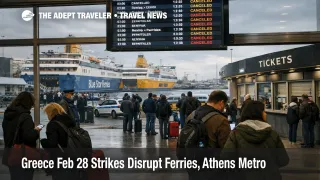
Greece Feb 28 strikes are a same day itinerary breaker on February 28, 2026, because anniversary rallies for the 2023 Tempi rail disaster are happening alongside walkouts that halt trains, stop ferry movements, and disrupt urban transport in Athens, Greece. The practical traveler consequence is misconnect risk across the whole chain, airport to city transfers, city to port transfers, and any intercity move that depends on rail or predictable road timing. Reuters reported that trains and ferries came to a halt, and that urban transport was disrupted as workers joined demonstrations in Athens and other cities.
The key operational detail is that this is not a minor delay day, it is a nationwide mobility constraint day. If a traveler is trying to land at Athens International Airport Eleftherios Venizelos (ATH) and reach a ferry, a cruise check in window, or even a timed hotel arrival in central Athens, Greece, the safe assumption is that the normal playbook breaks. Greece is also seeing broad civic activity and security deployment connected to the rallies, which can add road closures and unpredictable travel times around central gathering areas.
Greece Feb 28 Strikes: What Changed for Travelers
The change is simple, and it is immediate. Rail service is halted nationwide, ferry operations are stopped or heavily constrained, and Athens public transport is disrupted, which makes "same day positioning" the fragile point of the trip. To Vima reported that a 24 hour strike will disrupt public services nationwide on Saturday, February 28, 2026, with trains halted and ferry boats remaining docked. Reuters likewise reported trains and ferries coming to a halt as workers walked off the job to join demonstrations.
In Athens, Greece, travelers should treat central movement as conditionally available, not guaranteed. Ekathimerini reported that employees on Metro Line 1 and the tram would work between 9 a.m. and 9 p.m. to allow people to attend the rally, while authorities were expected to implement traffic changes in areas affected by demonstrations. That kind of partial window is helpful, but it is also a trap if the itinerary assumes full network coverage, normal station access, or predictable surface traffic to connect the gaps.
The net effect is that February 28 is a day where the travel system is constrained at multiple layers at once, rail, sea, and city circulation. When that happens, the backup modes get saturated quickly, taxis and rideshares lengthen waits, remaining metro lines crowd, and last minute hotel inventory tightens as missed departures become forced overnights.
Which Itineraries Are Most Likely To Break
The most exposed itineraries are the ones with a fixed downstream clock and a same day transfer. That includes island travelers connecting to ferries, cruise passengers trying to reach Piraeus, Greece, for embarkation, and anyone using Athens as a same day gateway for domestic connections. Ferry disruption is especially punishing because missing a sailing often means waiting for the next day's departure, and that can cascade into lost hotel nights on islands, missed tours, and expensive rebooking.
Intercity plans built on rail are also high risk. To Vima reported that Hellenic Train said no routes would operate across the entire network due to the strike. Even if a traveler's end destination is not Athens, Greece, the system wide rail halt pushes people onto buses, cars, and flights, and those substitutes can sell out or slow down in the same window that rallies and traffic controls are intensifying.
Within Athens, Greece, the exposure is not only "can I take a metro," it is whether the path between hotel, station, and port is still simple. Even with partial operating windows on some services, the day can include street closures, heavier policing, and congestion around central corridors. That matters most for airport to port transfers, because the traveler is already time constrained by flight arrival time, baggage delivery, and boarding cutoffs.
Travelers dealing with clustered European disruption windows should also recognize the second order effect, when many people rebook onto the same alternatives across the region, capacity and prices shift quickly. The pattern is similar to other recent Europe strike days, where the transfer becomes the failure point more often than the flight itself, as outlined in Berlin BVG Shutdown Feb 27 to Mar 1 and Italy Rail Strike 9:00 p.m. Start Raises Misconnect Risk.
What Travelers Should Do Now
For February 28, 2026 travel inside Greece, the safest move is to remove tight connections from the itinerary. If a traveler must catch a ferry, board a cruise, or make a flight bank after arriving into Athens International Airport Eleftherios Venizelos (ATH), the best buffer is arriving the prior day, then sleeping close to the departure point, either near the port, or near the airport, depending on the next morning's first commitment. If that is not possible, the traveler should plan an alternate path that does not depend on rail, and that can survive a longer road transfer than normal.
Decision thresholds should be blunt. If the plan requires crossing Athens, Greece, and arriving at a port or station with less than two hours of slack before the cutoff, the itinerary is exposed enough that rebooking is usually the rational move, even if it costs more. If the traveler has a high value, non refundable component, cruise embarkation, a timed excursion, or a paid check in window, shifting the move earlier, or adding an extra night, is often cheaper than absorbing a missed departure plus last minute hotel and transport.
Monitoring matters, but it only helps if it is tied to action. Travelers should check operator updates close to departure for any changes to limited service windows, station access, or ferry departures, and they should watch local authority travel notices for central road closures tied to rallies. If the updates indicate expanding stoppages, or worsening access around central Athens, Greece, the correct pivot is switching to walking for short links, booking a taxi earlier than usual for longer links, or moving the trip to a different day.
Why the Disruption Spreads Through Travel
This is a "multi node failure" day, and that is why it is so punishing. The first order effects are obvious, rail service is halted, ferries are stopped or constrained, and parts of Athens transit are disrupted. The second order effects are what break itineraries, because those primary constraints force most travelers onto the same substitutes at the same time. Road transfers become the pressure valve when rail and urban transport thin out, which means congestion spikes, taxis queue, and the time variance of a simple transfer grows.
The rally footprint adds another mechanism. When large crowds gather and police deploy for crowd management, authorities often implement traffic changes around central corridors. Even if a traveler never intends to participate in a demonstration, their transfer route can be routed around closures, slowed by checkpoints, or delayed by gridlocked streets, especially if the traveler is moving between the city center and port areas.
Finally, sea travel has low elasticity. A canceled ferry is not like a delayed metro, it can mean no same day substitute, and it can strand travelers in the wrong place for the night. That is why the most resilient plan is not "find a different ferry," it is changing the schedule so the trip does not depend on a single departure on a nationwide strike day.