

Greece Tempi Anniversary Strike Disrupts Trains, Ferries
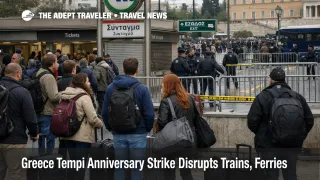
The Greece Tempi anniversary strike turned February 28, 2026 into a system wide transport constraint day, not a normal protest day with minor detours. Multiple unions tied walkouts and work stoppages to rallies marking three years since the February 28, 2023 Tempi rail disaster, and the result was simple for travelers, trains stopped, ferries halted, and urban transport ran on reduced windows in key cities.
The biggest practical change is that same day positioning became fragile across the whole chain. If you were relying on rail for intercity moves, a ferry for an island hop, or a predictable metro and road transfer between hotels, ports, and airports, the strike compressed your options into a few remaining corridors, and those corridors were more likely to saturate.
Athens, Greece was the most obvious pinch point because central rallies were planned at Syntagma Square, and authorities and operators telegraphed service constraints around that same window. In practical terms, that meant a higher chance of delayed airport transfers, slower port access to Piraeus, Greece, and day tour cancellations or meeting point changes in the center.
Which Trips Are Most Exposed
Trips with a fixed downstream clock, and a same day transfer, had the highest break risk. The most exposed combination was flight to ferry or cruise, especially if you planned to land, cross Athens, Greece, and still hit a sailing or check in window at Piraeus. With ferries halted nationwide for the full day, missing the day's movement often meant an overnight stay and a cascading rebook of hotels, ground transfers, and tours.
Rail dependent itineraries were also high risk because the shutdown was not limited to one corridor. Hellenic Train announced no routes would operate across the national network during the strike action, which removes a major fallback for both visitors and domestic travelers who would normally shift off congested roads. When rail disappears, KTEL coaches, rental cars, and short haul flights take the load, and availability tightens fast.
City center hotel stays in Athens, Greece and Thessaloniki, Greece carried a different kind of exposure, road access and station access uncertainty. Even when a metro line is technically operating, station closures near gathering points, detours, and rolling traffic controls can turn a 20 minute transfer into an hour without much warning, especially around midday rally starts and dispersal periods.
What Travelers Should Do Now
If you are inside Greece and still moving within the next 24 to 72 hours, treat this like an aftershock window. The strike day itself is finite, but the backlog is real, ferries resume into compressed demand, hotel rebooks cluster around the same next departures, and travelers who missed a connection tend to re enter the system in waves. Check your ferry or rail operator directly for the first available departures after the strike, and assume limited inventory on popular island routes until the queue clears.
Rebook early if you have a hard deadline, for example an international departure, a cruise embarkation, a wedding, or a timed entry day that cannot be moved. Waiting can save money if operators add extra capacity, but the tradeoff is losing the last clean options in the first restart cycle. For ferry and cruise travelers, the safest posture is to add a buffer night on the mainland side when you can, because ferry disruptions tend to convert into forced overnights rather than short delays.
In Athens, Greece, plan around the few corridors that usually stay usable, and build extra time through the center. Metro Line 3 is often the most resilient airport access tool when it is running, and operators signaled airport service continuation even while other modes faced limits. If you are routing to Piraeus, Greece, the more reliable choice is usually a direct airport to port transfer or the airport express bus pattern when it is operating, rather than a multi leg plan that depends on perfect timing through central stations.
For additional context on how this exact pattern breaks transfers, see the prior Adept Traveler coverage, Greece Feb 28 Strikes Disrupt Ferries, Athens Metro, and the airport rail vulnerability background in Greece Rail Strike Knocks Out Trains, Including Airport Link.
Why the Network Stopped, and How Disruption Spreads
This disruption was not caused by one failure point. It was a deliberate, multi sector work stoppage aligned with large memorial rallies for the Tempi rail disaster anniversary, which is why multiple modes failed at once. When ferries stop nationwide, trains stop nationwide, and urban transport compresses into limited windows, the normal traveler backup logic collapses because every backup depends on a mode that is also constrained.
The first order effect is obvious, services do not run, or run for short windows. The second order effects are what break trips, ports and airports still function, but travelers cannot reliably reach them, and the remaining options saturate. That is why the misconnect risk spikes even for travelers who are not attending demonstrations, because they are competing for scarce transfer capacity at the same time that police closures and crowd flows slow road movement in central districts.
Service restart is usually fast on paper, but slow in lived reality. A ferry schedule can resume the next day and still leave travelers stranded if their intended sailing is sold out, if their hotel check in timing no longer matches the next departure, or if they cannot reach the port cleanly through city congestion. The practical strategy is to treat the first restart day as a high demand day, confirm your specific departure, then build buffers around reaching the port or airport early enough that a detour does not become a missed departure.
Sources
- Greeks rally to mark anniversary of deadly 2023 train crash ahead of trial
- Greece braces for nationwide strikes, rallies marking Tempe train disaster anniversary
- Transport Disruptions Expected in Greece on February 28 Amid Nationwide Strike
- Unions Announce 24-Hour Strike for Tempi Anniversary
- Demonstration Alert - U.S. Embassy Athens (February 26, 2026)