

Shutdown Hits TSA Staffing, Airport Lines Less Predictable
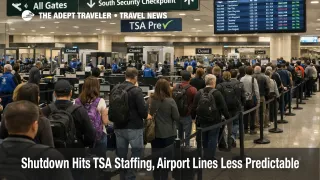
A partial federal shutdown is now translating into a practical airport problem, not just a Washington headline. After Transportation Security Administration officers received only a fraction of their regular pay on February 27, 2026, the risk of short notice absences and resignations rose again, which can show up as fewer open security lanes and longer, more erratic checkpoint lines at busy U.S. airports. The traveler consequence is timing uncertainty, especially during morning departure banks, when airports are already operating close to throughput limits.
This is new versus earlier shutdown coverage because it moves from "could cause delays" to a clear, frontline staffing stress signal with immediate operational stakes. Even if your flight is on time, the checkpoint is still a single point of failure, and time lost before security is time you cannot recover later in the process.
Shutdown TSA Staffing Strain: What Changed at Airports
The material change is the likelihood of uneven checkpoint staffing from one day to the next, and sometimes from one hour to the next. Reuters reported that TSA screeners received partial pay on February 27, 2026, and union officials warned that financial strain can drive more call outs, second jobs, and departures. In the prior major shutdown in October and November 2025, TSA leadership told Congress that roughly 1,110 officers left during those months, a detail that matters because hiring and training are slow, and attrition compounds quickly when morale drops.
For travelers, this does not mean checkpoints "close." It means the number of staffed lanes can shrink during peak windows, and the line becomes more variable. A checkpoint that moves normally at 630 a.m. can bog down by 715 a.m. if lanes consolidate, secondary screening backs up, or the airport shifts resources to keep baseline screening running.
Which Travelers Face the Highest Missed Flight Risk
This problem is not evenly distributed. The highest exposure is early departures and tight connections through large hubs such as Hartsfield Jackson Atlanta International Airport (ATL), Chicago O'Hare International Airport (ORD), and Los Angeles International Airport (LAX), where passenger volume is concentrated into departure banks. When staffing is thin, the line does not simply get longer, it gets bursty, and bursts are what break itineraries.
Families, groups, and travelers who need extra assistance get hit harder because they cannot "sprint solve" a sudden line swell. Add a checked bag cutoff, and the risk rises again, because missing the bag deadline can kill the trip even if you later clear security quickly. Business travelers are not immune either, a missed morning departure often has fewer same day replacements, so the cost of failure is a lost meeting, a forced overnight, or a same day fare spike.
International travelers can see a double bind. Outbound screening can slow, and inbound processing can also worsen when expedited programs are constrained, which increases the odds that an international arrival with a short domestic connection turns into a misconnect and a rebooking scramble.
What Travelers Should Do Before Heading to the Airport
Treat your plan as if the line will be worse than normal, then count any faster experience as a bonus. TSA's own public guidance is broad, it recommends allowing enough time for parking, check in, and security screening, which is directionally right but not specific enough for a shutdown driven variability day. Your job is to build a buffer that survives a lane consolidation surprise, not a buffer that only works on a normal Tuesday.
Set decision thresholds in advance. If you have a must arrive event, a cruise embarkation, a wedding, a court date, or anything that breaks if you arrive late, shift to an earlier flight, favor a nonstop, or route through an airport where you have more slack. Waiting for the day of travel only makes sense when you have multiple realistic same day backups and you can absorb a longer travel day without cascading costs.
Plan the whole front end, not just the checkpoint. Build time for parking or rideshare delays, for the airline counter if kiosks fail, and for the walk to your gate. If you check bags, look up your airline's bag cutoff and treat it like a hard wall. If the line is already long when you arrive, do not assume it will "move faster later," instead, pivot quickly, consider using a different checkpoint in the same terminal if the airport layout allows it, or ask airline staff what the most reliable routing is to reach your concourse.
Why Staffing Stress Turns Into Longer Lines
Airport security is a throughput system, not a customer service queue. The binding constraints are staffed lanes, document check capacity, secondary screening capacity, and the ability to keep shifts reliably covered. When officers are under financial pressure, even a small increase in absenteeism can reduce open lanes during peaks, and because arrivals are lumpy, the line can grow faster than it dissipates.
First order effects are visible at the checkpoint, fewer lanes, slower throughput, and longer waits. Second order effects hit after the checkpoint, more missed departures create more rebooking work at gates and in call centers, same day seat inventory drains, and stranded passengers accumulate around hubs, which can lift hotel demand near the airport and compound stress on airline support channels. This is why the shutdown TSA staffing strain story matters even for travelers who "usually breeze through," the system fails at the margins, and travel days are decided at the margin.
For readers who want the immediate related context, see US DHS Shutdown TSA Delays Raise Airport Line Risk and TSA PreCheck Suspension Reversed at US Airports. For the broader structural staffing lens in U.S. aviation, see U.S. Air Traffic Control Privatization: Reality Check.
Sources
- TSA officers get fraction of pay as government shutdown drags (Reuters)
- TSA agents are working without pay due to another shutdown (Los Angeles Times)
- TSA says PreCheck is open, after DHS says it's closed (Business Insider)
- How early should I arrive at the airport prior to my flight's departure (TSA FAQ)