

Greece Seafarers Strike Halts Ferries March 5, 2026
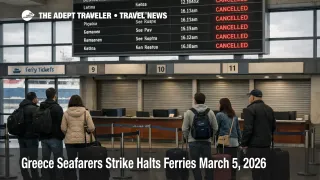
Greece seafarers strike ferries are set to shut down nationwide on Thursday, March 5, 2026, with the Panhellenic Seamen's Federation (PNO) calling a 24 hour walkout from 12:01 a.m. to midnight that covers all vessel categories. For travelers, this is the clean kind of disruption that removes the ferry layer for an entire day rather than merely thinning schedules, and it will likely halt departures from the Athens port complex, including Piraeus, Rafina, and Lavrio, along with most island and inter island sailings. If you have an island hotel check in, a same day airport transfer, or a tour tied to a ferry arrival, the safest assumption is that March 5 becomes a no sail day and your itinerary needs to shift to Wednesday, March 4, 2026, or Friday, March 6, 2026, unless your operator posts a specific exception. The strike call has been widely reported by Greek outlets, and the stated time window is consistent across coverage.
Greece Seafarers Strike Ferries: What Changed
The practical change versus the last Greece ferry disruption cycle is timing and certainty. March 5 is not a rolling risk window, it is a defined, nationwide stoppage window, 12:01 a.m. through midnight, and it applies broadly across ship categories rather than targeting one corridor. In operational terms, that means most ferry operators cannot run normal passenger service during the strike period, and travelers should expect cancellations, route rescheduling, and a concentrated rebooking surge onto the adjacent days.
This matters most for itineraries that treat Athens as a connector rather than a destination. A common failure pattern is an island departure into Attica in the morning, a cross city transfer, then a flight out of Athens International Airport Eleftherios Venizelos (ATH) the same day. When the ferry cancels, the flight does not wait, and replacement capacity tends to compress into the day before and the day after, not later that same day, because the whole ferry network is offline for the strike window.
The union's stated rationale in reporting focuses on seafarer safety and repatriation concerns tied to Middle East risk, which explains why the action is framed as nationwide and categorical rather than a limited labor dispute with partial service.
Which Travelers Face the Most Ferry Disruption
The highest exposure is any itinerary that depends on a specific sailing time on March 5, 2026, and cannot absorb a 24 hour slip. That includes island hotel check ins, domestic flights that require same day ferry positioning, cruise embarkations that require arriving from an island the same day, and day trips that sell a ferry crossing as part of the product.
Travelers departing from the Athens region ports are the most likely to feel the disruption first because those ports feed a large share of the mainland to island demand. If you are booked on Cyclades routes, Saronic Gulf hops, Crete runs, Dodecanese routes, or any plan where the vessel rotation begins or ends in Attica, assume the knock on effect will be broader than a single canceled segment. Even travelers not moving through Athens can get caught by the second order effect, vessels and crews that would normally be repositioning on March 5 are not moving, so March 6 can start with uneven equipment and crew placement and a backlog of passengers trying to travel on the first restart day.
If you are traveling with a vehicle, the risk tends to be higher because limited restart capacity and staging constraints can create longer waits after service resumes, and vehicles cannot shift modes as easily as foot passengers. If you are a foot passenger and your island has meaningful air service, you have more viable alternatives, but only if seats are still available at a price you will accept.
For readers who want the baseline mechanics from the last nationwide ferry stoppage, the earlier coverage remains useful context, even though the trigger is different this time: Greece Ferries Halt Feb 28, 24 Hour Seafarers Strike and Greece Tempi Anniversary Strike Disrupts Trains, Ferries.
How To Plan Around the March 5 Ferry Strike
Start by protecting the parts of your trip that cannot move. If you have an international departure, a cruise embarkation, a non flexible hotel night, or a timed activity on March 6 that depends on arriving by ferry on March 5, shift the ferry leg first, even if it forces an extra night in Athens, Greece, or on the mainland side of your route. The tradeoff is straightforward, one extra hotel night often costs less than a same day scramble that turns into missed flights, reissued tickets, and lost deposits.
Then decide whether you are shifting days or switching modes. For many travelers, the most reliable fix is moving sailings to March 4 or March 6, 2026, and rebuilding ground transfers and hotel check in timing around that change. Switching to a domestic flight can work for islands with frequent service, but it is a capacity and price game, and those seats tend to disappear quickly once a nationwide ferry day drops out of the network. If flying is your backup, check availability before you make any changes, because air inventory is often the first to tighten.
Finally, treat operator instructions as the source of truth for your specific ticket, not social media threads. In prior Greece ferry strikes, operators typically direct passengers to rebook through the original booking channel, including agencies, call centers, or the operator app, and that is where you will see the most accurate guidance for your sailing, including whether a late night departure just after the strike window is added. As of early March 4 reporting, a broad nationwide stoppage is the expected outcome, and travelers should plan as if normal sailings do not run during the strike window unless their operator posts a specific workaround.
Why a One Day Ferry Strike Breaks Itineraries So Cleanly
A nationwide seafarers strike halts ferry travel because crews are the enabling constraint for departures. When a labor action is called across ship categories for a defined window, operators cannot run normal passenger service, so the traveler experience becomes binary, either you travel outside the window or you do not travel at all.
The first order effect is obvious, cancellations and missed island transfers. The second order effects are what surprise travelers who think they are insulated, domestic flights sell out or spike in price, hotel demand rises in Athens and other mainland gateways, and ports process concentrated crowds on the first restart day as people try to move at once. Even if March 6 timetables look normal on paper, vessel rotations and crew positioning can be uneven after a full stop day, which can create residual delays and last minute changes.
The stated rationale in reporting also matters for expectations. When the trigger is framed around seafarer safety and repatriation tied to a geopolitical risk environment, the action is less likely to be resolved by a quick last minute compromise that restores partial service during the strike window. That does not guarantee every route cancels, but it is a strong signal that travelers should build around the full day stoppage rather than hoping for a reduced schedule.