

Global Entry Pause, TSA Pay Fight Hit U.S. Travel
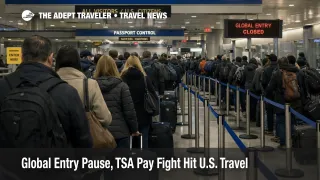
A partial Department of Homeland Security shutdown has entered its third week with two traveler facing consequences now fully in view, Global Entry remains paused, and travel groups are escalating pressure on Congress to protect pay for frontline aviation workers. For travelers, the immediate problem is not that airports stop operating. It is that international reentry becomes less predictable, and security staffing risk rises at the same time spring demand is building. If you are flying home from abroad, protecting a tight domestic connection matters more now. If you are departing from a busy U.S. hub, add more checkpoint buffer than you normally would.
The new element since earlier shutdown coverage is coordinated industry pressure around worker pay, alongside continued corporate travel complaints that the Global Entry pause is already eroding schedule reliability. U.S. Travel and allied groups launched the "Pay Federal Aviation Workers" campaign on March 5, 2026, after saying transportation security workers were facing their first $0 paycheck of the current shutdown. Travel Weekly also reported that travel managers are hearing complaints about longer arrivals, missed ground connections, and weaker predictability on international returns.
Global Entry Shutdown Travel: What Changed Now
The operational split is now clearer than it was in late February. Global Entry processing was suspended on February 22, 2026, while TSA PreCheck has generally remained available, creating a lopsided travel risk where outbound screening may still function reasonably, but inbound passport control can slow sharply. That matters most for travelers whose return trip only works if U.S. entry is fast and consistent.
At the same time, the travel industry's latest message is that unpaid frontline aviation staff are not just a labor issue, they are a system reliability issue. U.S. Travel, Airlines for America, the American Association of Airport Executives, and the American Hotel and Lodging Association said on March 5 that Congress should both reopen the government and pass legislation to keep essential aviation workers paid during future shutdowns. The package they highlighted includes the Aviation Funding Solvency Act, the Aviation Funding Stability Act, and the Keep America Flying Act.
Which Travelers Face the Most Friction
The most exposed travelers are international arrivals with short domestic connections, especially those who had been counting on Global Entry to make that connection reliable. Once Global Entry members are pushed back into standard inspection flows, the time risk moves from a convenience issue to a missed flight issue, particularly at hubs where arrivals come in banks. Corporate travelers are also feeling this more acutely because same day meetings, car pickups, and tightly timed ground transfers leave less room for arrivals uncertainty.
Domestic travelers are not immune. Earlier Adept Traveler reporting already documented that reduced TSA pay and staffing strain can turn into fewer open screening lanes and more erratic wait times at major airports. That does not mean every airport is failing all day. It means the margin for error is thinner during morning and late afternoon peaks, which is exactly when spring break and leisure demand tend to stack up. For related coverage, see US Shutdown: TSA Pay Protection Campaign Presses Congress and Global Entry Paused, Plan Longer U.S. Passport Lines.
What Travelers Should Do Before Flying
Treat buffer time as the main hedge while the shutdown continues. For international returns, avoid tight same day onward flights into the United States unless you can tolerate missing them. For domestic departures from large hubs, arrive earlier than usual during peak banks because the likely failure mode is not a full stoppage, it is slower throughput and less predictable line movement.
There is also a practical workaround for some returning travelers. Altour's John Rose said clients are being directed toward U.S. Customs and Border Protection's Mobile Passport Control app as one alternative for faster entry through dedicated lanes where available. That is not a substitute for Global Entry's usual speed and predictability, but it is one of the few realistic options while Global Entry remains paused. Travelers using it should still budget more time than they would under normal trusted traveler conditions.
The rebook versus wait threshold is pretty simple. Rebook early if your trip includes a short U.S. connection after an international arrival, a cruise embarkation, a same day business obligation, or separate tickets with no protection. Waiting makes more sense only if you have multiple later recovery options, flexible plans, and enough buffer that a longer queue will not break the day. For structural context on how staffing and policy stress spread through the system, see U.S. Air Traffic Control Privatization: Reality Check.
Why the Disruption Spreads Beyond the Checkpoint
The shutdown's travel effect is not limited to one agency counter. Global Entry's pause pushes vetted travelers back into standard inspection lines, which can increase average waits and, just as importantly, increase variability. That variability is what breaks trip planning, because a traveler can pad for a known 25 minute process more easily than for a process that might take 20 minutes one day and much longer the next.
Unpaid or underpaid frontline workers create a separate, but connected, problem. Security throughput depends on staffing at the exact hours when passenger volume surges. When staffing is less stable, even small reductions in open lanes can ripple quickly into missed departures, harder reaccommodation, extra hotel nights, and lost same day flexibility. That is why the industry's pay campaign matters to travelers, not just workers, because it is really an argument about keeping the air travel system's thin operating margin from thinning further during future funding lapses.
Sources
- America's Leading Travel Organizations Launch "Pay Federal Aviation Workers" Campaign, U.S. Travel Association
- Frustration over Global Entry, worker pay as partial shutdown persists, Travel Weekly
- US Shutdown: TSA Pay Protection Campaign Presses Congress, Adept Traveler
- Global Entry Paused, Plan Longer U.S. Passport Lines, Adept Traveler
- US Shutdown Hits Airports, TSA Pay Cut, Global Entry Paused, Adept Traveler