

Qatar Flights Stay Suspended Into March 7 Window
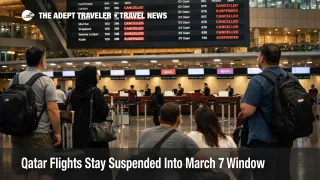
Qatar flights suspended is still the practical reality on March 6, 2026. Qatar Airways said in its 900 a.m. Doha update that scheduled operations remain temporarily suspended because Qatari airspace is still closed, and the airline will not provide another operational update until March 7 at 900 a.m. Doha time. That is the key change from Adept's March 5 Muscat coverage, the hoped for handoff back to normal Hamad International Airport (DOH) connections still has not happened. Travelers with Qatar tickets should keep fallback lodging, alternate routings, and buffer time active for at least one more cycle, rather than planning around a normal Doha reconnect that does not yet exist.
The March 6 update also confirms that Qatar is still relying on controlled relief flying where possible, and that affected passengers will be contacted directly with next steps. The airline again told passengers not to go to the airport unless they have received an official notification confirming their flight, which matters because a functioning relief channel is not the same thing as a broadly reopened hub.
Qatar Flights Suspended, What Changed for Travelers
What changed on March 6 is not a restart, it is a delay to the decision point. On March 5, Qatar Airways was running limited relief flights from Muscat, Oman, to London Heathrow Airport (LHR), Berlin Brandenburg Airport (BER), Copenhagen Airport (CPH), Adolfo Suárez Madrid Barajas Airport (MAD), Rome Fiumicino Leonardo da Vinci International Airport (FCO), and Amsterdam Airport Schiphol (AMS), plus a Riyadh, Saudi Arabia, to Frankfurt Airport (FRA) service. On March 6, the airline still had not restored normal Doha operations and instead pushed the next formal update to March 7.
That keeps the traveler problem centered on uncertainty, not ticketing alone. If your itinerary depends on a same day Doha connection, you still cannot treat DOH as a reliable hub for standard onward banks into Europe, Asia, or Africa. Even if your booking remains in the system, the operating posture is still suspension plus selective relief, not normal network flow. For earlier context on the workaround, see Qatar Relief Flights From Muscat Start March 5 and Muscat Relief Flights Become Qatar Airways Exit Route.
Which Qatar Passengers Face the Hardest Choices
The highest risk group is travelers departing within the next 24 to 48 hours on itineraries that require a standard Doha transfer to work. That includes passengers with onward segments on a single Qatar Airways ticket, because protection on one ticket helps with reaccommodation, but it does not create seats or restore a hub bank that is still suspended.
The next group under pressure is travelers on separate tickets, travelers with nonrefundable ground arrangements, and anyone whose trip has a hard start such as a cruise embarkation, tour departure, wedding, or work reporting date. Those travelers are more exposed because one extra day of closure does not just threaten the first segment, it can break the entire sequence of hotel check in, airport transfer, and onward connection timing. Qatar's own booking assistance page says passengers with confirmed bookings for travel between February 28 and March 15, 2026, can request a complimentary date change of up to 14 days from the original travel date or a refund of the unused value of the ticket, but that flexibility is most valuable before the rest of the itinerary collapses around it.
A narrower group may still benefit from waiting, mainly passengers already in Qatar's direct handling flow who can absorb an overnight and who are being actively contacted about relief options. That is a very different posture from self deploying to Oman and hoping to buy your way out. Qatar's repeated instruction not to proceed to the airport without official notification is the clearest sign that eligibility and assignment remain the constraint, not just runway availability.
What Travelers Should Do Before the March 7 Update
The rational choice is to set a personal deadline before the airline's March 7 update, not after it. If missing arrival by a day would break the purpose of your trip, use the current waiver window now and price alternate routings before more disrupted passengers compete for the same inventory. Waiting is only rational if an overnight slip is acceptable, your booking is protected, and you have lodging and communication in place.
Do not go to Hamad International Airport without direct notice from Qatar Airways. Keep your contact details current in your booking profile and app, because the airline says affected passengers will be contacted directly with flight details, arrangements, and next steps. If your ticket was issued by a travel agency or third party site, route assistance through that seller as well, because Qatar specifically tells those passengers to contact the original booking channel.
Watch three signals in the March 7 update window. First, whether Qatar Airways changes from "scheduled operations remain temporarily suspended" to restart language tied to a safe reopening of Qatari airspace. Second, whether the airline expands relief flying beyond the controlled channels already in use. Third, whether the booking assistance language changes, because waiver terms can tell you whether the carrier expects a quick normalization or a longer recovery.
Why the Doha Shutdown Still Ripples Beyond Qatar
The mechanism is bigger than one airport. Doha is one of the region's major connection machines, so every extra day of suspension keeps aircraft, crews, and passengers out of position. Even travelers who are not starting or ending in Qatar can be affected when Europe and Asia connection banks thin out, reaccommodation queues grow, and remaining seats through alternate hubs become harder to find.
That is why Muscat matters so much right now. The workaround has shifted part of the pressure into Oman, where hotel inventory, ground transfers, airport processing, and onward seats become the real bottlenecks for stranded passengers. Adept's March 5 Muscat reporting already showed that this was a controlled uplift channel rather than an open walk up option, and the March 6 suspension update means that pressure stays in place for at least one more decision cycle.
The bigger traveler lesson is that "next update due tomorrow" is not the same thing as "restart tomorrow." Until Qatar Civil Aviation Authority clearance turns into a published operating restart, the safer assumption is that Doha remains unavailable for normal connections and that alternate plans still need to be live.